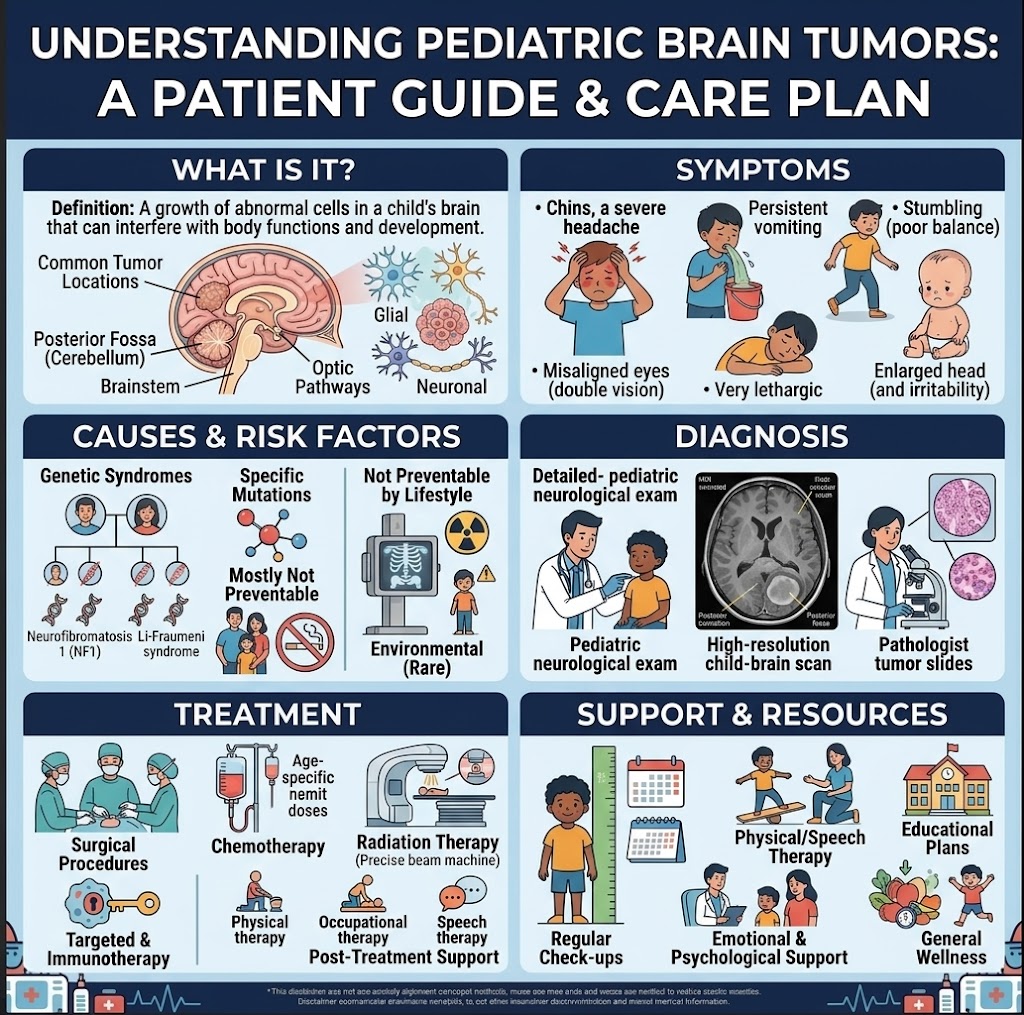
Pediatric brain tumors are abnormal cell growths that develop in or around a child's brain. These growths, called tumors, can press on nearby brain areas, leading to symptoms like headaches and nausea. They vary greatly: some grow quickly, others slowly. Some are cancerous (malignant), capable of spreading and destroying healthy tissue, while others are non-cancerous (benign). The exact cause is usually unknown, but they occur when brain cells develop DNA changes, leading to uncontrolled growth and survival, forming a mass. The type, location, and spread of the tumor, along with the child's age and health, guide treatment. Children's brain tumor treatment differs significantly from adults, emphasizing specialized pediatric centers.
Understanding the Condition
Pediatric Brain Tumors: A Parent's Guide
Understanding the Condition
Pediatric brain tumors are abnormal cell growths that develop in or around a child's brain. These growths, called tumors, can press on nearby brain areas, leading to symptoms like headaches and nausea. They vary greatly: some grow quickly, others slowly. Some are cancerous (malignant), capable of spreading and destroying healthy tissue, while others are non-cancerous (benign). The exact cause is usually unknown, but they occur when brain cells develop DNA changes, leading to uncontrolled growth and survival, forming a mass. The type, location, and spread of the tumor, along with the child's age and health, guide treatment. Children's brain tumor treatment differs significantly from adults, emphasizing specialized pediatric centers.
Common Symptoms
Headaches: May become more frequent and severe. In babies or non-verbal children, increased irritability can be a sign.
Nausea and Vomiting: Often unexplained or worsening over time.
Vision Changes: Such as double vision or difficulty seeing. For non-verbal children, squinting or covering one eye might be observed.
Fuller Soft Spot (in babies): A bulging fontanelle on a baby's skull.
Changes in Eye Movement: Unusual eye movements or inability to track objects properly.
Confusion and Irritability: Uncharacteristic changes in mood or mental clarity.
Difficulty with Balance: Problems with coordination or walking steadily.
Hearing Problems: New or worsening hearing loss.
Memory Problems: Issues remembering recent events or information.
Personality or Behavior Changes: Sudden shifts in temperament or usual behavior.
Seizures: Especially in a child who has not had seizures before.
Slurred Speech: Difficulty speaking clearly.
Trouble Walking: New onset of difficulty or changes in gait.
Trouble Swallowing: Problems with eating or drinking.
Weakness or Drooping on one side of the face: Facial asymmetry.
Weakness or Loss of Sensation in an arm or a leg: Numbness or reduced strength in limbs.
Consultation Guide
Which Specialist to Meet
You should seek care from a pediatric healthcare team specializing in brain tumors. This typically includes pediatric neuro-oncologists (cancer doctors), neurosurgeons (brain surgeons), neurologists (brain and nervous system specialists), and radiation oncologists.
Preparations Before Your Visit
Before your visit, compile a detailed list of your child's symptoms, including when they started and how they've progressed. Note any medications your child is taking and gather any relevant medical records. Prepare a list of questions for the doctor.
Book a doctor visit near me
Symptom Management and Rehabilitation: Treatments for pain, nausea, seizures. Physical, occupational, and speech therapy are crucial for regaining function. Nutritional support is vital. (Duration: Ongoing, tailored to needs throughout and after primary treatment.)
Consultation Guide
Checks how well your child's nervous system (brain, spinal cord, nerves, muscles) works to find conditions and their causes. Assesses reflexes, balance, coordination, strength, sensation, vision, hearing, and mental status.
Understanding Risk Factors: No known prevention. Risk factors include head radiation, certain genetic syndromes, and weakened immune systems. Parents do not cause brain tumors.
Long-Term Monitoring and Support
Diagnostic Procedures
Neurological Examination
What to Expect
A doctor performs simple tests: walking, touching nose, following light, answering questions. For young children, observation of development and reflexes. Takes minutes to over an hour.
Brain Magnetic Resonance Imaging (MRI)
Detailed imaging test providing clear pictures of the brain. Detects structural or functional changes, aiding diagnosis of tumors or other neurological disorders. Uses strong magnets and radio waves, no radiation.
What to Expect
Your child lies on a table sliding into a tube-shaped machine. Must stay very still for 30-60+ minutes. The machine is loud; earplugs or headphones are provided. Sedation or anesthesia might be used for young children. Contrast dye may be injected into a vein for better detail.
Biopsy (Surgical Tumor Removal for Diagnosis)
What to Expect
Treatment Options
Surgical removal of a small tumor tissue sample for microscopic examination. Essential for confirming tumor type (cancerous/non-cancerous) to plan effective treatment.
Surgical Procedures
Brain Tumor Surgery (Craniotomy): Aims to safely remove as much tumor as possible without harming healthy brain tissue. Often the first treatment. (Duration: Surgery lasts hours. Hospital stay days to a week, followed by weeks of home recovery.)
Transsphenoidal Surgery: Minimally invasive, accessing base-of-brain tumors (e.g., pituitary) through the nasal cavity, avoiding open skull incision. (Duration: A few hours procedure. Hospital stay 1-3 days, with weeks of home recovery.)
Proton Therapy: Uses high-energy proton beams to precisely target tumor cells, minimizing radiation exposure to surrounding healthy, developing brain tissue. (Duration: Daily, five days a week, over several weeks (e.g., 4-7 weeks).)
Other Radiation Therapies: High-powered X-ray energy beams destroy tumor cells. Stereotactic radiosurgery uses highly focused beams for precise targeting, often in fewer sessions. (Duration: X-ray radiation: daily for weeks. Stereotactic radiosurgery: 1-5 sessions.)
Systemic Anti-Cancer Medications: Medications use chemicals to kill fast-growing tumor cells throughout the body. Given orally or intravenously, often combined with other treatments. (Duration: Cycles vary (months to over a year), with treatment periods followed by rest.)
Regular Follow-Up Care: Essential after treatment, including neurological exams and imaging scans (MRI) to monitor for recurrence and manage late effects.
Multidisciplinary Team Support: A team of specialists (neurologists, oncologists, psychologists) provides comprehensive care for medical, emotional, educational, and social needs.
Psychological and Emotional Support: Counseling, support groups, and mental health services are vital for children and families coping with a brain tumor.
Prevention & Long-Term Wellbeing
Under general anesthesia, a neurosurgeon makes a scalp incision and small skull opening to access and remove the tissue. Sometimes, much of the tumor is removed. The skull is closed, and the scalp stitched. Hospital stay for recovery.
Prevention
Tags & Topics
Notice an error or need an update?
Help us keep medical information accurate. Report incorrect info or suggest an edit.


