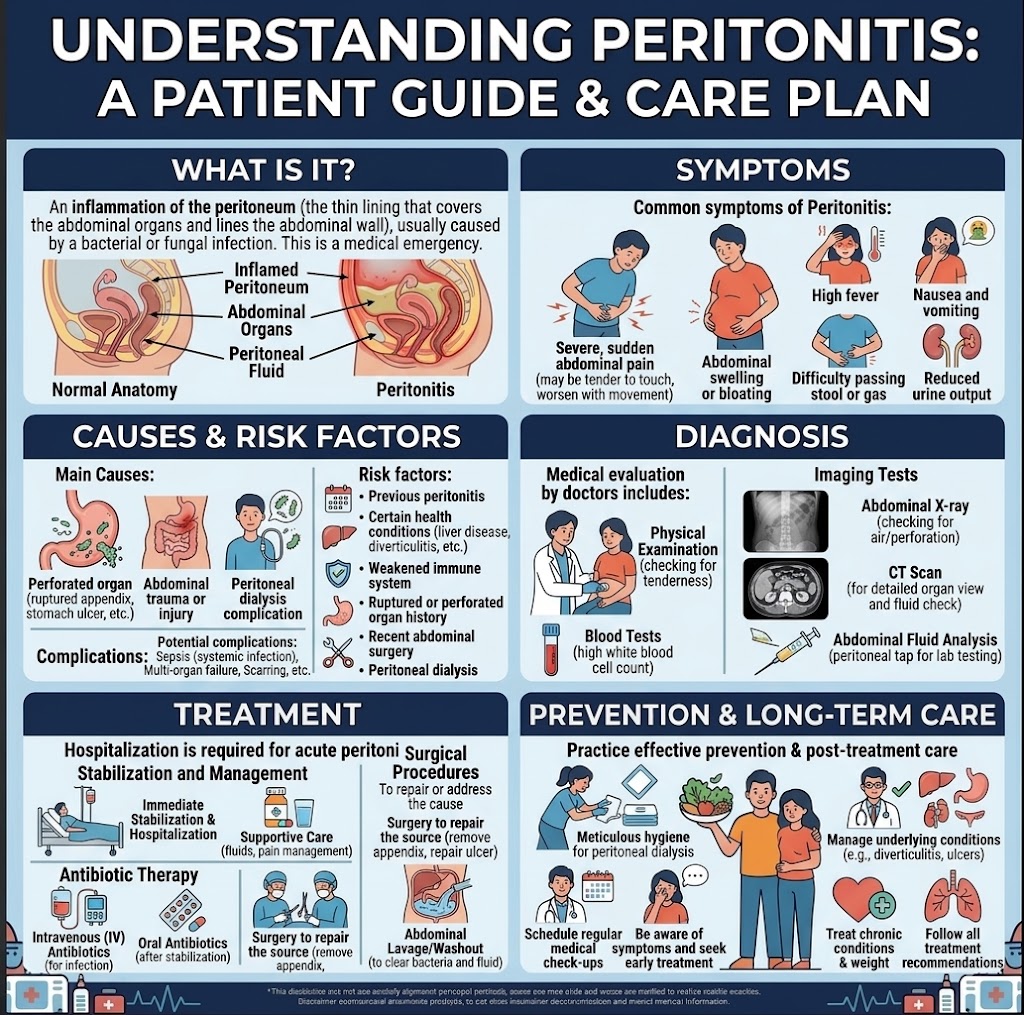
Peritonitis is a serious condition involving inflammation of the peritoneum, the thin tissue lining the inside of the abdomen and covering its organs. This inflammation is usually caused by a bacterial or fungal infection. Prompt medical treatment is vital to prevent life-threatening complications.Two main types exist:* **Spontaneous Bacterial Peritonitis:** Occurs when bacteria spread into the peritoneum, often linked to severe liver or kidney disease.* **Secondary Peritonitis:** Develops from an infection originating elsewhere, commonly due to a ruptured abdominal organ (like the appendix or intestine), or complications from surgery or other medical conditions.Untreated, peritonitis can lead to a severe body-wide infection and be fatal. Immediate treatment, typically with infection-fighting medicines and addressing the root cause, is essential.
Understanding the Condition
Peritonitis: Understanding Abdominal Inflammation
Understanding the Condition
Common Symptoms
Belly Pain or Tenderness: Often severe and worsening with movement or touch.
Bloating or Fullness: A distended abdomen due to fluid buildup and inflammation.
Upset Stomach and Vomiting: Common digestive disturbances accompanying the inflammation.
Loss of Appetite: A general symptom often associated with severe illness.
Reduced Urine Output: A sign of potential dehydration or stress on the kidneys.
Inability to Pass Stool or Gas: Indicates slowed or stopped bowel function.
Feeling Tired: A general symptom of systemic illness and infection.
Cloudy Dialysis Fluid (for Peritoneal Dialysis Patients): A direct visual sign of infection within the peritoneal fluid.
White Flecks, Strands, or Clumps (Fibrin) in Dialysis Fluid (for Peritoneal Dialysis Patients): Specific indicators of an ongoing infection in the dialysis fluid.
Consultation Guide
Which Specialist to Meet
Seek immediate emergency care. You may see an emergency physician, gastroenterologist (digestive system), infectious disease specialist, nephrologist (kidney specialist, if on dialysis), or a general surgeon.
Preparations Before Your Visit
Pain Relief: Medications to manage abdominal pain and discomfort. (Duration: As needed for symptom control.)
Fluid Drainage: If significant fluid or pus has accumulated, it may be drained using a needle or a small tube inserted into the abdomen, often guided by imaging. (Duration: Can be a one-time procedure, or a catheter may remain for continuous drainage for several days.)
Symptom Awareness: Be vigilant for any return of peritonitis symptoms (e.g., abdominal pain, fever) and seek immediate medical attention if they reappear.
Adherence to Medication: Complete all prescribed courses of antibiotics or other medications, even if symptoms improve, to ensure the infection is fully cleared.
Consultation Guide
Peritonitis is a serious condition involving inflammation of the peritoneum, the thin tissue lining the inside of the abdomen and covering its organs. This inflammation is usually caused by a bacterial or fungal infection. Prompt medical treatment is vital to prevent life-threatening complications.Two main types exist:* **Spontaneous Bacterial Peritonitis:** Occurs when bacteria spread into the peritoneum, often linked to severe liver or kidney disease.* **Secondary Peritonitis:** Develops from an infection originating elsewhere, commonly due to a ruptured abdominal organ (like the appendix or intestine), or complications from surgery or other medical conditions.Untreated, peritonitis can lead to a severe body-wide infection and be fatal. Immediate treatment, typically with infection-fighting medicines and addressing the root cause, is essential.
Exploratory Surgery (Laparotomy/Laparoscopy): Often necessary to find and repair the underlying cause, such as closing a hole in an organ (e.g., ruptured appendix, stomach ulcer, perforated diverticulum), removing infected tissue, or draining large abscesses. The abdominal cavity is thoroughly washed out during surgery. (Duration: Surgery can take several hours. Recovery varies, from a few days to several weeks in the hospital, followed by extended home recovery.)
Diagnostic Procedures
These tests check for signs of infection (e.g., elevated white blood cells), inflammation, and evaluate organ function (kidney, liver).
What to Expect
A small blood sample is drawn, usually from an arm vein. Expect a brief pinch.
Fluid Analysis (Paracentesis)
If fluid accumulates in the abdomen, a sample may be collected for laboratory analysis to identify infection and specific germs.
What to Expect
You'll lie down. After numbing, a thin needle is inserted through the abdominal wall to withdraw fluid. You may feel pressure.
CT Scan (Computed Tomography)
Uses X-rays and computer processing to create detailed cross-sectional images of abdominal organs, blood vessels, and tissues. It helps pinpoint infection sources like a ruptured appendix, diverticulitis, or abscesses.
What to Expect
You lie on a table that slides into a large, ring-shaped scanner. You might hear sounds and be asked to hold your breath. Contrast dye may be used. It's painless and takes 10-30 minutes.
Ultrasound (Sonography)
Uses high-frequency sound waves to generate real-time images of internal structures. It can identify fluid collections, abscesses, or inflammation without radiation, sometimes guiding drainage procedures.
What to Expect
Gel is applied to your abdomen, and a handheld device (transducer) is moved across the skin. You may feel slight pressure. It's painless and takes 20-40 minutes.
A quick test using radiation to produce images of internal structures. Abdominal X-rays can show bowel obstruction, free air (indicating a perforation), or enlarged organs, providing initial clues.
What to Expect
You'll be positioned by a technician. You need to stay still and possibly hold your breath briefly. The procedure is very quick, usually a few minutes.
Manage Underlying Conditions: Promptly diagnose and treat conditions such as appendicitis, diverticulitis, or stomach ulcers that can potentially lead to peritonitis.
Treatment Options
As peritonitis is an emergency, preparation is minimal. Be ready to provide your complete medical history, including current conditions, recent surgeries, and medications. Avoid eating or drinking, as surgery might be needed.
Book a doctor visit near me
Medications
Infection-Fighting Drugs: Administered to combat bacterial or fungal infections. Given intravenously in severe cases. (Duration: Typically several days to weeks, depending on infection type and severity.)
Maintain Clean Environment: Store all dialysis supplies in a clean, dry place and ensure your treatment area is sanitized before use.
Mask Wearing: Wear a surgical mask during dialysis fluid exchanges to minimize the risk of airborne germ transmission.
Adherence to Care Team Instructions: Follow all specific guidance from your dialysis care team regarding proper catheter care and dialysis procedures.
Prophylactic Medication: If you have a history of peritonitis or conditions like liver cirrhosis causing fluid buildup, your doctor may prescribe preventive antibiotics.
Prevention & Long-Term Wellbeing
Prevention (Peritoneal Dialysis Patients)
Strict Hand Hygiene: Wash hands thoroughly with soap and water, scrubbing under fingernails and between fingers, before touching your dialysis catheter or supplies.
Catheter Site Care: Clean the skin around your peritoneal dialysis catheter daily with an antiseptic solution, as instructed by your healthcare team.
General Prevention (Addressing Underlying Conditions)
Regular Follow-Ups: Attend all scheduled doctor appointments to monitor recovery, assess for complications, and manage any ongoing health issues.
Tags & Topics
Notice an error or need an update?
Help us keep medical information accurate. Report incorrect info or suggest an edit.


