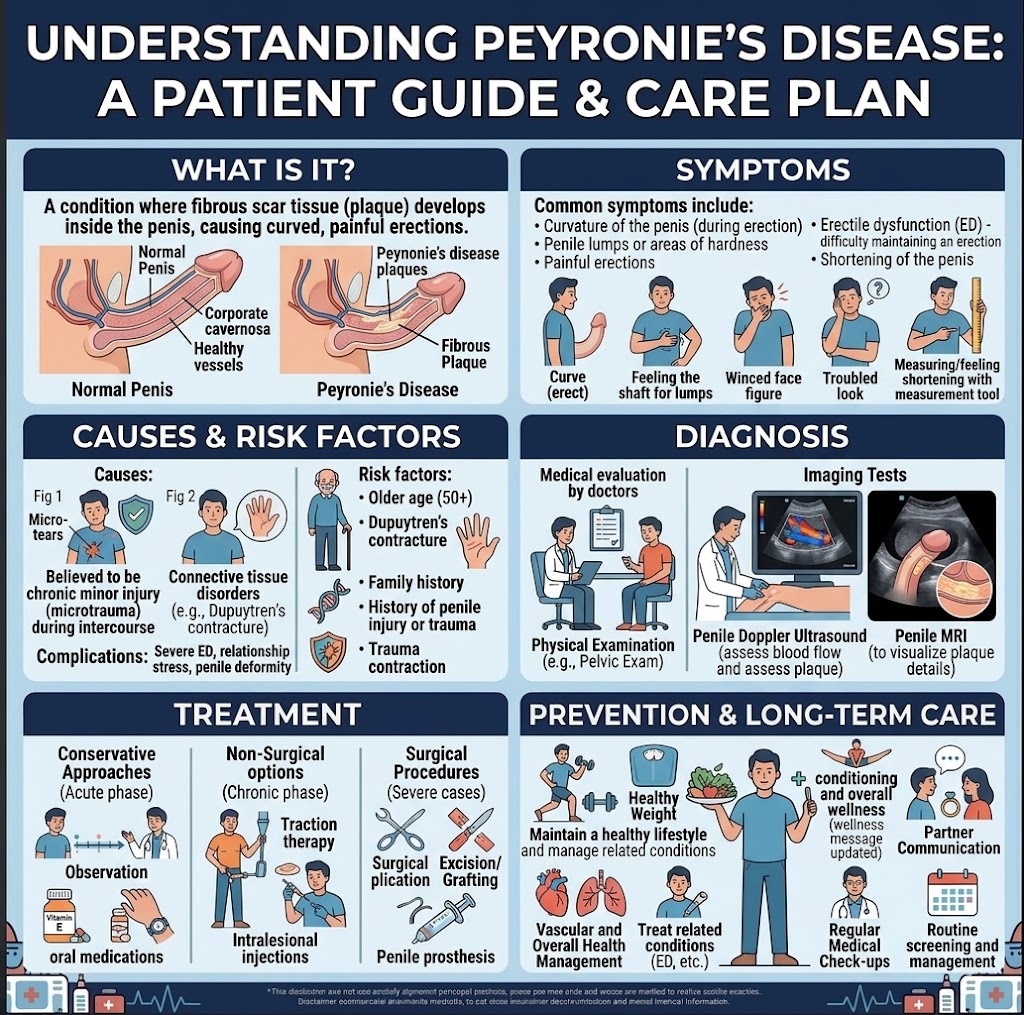
Peyronie's (pronounced pay-roe-NEEZ) disease is a condition where tough, fibrous scar tissue forms beneath the skin of the penis. This scar tissue, also called plaque, prevents the penis from stretching normally during an erection, leading to a noticeable curve, pain, and sometimes shortening. While a slight curve in an erection is normal, Peyronie's disease causes a significant bend or discomfort that can interfere with sexual activity and cause emotional distress. It is not a form of cancer. Peyronie's disease rarely resolves completely on its own, but early detection and treatment can prevent worsening of symptoms and may lead to improvement.
Understanding the Condition
Peyronie's Disease: Understanding Curved Erections
Understanding the Condition
Peyronie's (pronounced pay-roe-NEEZ) disease is a condition where tough, fibrous scar tissue forms beneath the skin of the penis. This scar tissue, also called plaque, prevents the penis from stretching normally during an erection, leading to a noticeable curve, pain, and sometimes shortening. While a slight curve in an erection is normal, Peyronie's disease causes a significant bend or discomfort that can interfere with sexual activity and cause emotional distress. It is not a form of cancer. Peyronie's disease rarely resolves completely on its own, but early detection and treatment can prevent worsening of symptoms and may lead to improvement.
Common Symptoms
Scar Tissue (Plaque): You might feel flat lumps or a band of hard tissue under the skin of the penis. This scar tissue, though also called 'plaque,' is different from plaque that builds up in blood vessels or on teeth. The area over the scar tissue can feel tender.
Penile Bend: During an erection, the penis may curve significantly upward, downward, or to one side. This bend can be mild or severe.
Erection Problems: Peyronie's disease can make it difficult to get or maintain an erection, a condition known as erectile dysfunction. Some individuals notice erection problems even before other symptoms appear.
Penile Shortening: The penis may become noticeably shorter when erect due to the inelastic scar tissue.
Pain in the Penis: Pain can occur whether the penis is erect or not. This pain often improves within one to two years, but the curving and shortening may persist.
Other Changes in Penile Shape: The erect penis might appear narrow, indented, or develop an 'hourglass' shape, with a tight, narrow band around the shaft.
Consultation Guide
Which Specialist to Meet
Before your appointment, prepare a list of your symptoms, including when they started, how they have progressed, and any associated pain or difficulty with sexual activity. Note any known injuries to the penis, your family medical history, and all medications you are currently taking. Be ready to discuss any emotional impact the condition has had on you or your relationships.
Book a doctor visit near me
Watchful Waiting: For mild cases, particularly if the pain is the primary symptom and is expected to improve, your doctor may recommend monitoring your condition without immediate intervention. This is often an option during the 'active phase' of the disease (first 1-1.5 years) when symptoms might still be evolving. (Duration: Typically 6 to 18 months, with regular symptom monitoring.)
Prescription Pain Management: If pain is severe or persistent, your doctor may prescribe stronger pain medication or other pain management strategies. (Duration: As prescribed by your doctor, for the duration of symptoms.)
Consultation Guide
Penile Implants: These devices are surgically placed inside the penis to allow a man to achieve an erection. Implants are often recommended when Peyronie's disease has caused severe erectile dysfunction that doesn't respond to other treatments, or when the curvature is significant. Implants can correct both curvature and erectile dysfunction simultaneously. (Duration: A one-time surgical procedure. Recovery typically takes several weeks, and the implants are permanent.)
Healthy Lifestyle Choices: Avoid smoking, maintain a healthy weight, and adopt a generally healthy lifestyle to support overall tissue healing and reduce risk factors.
Long-Term Monitoring and Support
Psychological and Relationship Support: Seek counseling or join support groups to help cope with the emotional distress, anxiety, depression, and potential strain on relationships that Peyronie's disease can cause. Open communication with your partner is also crucial.
Diagnostic Procedures
It is recommended to consult a urologist, a doctor specializing in the urinary tract and male reproductive system, or a men's health specialist. These experts can accurately diagnose Peyronie's disease and discuss suitable treatment options.
Preparations Before Your Visit
What to Expect
During the physical exam, your doctor will visually inspect and gently feel your penis for any lumps or hard areas. If an induced erection is necessary, a small injection will be given into the penis to achieve an erection. This allows the doctor to accurately measure the degree of curvature and take photographs for documentation. You may feel a brief pinch from the injection.
An ultrasound uses sound waves to create images of the structures inside the penis. This allows the doctor to visualize the scar tissue, assess blood flow, and determine if there is any calcification (hardening) within the plaque. It helps in precisely mapping the extent of the disease.
What to Expect
A clear gel will be applied to your penis, and a small handheld device called a transducer will be moved gently over the skin. This device emits sound waves and creates images on a monitor. The procedure is generally painless and takes about 15-30 minutes. In some cases, an injection may be given to induce an erection during the ultrasound to better evaluate the penile curvature and blood flow in the erect state.
Treatment Options
Your doctor will examine your penis to feel for the presence and location of scar tissue. In some cases, to fully assess the curvature and its severity, the doctor may induce a temporary erection using an injection of medication into the penis.
Home Remedies and Observation
Medications
Oral Medications: Several oral medications may be prescribed to help reduce inflammation, pain, or the progression of scar tissue. The effectiveness of these medications can vary among individuals. (Duration: Typically taken daily for several months to a year, depending on the medication and patient response.)
Injected Medications: Medications are injected directly into the penile plaque to help break down the scar tissue, reduce its size, and improve the curvature. These injections are administered in a doctor's office. (Duration: A course typically involves multiple injections (e.g., once every few weeks) over several months.)
Therapies
Penile Traction Therapy: This therapy involves wearing a device that gently stretches the penis. The goal is to help remodel the scar tissue, reduce curvature, and potentially restore some penile length. (Duration: The device is typically worn for specific periods each day, often for three to nine months or longer.)
Surgical Procedures
Plication Procedure: This surgery involves placing stitches on the side of the penis opposite the curve to shorten that side, thereby straightening the penis. This procedure is generally suitable for less severe curves and typically results in some degree of penile length reduction. (Duration: A one-time surgical procedure. Recovery usually takes several weeks.)
Over-the-Counter Pain Relievers: Non-prescription pain medications may help manage mild discomfort or pain associated with Peyronie's disease. (Duration: As needed for pain relief.)
Regular Medical Follow-ups: Consistent visits with your urologist are essential to monitor the progression of the disease, assess the effectiveness of treatments, and address any new concerns or complications.
Erectile Dysfunction Management: If erectile dysfunction persists or develops, work with your doctor to explore specific treatments for ED, which may include oral medications, vacuum devices, or injections, in addition to Peyronie's treatments.
Prevention & Long-Term Wellbeing
Graft Repair: In this procedure, the surgeon cuts or removes the scar tissue, allowing the penis to straighten. A patch of tissue (from human, animal, or synthetic material) is then used to fill the gap. This method can help preserve penile length but carries a slightly higher risk of post-operative erectile dysfunction. (Duration: A one-time surgical procedure. Recovery usually takes several weeks.)
Prevention
Mindful Sexual Activity: Engage in sexual activity carefully to minimize the risk of penile trauma, especially if you notice any tenderness or early signs of the condition.
Managing Underlying Health Conditions: Control conditions such as diabetes, high blood pressure, and other connective tissue disorders that may increase your risk of developing Peyronie's disease.
Tags & Topics
Notice an error or need an update?
Help us keep medical information accurate. Report incorrect info or suggest an edit.


