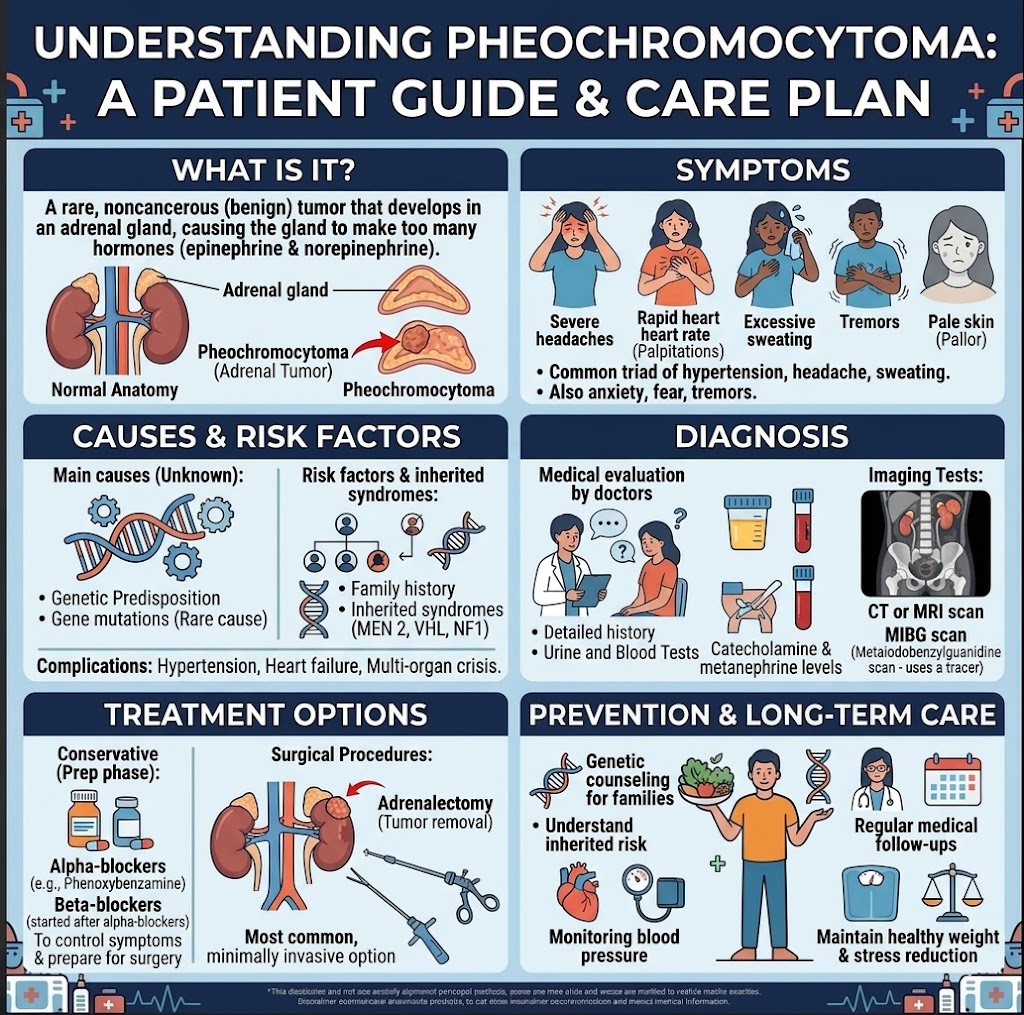
A pheochromocytoma (pronounced fee-o-kroe-moe-sy-TOE-muh) is a rare growth that develops in one of your two adrenal glands. These small glands sit on top of each kidney and produce essential hormones, including those that regulate blood pressure. While most pheochromocytomas are non-cancerous and do not spread to other parts of the body (benign), some can be cancerous and spread (malignant). This tumor causes the adrenal gland to release too many hormones like adrenaline and noradrenaline, leading to symptoms such as very high blood pressure, headaches, and profuse sweating. If left untreated, a pheochromocytoma can cause serious or life-threatening damage to vital organs. Fortunately, surgical removal of the tumor often resolves the symptoms and returns blood pressure to a healthy range.
Understanding the Condition
Pheochromocytoma: Understanding a Rare Adrenal Gland Tumor
Understanding the Condition
A pheochromocytoma (pronounced fee-o-kroe-moe-sy-TOE-muh) is a rare growth that develops in one of your two adrenal glands. These small glands sit on top of each kidney and produce essential hormones, including those that regulate blood pressure. While most pheochromocytomas are non-cancerous and do not spread to other parts of the body (benign), some can be cancerous and spread (malignant). This tumor causes the adrenal gland to release too many hormones like adrenaline and noradrenaline, leading to symptoms such as very high blood pressure, headaches, and profuse sweating. If left untreated, a pheochromocytoma can cause serious or life-threatening damage to vital organs. Fortunately, surgical removal of the tumor often resolves the symptoms and returns blood pressure to a healthy range.
Common Symptoms
High Blood Pressure: Often severe and sometimes fluctuating, this is a hallmark symptom.
Heavy Sweating: Episodes of excessive sweating unrelated to exertion or heat.
Rapid Heartbeat: Feeling your heart pounding or racing.
Headache: Intense headaches that can come on suddenly.
Nervous Shaking: Uncontrollable tremors or jitters.
Pale Skin: Your skin may appear unusually light in color.
Shortness of Breath: Difficulty catching your breath during episodes.
Panic Attack-Like Symptoms: Sudden intense fear, anxiety, or a sense of impending doom.
Vision Problems: Blurred vision or other visual disturbances.
Constipation: Difficulty with bowel movements.
Weight Loss: Unexplained loss of body weight.
Consultation Guide
Which Specialist to Meet
You should consult your primary care doctor, who may then refer you to an endocrinologist (a doctor specializing in hormone disorders), an endocrine surgeon, or a genetic counselor if an inherited condition is suspected.
Preparations Before Your Visit
Before your visit, make a list of all your symptoms, including when they started and how often they occur. Write down any medications, supplements, or vitamins you are taking. Gather your medical history, including any family history of high blood pressure or genetic conditions. Prepare a list of questions for your doctor to ensure all your concerns are addressed.
Book a doctor visit near me
Blood Pressure Control Medications: Specific medications, such as alpha-blockers and beta-blockers, are used to stabilize blood pressure and heart rate. These drugs help manage the effects of excess hormones released by the tumor. (Duration: Typically taken for several weeks before surgery to prepare the body, and potentially longer-term if surgery is not immediately possible or for ongoing symptom management.)
Regular Screening for At-Risk Individuals: For those with known genetic risk factors, regular blood pressure checks, blood tests to measure hormone levels, and imaging scans (like CT or PET scans) may be recommended to detect tumors early, often before symptoms become severe.
Long-Term Monitoring and Management
Diagnostic Procedures
This test examines your DNA to identify any changes (mutations) in your genes that may increase your risk for a pheochromocytoma or related conditions. It's especially important if there's a family history of the tumor or certain genetic syndromes.
What to Expect
A small sample of your DNA is collected, usually through a blood draw or a simple swab from the inside of your cheek. These procedures carry minimal physical risk. If a prenatal genetic test is needed (like amniocentesis or chorionic villus sampling), there is a small risk of pregnancy loss. You will discuss the implications of the results with your doctor or a genetic counselor before and after the test.
CT Scan (Computed Tomography Scan)
A CT scan uses specialized X-ray equipment and computer processing to create detailed cross-sectional images (like 'slices') of bones, blood vessels, and soft tissues inside your body. It helps doctors pinpoint the exact location and size of a tumor in the adrenal gland or elsewhere.
What to Expect
You will lie still on a narrow table that slides into a large, doughnut-shaped scanner. You might receive a contrast dye, either orally or injected into a vein, to make certain structures show up more clearly. The scan itself is painless and usually takes about 10-30 minutes. You will be asked to hold your breath briefly at certain times.
PET Scan (Positron Emission Tomography Scan)
A PET scan is an imaging test that shows the metabolic activity of your body's tissues and organs. It uses a small amount of a radioactive substance (tracer) injected into your body. Cancer cells or tumor cells often show higher metabolic activity and 'light up' on the scan, helping to detect tumors that might not be visible on other scans or to check if a tumor has spread. PET scans are often combined with CT or MRI scans (PET-CT or PET-MRI) for more detailed images.
What to Expect
You will receive an injection of a radioactive tracer, usually into a vein in your arm or hand. You'll then wait for about an hour for the tracer to be absorbed by your tissues. After that, you'll lie on a narrow table that slides into a doughnut-shaped scanner. The scan typically takes around 30 minutes, during which you must remain very still. The images will then be analyzed by a specialist.
Genetic Counseling and Testing: If you have a family history of pheochromocytoma or a related genetic condition (like MEN 2, Von Hippel-Lindau disease, Neurofibromatosis 1, or Hereditary Paraganglioma Syndromes), genetic counseling can help assess your risk. Genetic testing can confirm if you carry a gene mutation, allowing for early monitoring.
Post-Treatment Follow-Up: Even after successful treatment, ongoing monitoring is crucial. This includes regular doctor visits, blood pressure checks, and laboratory tests to measure hormone levels. Imaging scans may also be performed periodically to detect any recurrence of the tumor or the development of new tumors, especially if you have a genetic predisposition.
Treatment Options
Medications
Tumor Removal Surgery: The primary treatment for pheochromocytoma involves surgically removing the tumor, usually from the adrenal gland. This often leads to a cure, with blood pressure returning to normal levels. (Duration: Hospital stay is usually a few days, with a full recovery typically taking several weeks, depending on the type of surgery (e.g., minimally invasive or open surgery).)
Other Procedures and Therapies
Ablation Therapy (Radiofrequency Ablation, Cryoablation): These minimally invasive procedures destroy abnormal tissue using extreme heat (radiofrequency ablation) or extreme cold (cryoablation). Thin probes are guided to the tumor, often used when surgery is not an option or for smaller, localized tumors. (Duration: May involve one or more sessions. Recovery is generally faster than open surgery, typically ranging from a few days to a couple of weeks.)
Radiation Therapy: This treatment uses high-energy beams, like X-rays or proton beams, to kill cancer cells or shrink tumors. It's precisely aimed at the affected area to minimize harm to healthy tissue. It may be used for malignant tumors or if surgery is not possible. (Duration: Typically administered in daily sessions over several weeks, depending on the tumor's size and location.)
Chemotherapy: A drug treatment that uses powerful chemicals to kill fast-growing cancer cells throughout the body. It is generally reserved for malignant pheochromocytomas that have spread. (Duration: Administered in cycles, usually over several months, with periods of treatment followed by rest to allow the body to recover.)
Prevention & Long-Term Wellbeing
Prevention and Early Detection
Blood Pressure Management: Maintain a healthy lifestyle, including a balanced diet, regular exercise, and stress management, to support overall cardiovascular health and help manage blood pressure, even after tumor removal.
Tags & Topics
Notice an error or need an update?
Help us keep medical information accurate. Report incorrect info or suggest an edit.


