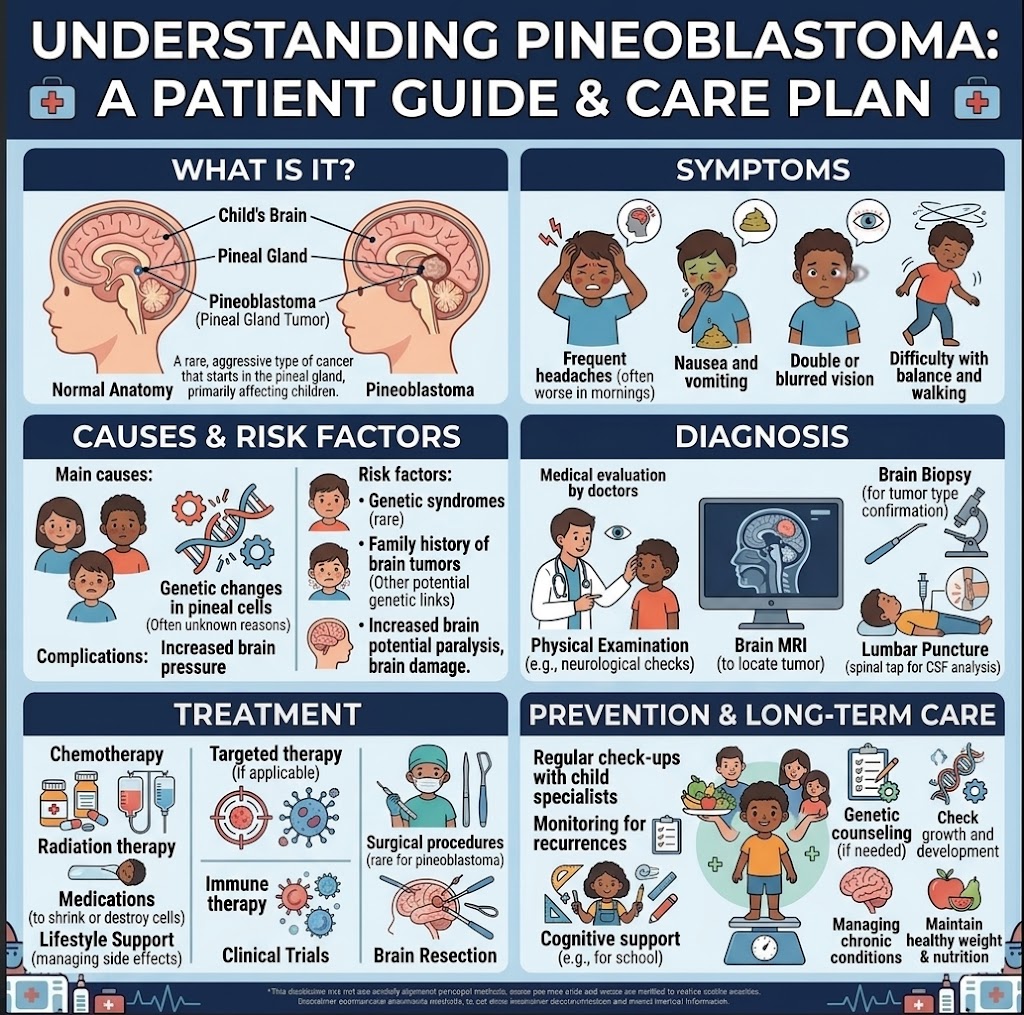
Pineoblastoma is a rare and aggressive brain cancer originating in the pineal gland, a small gland in the brain's center that regulates sleep-wake cycles by producing melatonin. This cancer involves a rapid, uncontrolled growth of cells that form a tumor, which can invade and damage surrounding brain tissue. While it can occur at any age, it is most common in young children. Symptoms often include headaches, unusual sleepiness, and eye movement changes. Treatment is challenging as the cancer may spread within the brain and its surrounding fluid, though it rarely affects other body parts. Initial treatment usually involves surgery, often followed by additional therapies.
Understanding the Condition
Pineoblastoma: A Guide for Non-Medical Readers
Understanding the Condition
Pineoblastoma is a rare and aggressive brain cancer originating in the pineal gland, a small gland in the brain's center that regulates sleep-wake cycles by producing melatonin. This cancer involves a rapid, uncontrolled growth of cells that form a tumor, which can invade and damage surrounding brain tissue. While it can occur at any age, it is most common in young children. Symptoms often include headaches, unusual sleepiness, and eye movement changes. Treatment is challenging as the cancer may spread within the brain and its surrounding fluid, though it rarely affects other body parts. Initial treatment usually involves surgery, often followed by additional therapies.
Common Symptoms
Behavioral Changes: Shifts in mood, personality, or usual conduct.
Lack of Energy: Persistent fatigue or decreased activity.
Memory and Thinking Problems: Difficulties with concentration, remembering, or processing thoughts.
Headaches: Frequent or severe head pain, potentially worsening.
Sleepiness: Unusual drowsiness or increased need for sleep.
Eye Symptoms (Parinaud Syndrome): Occur when the tumor affects vision-controlling brain parts. These include: Blurred or Double Vision (difficulty seeing clearly or seeing two images), Focusing Problems (trouble seeing nearby objects clearly), and Difficulty Looking Upward (inability to move eyes fully upwards).
Consultation Guide
Which Specialist to Meet
If you or your child experience concerning symptoms, consult a primary care doctor who may refer you to specialists such as a Neurologist (brain and nervous system doctor), a Neurosurgeon (brain surgeon), or an Oncologist (cancer specialist). For children, a Pediatric Oncologist is often involved.
Preparations Before Your Visit
Before your visit, list all symptoms with their onset and frequency, compile a complete medical history including past illnesses and family conditions, note all current medications/supplements, prepare questions for the doctor, and gather any relevant past medical records or test results.
Book a doctor visit near me
Symptom Management: Addressing symptoms and side effects of treatment, such as fatigue, nausea, or neurological deficits, to improve quality of life.
Consultation Guide
No Known Prevention: Pineoblastoma cannot be prevented. Its exact cause is often unknown, and it is not linked to lifestyle or environmental factors. While a rare genetic condition (hereditary retinoblastoma) increases risk, prevention is not possible.
Diagnostic Procedures
Brain Magnetic Resonance Imaging (MRI)
An MRI uses powerful magnets and radio waves to create detailed internal images of the brain and spinal cord, helping doctors identify tumors and assess tissue changes. Images are 'slices' of the brain, with clarity determined by magnet strength (e.g., 1.5T, 3T, 7T).
What to Expect
You will lie on a movable table that slides into a large, tube-shaped machine. Remaining very still is essential. The machine produces loud knocking or buzzing noises, so ear protection is provided. While generally painless, the enclosed space can be uncomfortable for some. A contrast dye may be injected intravenously to enhance image clarity. The scan typically lasts 30 to 60 minutes. This test does not use radiation.
Lumbar Puncture (Spinal Tap)
This procedure collects a sample of cerebrospinal fluid (CSF)—the clear fluid protecting the brain and spinal cord. Analyzing CSF helps determine if cancer cells have spread from the pineal gland into the central nervous system or to rule out other central nervous system conditions.
What to Expect
You will typically lie on your side with knees drawn up to your chest, or sit and lean forward, to help arch your back. The skin in your lower back will be cleaned and numbed with a local anesthetic. A thin, hollow needle is then carefully inserted into the spinal canal to withdraw a small amount of CSF. You might feel pressure or a brief sting. After removal, a bandage is applied. You may be advised to lie flat for a few hours afterward to minimize headache risk.
Psychological Support: Counseling or support groups can help patients and their families cope with the emotional and psychological challenges of a cancer diagnosis and treatment.
Treatment Options
Surgical Procedures
Brain Tumor Surgery: The primary goal is to safely remove as much of the tumor as possible without harming healthy brain tissue. Complete removal is not always feasible. (Duration: Typically a single, complex operation. Hospital recovery can range from several days to weeks, followed by a longer rehabilitation period.)
Brain Stereotactic Radiosurgery (SRS): This non-surgical method uses highly focused radiation beams to precisely target and destroy tumor cells. It utilizes advanced imaging and computer guidance, avoiding incisions. (Duration: Often completed in one session or a few sessions over several days. Actual radiation delivery is brief, but preparation and setup can take several hours.)
Medications
Chemotherapy: Anti-cancer drugs are used to kill rapidly growing cancer cells throughout the body. Administered intravenously (into a vein) or orally (by mouth), chemotherapy often follows surgery to eliminate remaining cells or treat tumors that have spread. (Duration: Given in cycles over several months to more than a year, with scheduled rest periods between treatments.)
Therapies
Radiation Therapy: High-energy beams are directed at the tumor from outside the body (external beam radiation) to destroy cancer cells by damaging their genetic material. This prevents their growth and division. (Duration: Typically administered five days a week for 4 to 6 weeks. Each daily session is usually brief, lasting only a few minutes.)
Regular Follow-up Appointments: Crucial for monitoring treatment efficacy, detecting any recurrence, and managing long-term side effects. These include physical and neurological exams.
Routine Imaging Scans: Periodic brain MRI scans are essential to visualize the treated area and detect any changes or new tumor growth. The frequency is determined by the medical team.
Neurocognitive and Developmental Assessments: For children, regular evaluations of cognitive function, learning abilities, and developmental milestones are important to address potential impacts of the disease or its treatment.
Supportive Care and Rehabilitation
Rehabilitation Therapies: Physical, occupational, and speech therapies to help regain strength, balance, coordination, and assist with daily living activities if affected by the tumor or its treatment.
Prevention & Long-Term Wellbeing
Prevention
Tags & Topics
Notice an error or need an update?
Help us keep medical information accurate. Report incorrect info or suggest an edit.


