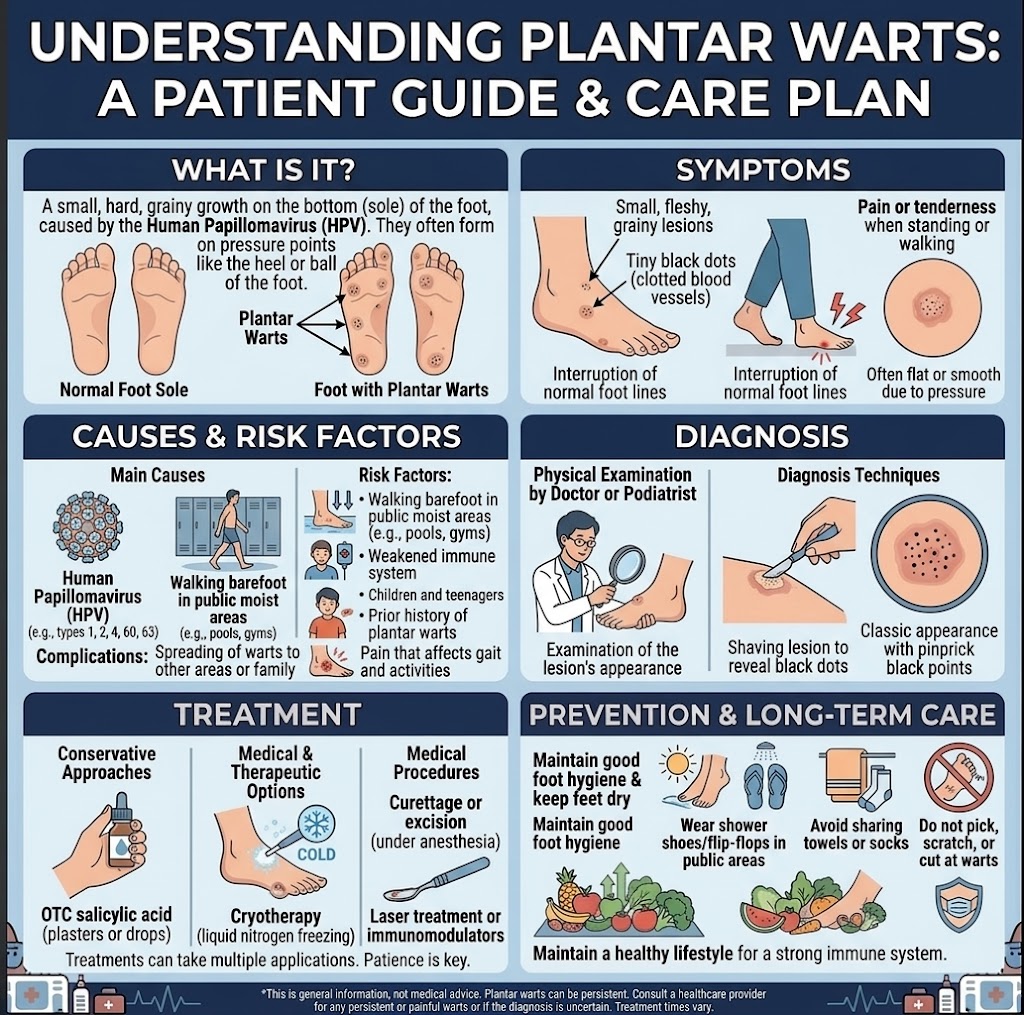
Plantar warts are small, rough growths that appear on the soles of your feet, commonly on pressure points like the balls and heels. The constant pressure from walking or standing can sometimes cause these warts to grow inward beneath a thick layer of hardened skin, known as a callus. These warts are caused by an infection with the Human Papillomavirus (HPV), which enters the skin through tiny cuts or breaks on the foot's bottom. While generally not a serious health concern and often disappearing on their own, particularly in children, treatments are available to speed up their removal. Ignoring painful warts might unconsciously alter your posture, potentially leading to discomfort in muscles or joints over time.
Understanding the Condition
Plantar Warts: Understanding and Managing Rough Growths on Your Feet
Understanding the Condition
Common Symptoms
Visible Growth: A small, rough bump or growth on the sole of your foot, typically near the toes, or on the ball or heel. For individuals with brown or Black skin, the wart might appear lighter than the surrounding healthy skin.
Callus Formation: A patch of hard, thickened skin (callus) that forms over a spot where a wart has grown inwards.
Black Dots: Tiny black dots, often called 'wart seeds,' which are actually small clotted blood vessels visible within the wart.
Mosaic Warts: Several warts grouped together on the sole of the foot, known as 'mosaic warts.'
Interrupted Skin Lines: A growth that disrupts the normal skin lines and ridges on the sole of your foot.
Before your appointment, be prepared to describe your symptoms, including when you first noticed the wart, how it has changed, and any pain you've experienced. Make a list of all medications you are currently taking, any allergies you have, and your complete medical history. Avoid applying any creams, lotions, or nail polish to your foot on the day of the visit, as this could make it harder for the doctor to examine the wart properly.
Book a doctor visit near me
The doctor will ask about your symptoms and medical history. Then, they will visually examine your foot, possibly using a magnifying glass for a closer look. They might gently press on the wart or use a small, sterile instrument to scrape away a thin layer of skin. This process is usually quick and causes minimal discomfort, helping to identify the characteristic pinpoint bleeding that confirms the presence of wart tissue.
Consultation Guide
Plantar warts are small, rough growths that appear on the soles of your feet, commonly on pressure points like the balls and heels. The constant pressure from walking or standing can sometimes cause these warts to grow inward beneath a thick layer of hardened skin, known as a callus. These warts are caused by an infection with the Human Papillomavirus (HPV), which enters the skin through tiny cuts or breaks on the foot's bottom. While generally not a serious health concern and often disappearing on their own, particularly in children, treatments are available to speed up their removal. Ignoring painful warts might unconsciously alter your posture, potentially leading to discomfort in muscles or joints over time.
Regular Foot Checks: Periodically inspect your feet for any new growths, especially if you have had plantar warts before or have risk factors like a weakened immune system or diabetes.
Prompt Medical Attention: If warts return, multiply, or cause discomfort, consult your healthcare provider for early intervention.
Diagnostic Procedures
A healthcare provider will carefully inspect the growth on your foot. They will look for key characteristics that help confirm it's a plantar wart, such as its location, texture, any disruption to your normal skin lines, and the presence of tiny black dots. They may also gently scrape the top layer of the wart to make these features more visible.
What to Expect
In rare instances, if the diagnosis isn't clear or the growth appears unusual, a small piece of the wart tissue may be removed. This sample is then sent to a laboratory for detailed examination under a microscope. This helps confirm the diagnosis and rule out other skin conditions.
What to Expect
First, a local anesthetic will be injected into the skin around the wart to numb the area. You might feel a brief sting or pressure as the anesthetic is administered. The doctor will then use a small, sterile blade or a specialized circular tool to take a tiny tissue sample. After the sample is taken, the area will be bandaged, and you'll receive instructions on how to care for the wound. The tissue sample is then sent to a pathologist who will analyze it to provide a definitive diagnosis.
Treatment Options
Pain or Tenderness: Pain or tenderness in the affected area when you walk or stand. Consult a healthcare provider if the growth is bleeding, very painful, changes shape or color, persists/multiplies/returns after self-treatment, or if pain affects daily activities. Seek advice if you have diabetes, reduced foot sensation, a weakened immune system, or are unsure if it's a wart.
Consultation Guide
Which Specialist to Meet
You can typically begin by seeing your family doctor or general practitioner. Depending on the wart's nature or complexity, they might refer you to a podiatrist (a foot specialist) or a dermatologist (a skin specialist).
Preparations Before Your Visit
Salicylic Acid Preparations: Over-the-counter liquid, gel, or patch treatments containing salicylic acid. They work by gradually peeling away layers of the wart. (Duration: Requires daily application for several weeks to a few months.)
Office-Based Procedures
Cryotherapy (Freezing): A healthcare provider applies liquid nitrogen to the wart, freezing and destroying the tissue, causing a blister that eventually peels off. (Duration: Each session is brief, but multiple treatments are often needed, typically scheduled a few weeks apart, over several weeks to months.)
Laser Treatment: A specialized laser is used to heat and destroy the tiny blood vessels feeding the wart, causing it to die and fall off. (Duration: May require one or more sessions, depending on the wart's size and response.)
Prescription Medications
Stronger Peeling Agents: Prescription-strength topical medications containing acids, more potent than over-the-counter options, dissolve wart tissue. (Duration: Applied as directed, usually over several weeks to months.)
Immune-Stimulating Creams/Injections: Prescribed creams or injections can stimulate your body's immune system to fight the wart virus. (Duration: Varies widely, from weeks to several months, depending on the specific medication and individual response.)
Surgical Procedures
Excisional Surgery (Cutting Out the Wart): After numbing the area, the doctor surgically removes the wart with a sterile scalpel. (Duration: A single procedure, followed by a healing period of a few weeks for the surgical site.)
Prevention & Long-Term Wellbeing
Prevention
Avoid Direct Contact: Steer clear of touching warts, including your own. Always wash your hands thoroughly after any accidental contact.
Keep Feet Clean and Dry: Ensure your feet are regularly washed and completely dried, as this helps prevent the virus from thriving.
Wear Foot Protection: Always wear sandals, water shoes, or other protective footwear when walking in public areas like swimming pools, locker rooms, and gym showers, where the virus is common.
Don't Pick or Scratch Warts: This can spread the virus to other parts of your body or to other people.
Use Dedicated Tools: If you use an emery board, pumice stone, or nail clipper on a wart, keep that tool separate and do not use it on your healthy skin or nails to prevent spreading the virus.
Long-Term Monitoring
Maintain Overall Health: A strong immune system can help your body fight off viruses. Eat a balanced diet, exercise regularly, and get enough sleep.
Tags & Topics
Notice an error or need an update?
Help us keep medical information accurate. Report incorrect info or suggest an edit.


