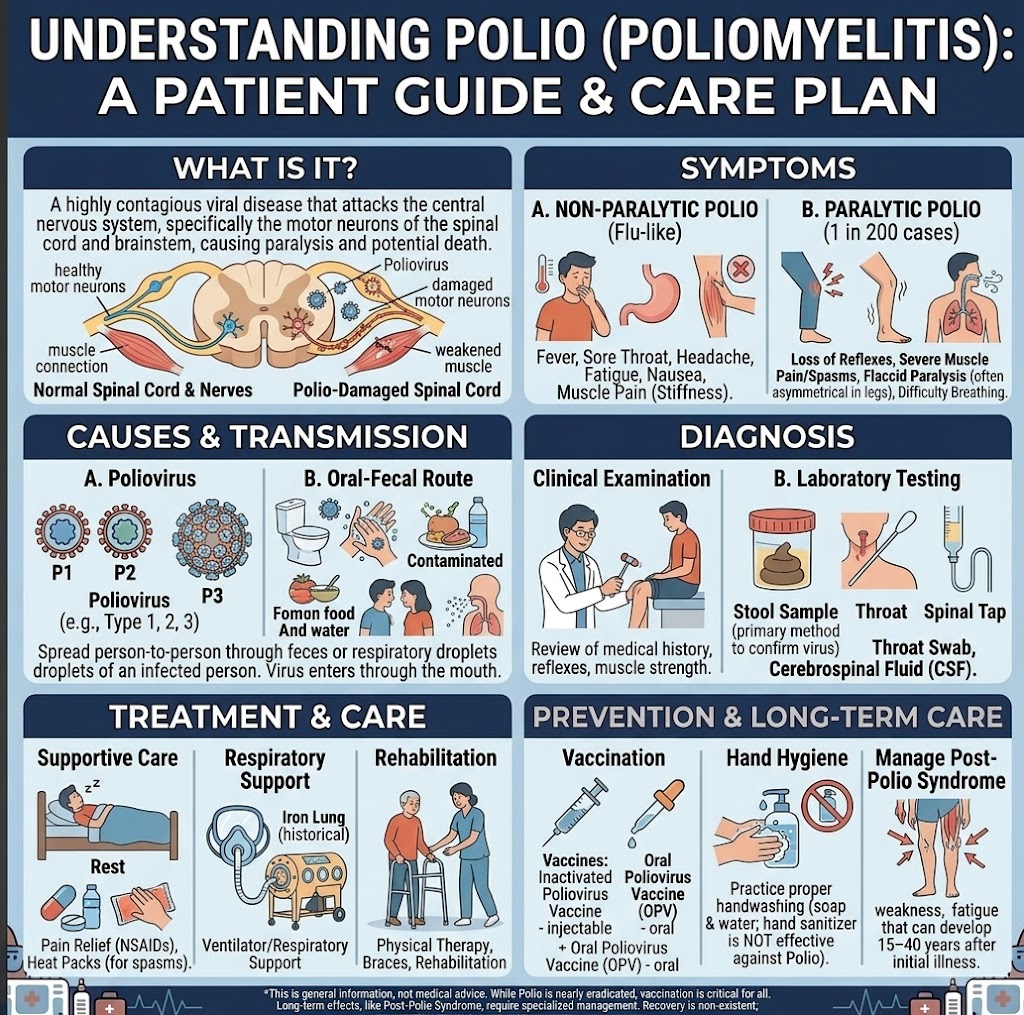
Polio, or poliomyelitis, is a highly infectious disease caused by a virus that targets the nervous system, particularly nerve cells in the spinal cord and brainstem. While many infected individuals display no symptoms, severe cases can lead to irreversible muscle weakness, permanent paralysis, breathing difficulties, or death. Although global immunization initiatives have dramatically reduced cases, the virus continues to spread in regions with low vaccination coverage, making ongoing prevention vital.
Understanding the Condition
Understanding Polio: Prevention, Symptoms, and Management
Understanding the Condition
Polio, or poliomyelitis, is a highly infectious disease caused by a virus that targets the nervous system, particularly nerve cells in the spinal cord and brainstem. While many infected individuals display no symptoms, severe cases can lead to irreversible muscle weakness, permanent paralysis, breathing difficulties, or death. Although global immunization initiatives have dramatically reduced cases, the virus continues to spread in regions with low vaccination coverage, making ongoing prevention vital.
Common Symptoms
Asymptomatic Infection: Approximately 95% of people infected with the poliovirus show no symptoms at all, but they can still silently spread the virus to others.
Abortive Poliomyelitis: A mild version of the disease affecting about 5% of patients. It causes short-lived, flu-like symptoms lasting 2 to 3 days, including muscle aches, fever, sore throat, stomachache, and loss of appetite.
Nonparalytic Poliomyelitis: An intermediate form of the illness affecting roughly 1% of patients. It lasts longer than mild polio and causes more intense symptoms without permanent paralysis. Symptoms include neck stiffness, severe headache, and aches in the limbs.
Paralytic Poliomyelitis: The rarest and most dangerous form. It involves the loss of motor neuron function, causing rapid muscle flaccidity, severe pain, loss of reflexes, permanent paralysis of limbs, and respiratory failure if chest muscles are affected.
Consultation Guide
Which Specialist to Meet
You should consult a Pediatrician, a Primary Care Physician, or an Infectious Disease Specialist. If neurological symptoms are present, a Neurologist or Physical Medicine and Rehabilitation Specialist may be required.
Preparations Before Your Visit
Before your appointment, document all symptoms and when they started, gather complete childhood and travel vaccination histories, list all foreign travel within the last month, and write down any questions you have regarding booster immunization or exposure risks.
Book a doctor visit near me
Diagnostic Procedures
The most reliable method of diagnosing polio, used to isolate and identify the active poliovirus.
What to Expect
You will be provided with a sterile collection kit to gather a stool sample at home or in the clinic. The sample is then capped securely and sent immediately to a specialized lab. The process is completely painless.
A diagnostic test used during the first few days of suspected infection to detect viral particles in the throat.
What to Expect
A healthcare provider will ask you to open your mouth wide and will gently rub a sterile cotton-tipped swab across the back of your throat. This takes only a few seconds and may trigger a momentary gag reflex.
Lumbar Puncture (Spinal Tap)
A procedure used to analyze cerebrospinal fluid (CSF) for signs of central nervous system inflammation or infection.
What to Expect
You will lie on your side with your knees pulled to your chest. The clinician will clean and numb your lower back with a local anesthetic. A thin needle is inserted between two vertebrae to collect a small fluid sample. You will need to lie flat for a few hours afterward to avoid a headache.
Magnetic Resonance Imaging (MRI)
An advanced imaging scan used to visualize damage to the spinal cord or brainstem motor neurons.
What to Expect
You will lie flat on a motorized table that slides into a tube-shaped scanner. You must remain completely still during the scan, which takes 30 to 60 minutes. The machine makes loud tapping noises, so you will be given earplugs or headphones.
Treatment Options
Supportive Care & Medications
Pain Management & Antipyretics: Medications to reduce fever, soothe muscle spasms, and control body aches. No specific antiviral drugs cure polio, so treatment focuses on comfort. (Duration: Used daily or as needed during the acute phase of infection, typically 2 to 4 weeks.)
Prevention & Long-Term Wellbeing
Mechanical Ventilation: Breathing support using portable or intensive care ventilators to assist patients whose respiratory muscles have been paralyzed. (Duration: Varies from a few weeks during recovery to lifelong support depending on muscle recovery.)
Therapies & Assistive Devices
Physical Therapy: Customized exercise regimens designed to prevent joint deformities (contractures), preserve muscle flexibility, and restore strength during recovery. (Duration: Begins during early recovery and usually continues for months, years, or throughout life.)
Orthopedic Bracing & Assistive Tools: Prescription of custom leg braces, splints, crutches, or wheelchairs to support weakened limbs, improve mobility, and correct alignment. (Duration: Often permanent for those living with chronic paralytic polio.)
Childhood Vaccination (IPV): Ensure children receive the standard 4-dose series of the Inactivated Poliovirus Vaccine at ages 2 months, 4 months, 6 to 18 months, and a final booster at 4 to 6 years.
Adult Booster Immunization: Unvaccinated adults should complete a 3-dose IPV series. Fully vaccinated adults planning to travel to areas with active polio transmission should receive a single lifetime booster dose of IPV.
Hygiene and Sanitation: Practice diligent hand hygiene, washing thoroughly with soap and water after using the restroom, changing diapers, and before eating, especially in areas with compromised water quality.
Post-Polio Syndrome Monitoring: Survivors of polio should engage in regular, non-fatiguing exercise, practice energy conservation, and see specialists immediately if new muscle pain or progressive weakness develops decades after the initial illness.
Tags & Topics
Notice an error or need an update?
Help us keep medical information accurate. Report incorrect info or suggest an edit.


