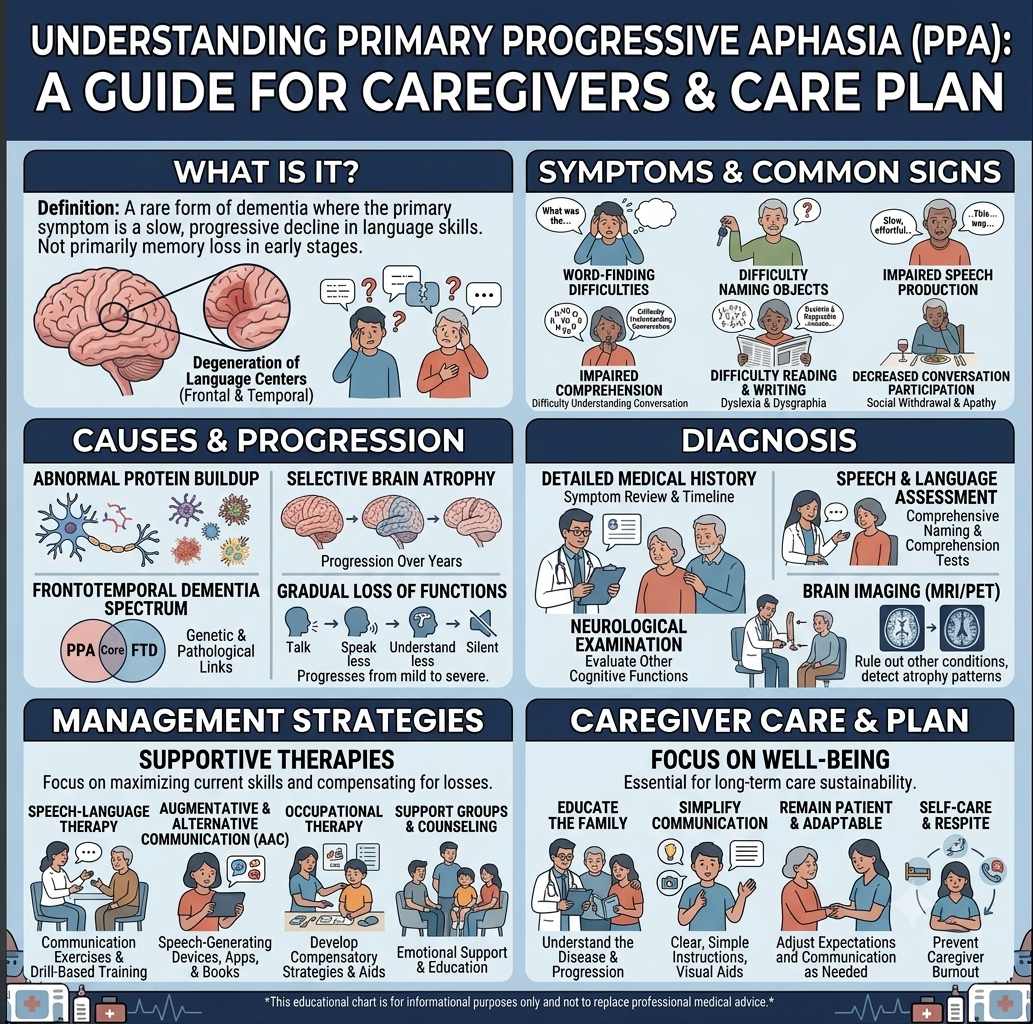
Primary Progressive Aphasia (PPA) is a rare brain condition that gradually affects a person's ability to communicate. Individuals with PPA slowly lose the capacity to speak, understand language, read, or write. Symptoms typically begin before age 65 and worsen over time. While PPA primarily impacts language, it is a type of frontotemporal dementia, meaning it stems from the deterioration of brain areas vital for speech and language. Although not everyone with PPA initially shows broader signs of dementia, most will develop it over time, which involves difficulties with daily tasks due to changes in thinking and understanding.
Understanding the Condition
Primary Progressive Aphasia: Understanding a Rare Communication Disorder
Understanding the Condition
Primary Progressive Aphasia (PPA) is a rare brain condition that gradually affects a person's ability to communicate. Individuals with PPA slowly lose the capacity to speak, understand language, read, or write. Symptoms typically begin before age 65 and worsen over time. While PPA primarily impacts language, it is a type of frontotemporal dementia, meaning it stems from the deterioration of brain areas vital for speech and language. Although not everyone with PPA initially shows broader signs of dementia, most will develop it over time, which involves difficulties with daily tasks due to changes in thinking and understanding.
Common Symptoms
Speaking Difficulties: Trouble finding the right words, leading to pauses and hesitation during speech. Difficulty repeating phrases or sentences. Making errors in speech sounds or struggling to produce words clearly (known as apraxia of speech). Omitting words or using them in the wrong order in sentences.
Understanding Language: Struggling to understand spoken or written language, especially single words, long sentences, or complex instructions. Difficulty grasping the meaning of words.
Reading and Writing Difficulties: Inability to name common objects. Trouble spelling words, particularly those that aren't phonetic (e.g., 'yacht'). Struggling to understand written language or express thoughts in writing.
Consultation Guide
Which Specialist to Meet
You should consult a neurologist, a doctor specializing in brain and nervous system conditions. A speech-language pathologist can help assess and manage communication difficulties, and a genetic counselor can provide guidance if family history suggests a genetic link.
Preparations Before Your Visit
Before your visit, make a list of all your symptoms, including when they started and how they've progressed. Note down your full medical history, any current medications, and prepare questions for the doctor. Bringing a family member or close friend can also be helpful for support and to provide additional information.
Book a doctor visit near me
A neurologist performs this exam to assess the health and function of your brain, spinal cord, nerves, and muscles. It helps identify any issues within your nervous system that might be contributing to your symptoms.
The doctor will ask about your medical history and symptoms. They will then perform a series of tests to check your mental status (alertness, memory, language), reflexes, coordination, balance, vision, and sensation. This exam can take anywhere from a few minutes to over an hour.
Positron Emission Tomography (PET) Scan
Medications (for symptom management)
Medications for Associated Symptoms: While there are no medications that cure Primary Progressive Aphasia or stop its progression, certain medications may be prescribed to manage associated symptoms that can arise as the condition progresses. These might include treatments for depression, anxiety, or behavioral changes that can occur with dementia. (Duration: As prescribed; long-term.)
Psychological Support and Counseling: Support for individuals with PPA and their families is crucial. Counseling can help cope with the emotional challenges of living with a progressive communication disorder, including feelings of frustration, isolation, or depression. Support groups offer a shared space for connection and practical advice. (Duration: As needed; ongoing.)
Coping with Emotional and Behavioral Changes: Depression is common as the disease progresses. Other potential complications include changes in emotions (e.g., reduced empathy), poor judgment, or socially inappropriate behaviors. Medical and psychological support are important to manage these symptoms and maintain quality of life for the individual and their caregivers.
Diagnostic Procedures
This test examines your DNA to identify specific changes (mutations) in genes that might be linked to Primary Progressive Aphasia. While PPA often occurs randomly, certain rare genetic changes increase risk.
What to Expect
A small sample of blood is usually drawn from your arm or a cheek swab is collected. This sample is then analyzed in a lab. Before testing, you'll typically have a discussion with a genetic counselor to understand the potential results and implications for you and your family.
Neurological Examination
What to Expect
A PET scan is an imaging test that reveals how well your body's tissues and organs are functioning metabolically. It uses a safe, radioactive tracer injected into your bloodstream to highlight areas of unusual activity in the brain, often detecting problems before they appear on other scans.
What to Expect
You will receive an injection of a small amount of radioactive tracer, usually into a vein in your arm. After waiting for the tracer to circulate (typically 30-60 minutes), you will lie on a narrow table that slides into a large, doughnut-shaped scanner. You need to remain still during the 30-minute scan. PET scans are often combined with CT or MRI scans for more detailed images (PET-CT or PET-MRI).
Single-Photon Emission Computerized Tomography (SPECT) Scan
A SPECT scan is another imaging test that uses a radioactive substance and a special camera to create 3D pictures showing blood flow and activity within organs. For the brain, it can show which areas are more or less active, helping to identify affected regions.
What to Expect
Similar to a PET scan, a radioactive tracer is injected into your bloodstream. After a waiting period, you will lie on a table while a special camera rotates around your head to capture images. The process is painless and typically takes about 30 minutes, during which you must remain very still.
Treatment Options
Therapies
Speech-Language Therapy: This therapy helps individuals improve or maintain their communication skills. A speech-language pathologist works on strategies to compensate for language difficulties, practice speaking, understanding, reading, and writing, and explore alternative communication methods if needed. This can include exercises to strengthen speech muscles or learn new ways to express thoughts. (Duration: Ongoing; tailored to individual progression.)
Prevention & Long-Term Wellbeing
Brain Health and Prevention
Adopting a Healthy Lifestyle (GROWTH): While there's no guaranteed prevention for PPA, maintaining overall brain health can be beneficial. This involves: **G**etting quality sleep, **R**educing stress, **O**pening connections (social engagement), **T**rying new things (mental stimulation), and **H**ealthy eating habits.
Managing Complications and Long-Term Support
Managing Progressive Communication Loss: As PPA advances, communication becomes increasingly challenging. Strategies include simplifying language, using visual aids, encouraging non-verbal communication, and utilizing assistive technologies. Family education and support are vital to adapt to changing communication needs.
Addressing Cognitive and Physical Changes: Over time, other mental skills like memory, planning, and organization may be affected, requiring support for daily activities. Some individuals may develop problems with movement, balance, or swallowing, necessitating therapies (e.g., physical or occupational therapy) and close medical monitoring. Adjustments to living environments may also be needed for safety.
Tags & Topics
Notice an error or need an update?
Help us keep medical information accurate. Report incorrect info or suggest an edit.


