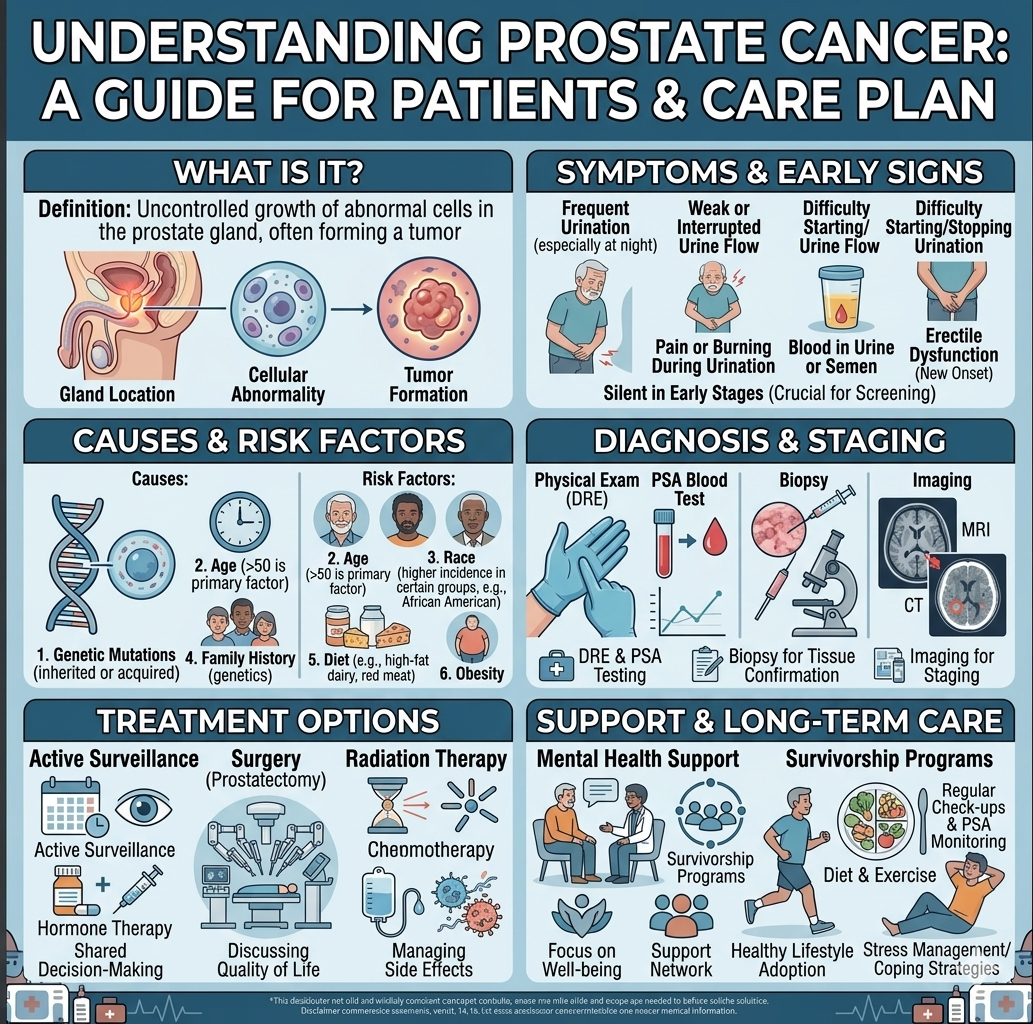
Prostate cancer is a type of cancer that starts in the prostate, a small gland in the male reproductive system located just below the bladder. This gland helps produce semen. It is one of the most common cancers, often growing slowly and typically found in its early stages. Most people diagnosed with prostate cancer can be cured. When found early, there are many treatment choices, including surgery, radiation, or simply monitoring its growth. Even if the cancer spreads, numerous treatment options can slow its progression and extend life.
Understanding the Condition
Prostate Cancer: A Clear Guide for Non-Medical Individuals
Understanding the Condition
Common Symptoms
Early-Stage Symptoms (when present): Prostate cancer often causes no symptoms at first, especially in its early stages when confined to the prostate. If symptoms occur, they can include:* Blood in the urine, making it appear pink, red, or cola-colored.* Blood in the semen.* Needing to urinate more often, particularly at night.* Difficulty starting urination.
Advanced-Stage Symptoms (if cancer spreads): If prostate cancer spreads beyond the prostate (called metastatic or stage 4 cancer), other symptoms may arise:* Accidental leaking of urine.* Difficulty getting or maintaining an erection (erectile dysfunction).* Feeling very tired.* Unexplained weight loss.* Weakness in the arms or legs.
Consultation Guide
Which Specialist to Meet
Before your appointment, gather your medical history, including any family history of cancer. Make a list of all medications you take. Prepare a list of your symptoms and any questions you have about prostate health, screening options, and potential risks. Being open and honest with your medical team is crucial.
Book a doctor visit near me
Consultation Guide
The procedure is quick and typically causes only mild pressure or discomfort. You will likely be asked to lie on your side or bend over.
You lie on a motorized table that slides into a large, donut-shaped machine. You need to remain very still. Sometimes, a contrast dye is injected into a vein to improve image clarity, which can cause a warm sensation.
MRI (Magnetic Resonance Imaging)
An MRI uses powerful magnets and radio waves to create highly detailed images of organs and soft tissues without using X-rays. It's often used to assess the prostate and surrounding tissues for cancer.
Consider Genetic Counseling: If diagnosed with prostate cancer at a young age or if you have a strong family history, consider consulting a genetic counselor to understand inherited risk factors for yourself and your family.
Diagnostic Procedures
Prostate cancer is a type of cancer that starts in the prostate, a small gland in the male reproductive system located just below the bladder. This gland helps produce semen. It is one of the most common cancers, often growing slowly and typically found in its early stages. Most people diagnosed with prostate cancer can be cured. When found early, there are many treatment choices, including surgery, radiation, or simply monitoring its growth. Even if the cancer spreads, numerous treatment options can slow its progression and extend life.
You should consult with a primary care doctor or family physician first to discuss your concerns. They may refer you to a urologist (a specialist in the urinary system and male reproductive organs) for diagnosis and initial treatment options, or an oncologist (a cancer specialist) for managing cancer treatment.
Preparations Before Your Visit
Digital Rectal Exam (DRE)
A doctor inserts a gloved, lubricated finger into the rectum to feel the prostate gland. They check for any unusual texture, shape, or size that might indicate a problem.
What to Expect
This is a blood test that measures the level of prostate-specific antigen (PSA), a protein made by the prostate. High PSA levels can be a sign of prostate cancer, but also non-cancerous conditions like an enlarged or inflamed prostate.
What to Expect
A small blood sample will be drawn from a vein in your arm, similar to any routine blood test. You might feel a brief pinch. Your doctor may advise avoiding ejaculation or strenuous exercise before the test.
A procedure where a urologist uses a thin needle to collect small tissue samples from the prostate. These samples are then examined under a microscope to check for cancer cells and determine their aggressiveness.
What to Expect
This procedure is often performed with local anesthetic. An ultrasound probe, inserted into the rectum, guides the needle. You might feel a brief, sharp sensation. You'll typically receive antibiotics beforehand to prevent infection, and mild soreness or light bleeding may occur afterward.
This imaging technique uses sound waves to create pictures of internal body structures. For prostate cancer, it's often used transrectally to guide a biopsy or to visualize the prostate gland.
What to Expect
For a transrectal ultrasound, a small probe is gently inserted into the rectum. You might feel some pressure, but it is generally not painful.
CT Scan (Computed Tomography Scan)
What to Expect
What to Expect
You lie on a movable table that slides into a large, tube-shaped machine. The machine can be noisy, so earplugs or headphones are usually provided. It's crucial to stay completely still during the scan. Contrast dye may be injected into a vein.
A nuclear imaging test that involves injecting a small amount of a radioactive substance (tracer) into your bloodstream. This tracer is absorbed more by areas of high bone activity, which can indicate cancer that has spread to the bones or other bone conditions.
What to Expect
After the tracer injection, there's a waiting period (a few hours) for it to distribute. You then lie still on a table while a special camera scans your body. The procedure itself is painless.
Choline C-11 PET Scan
This imaging test uses a radioactive form of the vitamin choline as a tracer, injected into a vein. Prostate cancer cells and other fast-growing cells absorb more choline, helping to find recurrent prostate cancer anywhere in the body. It's often combined with a CT or MRI.
What to Expect
After the tracer injection, you'll wait briefly for it to circulate. Then you lie on a table that moves into the PET scanner. You must remain still. You may be asked to fast or limit certain activities before the scan.
A PET scan that uses a specific tracer designed to stick to Prostate-Specific Membrane Antigen (PSMA), a protein found on the surface of prostate cancer cells. This test is highly effective at detecting prostate cancer that has spread or returned.
What to Expect
Similar to other PET scans, a tracer is injected into a vein, followed by a waiting period, and then you lie on a table that slides into the scanner. Staying still is important. Preparation instructions like fasting may be given.
Active Surveillance: For small, slow-growing, early-stage prostate cancers, doctors may recommend close monitoring without immediate treatment. This involves regular PSA tests, digital rectal exams, and sometimes repeat biopsies to watch for any changes. (Duration: Ongoing, for as long as the cancer remains low risk or your life expectancy is limited.)
Hormone Therapy (Androgen Deprivation Therapy - ADT): This treatment lowers or blocks testosterone, as most prostate cancer cells rely on this hormone to grow. It can be administered through injections or oral medications. (Duration: Can be continuous or intermittent (off and on), lasting months to years depending on the cancer stage and response.)
Treatment Options
A CT scan uses X-rays and computer processing to create detailed cross-sectional images (slices) of bones, blood vessels, and soft tissues inside the body. It helps detect cancer spread or plan treatments.
Monitoring & Observation
Prostatectomy (Prostate Removal Surgery): Surgery to remove part or all of the prostate gland. A 'radical prostatectomy' removes the entire gland and some surrounding tissue, typically for cancer that has not spread. This can be done through open surgery, or minimally invasive techniques like laparoscopic or robot-assisted surgery. (Duration: A single procedure, with recovery taking several weeks to months depending on the surgical method.)
Brachytherapy (Internal Radiation): Radioactive seeds or temporary implants are placed directly into or very near the prostate gland to deliver a concentrated dose of radiation directly to the cancerous tissue, minimizing harm to surrounding healthy tissue. (Duration: Permanent seeds release radiation over several months. Temporary implants involve multiple short treatments over several days or weeks.)
Medications
Chemotherapy: Uses powerful medications given orally or intravenously to kill fast-growing cancer cells throughout the body. It's often used for advanced prostate cancer or when hormone therapy is no longer effective. (Duration: Administered in cycles (e.g., weekly or every few weeks) over several months.)
Discuss Risk-Lowering Medications: If you have a high risk of prostate cancer, discuss with your doctor whether certain medications, typically used for prostate enlargement, could help lower your risk. Understand the potential benefits and risks.
Maintain Open Communication: Always be open and honest with your medical team. Don't hesitate to ask any questions or express concerns you have; being informed makes all the difference.
Attend Follow-up Appointments: Regular check-ups and monitoring after treatment are crucial for early detection of recurrence and managing any long-term side effects.
Manage Side Effects: Work with your healthcare team to manage potential long-term side effects of prostate cancer and its treatments, such as urinary incontinence, erectile dysfunction, and fatigue.
Prevention & Long-Term Wellbeing
Cryoablation (Cryotherapy): A minimally invasive procedure that uses extreme cold to freeze and destroy prostate cancer cells. Thin metal probes are inserted into the prostate, through which a gas circulates to freeze the tissue. (Duration: A single procedure, with recovery typically within days to a few weeks.)
External Beam Radiation Therapy (EBRT): High-energy beams (such as X-rays or protons) are delivered from a machine outside the body, aimed directly at the prostate to kill cancer cells. This includes standard radiation, proton therapy, and Stereotactic Body Radiotherapy (SBRT), which delivers higher doses in fewer sessions. (Duration: Standard X-ray radiation or proton therapy typically takes 4-8 weeks. SBRT can be completed in about 2 weeks.)
Prevention
Choose a Healthy Diet: Eat a variety of fruits, vegetables, and whole grains. Limit red meat, processed foods, sugary drinks, and animal fats. Foods like tomatoes, broccoli, cauliflower, and soy may be beneficial. Focus on a heart-healthy diet.
Exercise Most Days: Aim for at least 30 minutes of moderate-intensity exercise on most days of the week. Regular physical activity helps maintain a healthy weight and improves overall health and mood.
Maintain a Healthy Weight: Achieving and maintaining a healthy body weight through diet and exercise is important, as obesity may increase the risk of more aggressive prostate cancer.
Don't Smoke: If you don't smoke, don't start. If you smoke, seek help from a healthcare professional to quit, as smoking can increase the risk of prostate cancer returning or spreading.
Tags & Topics
Notice an error or need an update?
Help us keep medical information accurate. Report incorrect info or suggest an edit.


