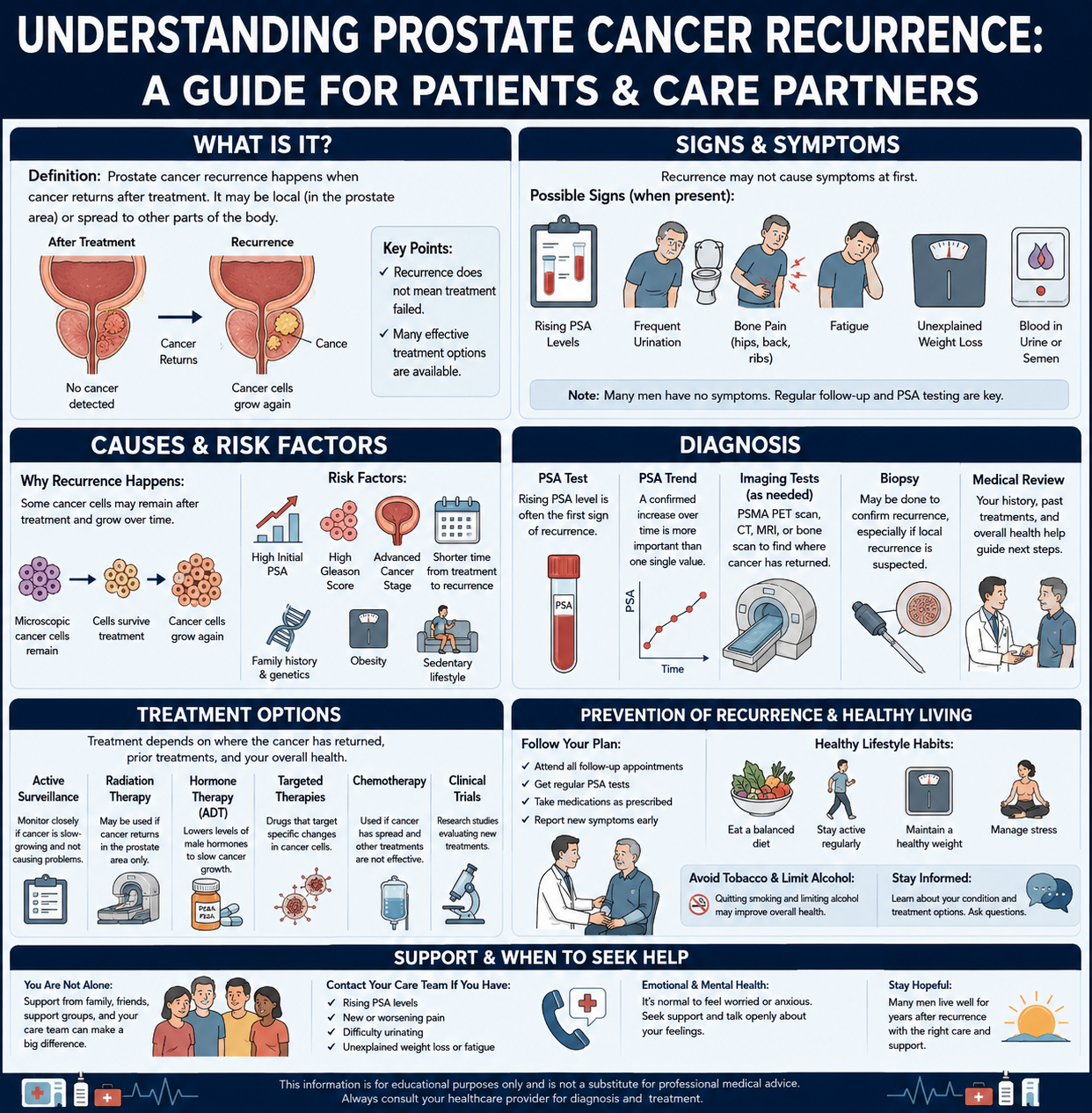
Prostate cancer recurrence means the cancer has returned after initial treatment. This happens when some cancer cells remain hidden in the body and begin to grow again. Recurrence often occurs within the first five years after treatments like surgery or radiation, but it can happen at any time. Studies show that 3 to 5 out of every 10 people treated for early-stage prostate cancer experience recurrence. The earliest sign is typically a rise in prostate-specific antigen (PSA) levels in the blood. If PSA rises without visible cancer on scans, it's called 'biochemical recurrence.' If scans show the cancer, it's 'radiographic recurrence.' Recurrence can be local (in the prostate area) or spread to other parts of the body. Treatments aim for a cure when localized, or to control growth and extend life if it has spread.
Understanding the Condition
Prostate Cancer Recurrence: What You Need to Know
Understanding the Condition
Common Symptoms
Early Recurrence (Often Asymptomatic): Prostate cancer recurrence often doesn't cause symptoms when it's found early, typically detected by a blood test (PSA test) before any physical signs appear.
Later Stage Recurrence Symptoms: If the cancer grows undetected, it can eventually cause symptoms such as:- Accidental leaking of urine- Blood in the urine- Extreme tiredness- Weakness in the arms or legs- Unexplained weight loss
Consultation Guide
Which Specialist to Meet
You should consult with your primary care doctor, a urologist (a doctor specializing in the urinary system and male reproductive organs), or an oncologist (a cancer specialist).
Preparations Before Your Visit
If you experience any new or worsening symptoms, make a detailed list including when they started, their frequency, and intensity. Be prepared to discuss your complete medical history, including previous prostate cancer treatments. Also, list any questions you have. If preparing for diagnostic tests, carefully follow all specific dietary or medication instructions provided by your healthcare team beforehand.
Book a doctor visit near me
Symptom Awareness: Be vigilant about any new or worsening symptoms. Promptly report any concerns to your doctor, as early detection of recurrence often provides more treatment options and better outcomes.
Consultation Guide
A healthcare professional will draw a small sample of blood, typically from a vein in your arm. The procedure is quick and usually causes minimal discomfort.
Diagnostic Procedures
PSA Test (Prostate-Specific Antigen)
A blood test that measures the level of prostate-specific antigen (PSA), a protein produced by prostate cells. A rising PSA level is often the first indicator of prostate cancer recurrence.
What to Expect
What to Expect
You will typically lie on your back or side. A doctor will use an ultrasound probe, often inserted into the rectum, to guide a thin needle to take several tissue samples from the prostate. This is usually performed with local anesthesia to minimize discomfort. You might feel some pressure or a brief, sharp sensation during the procedure.
This test examines your DNA to identify specific changes or mutations within cancer cells. These changes can provide insight into how aggressive the cancer might be or how it might respond to certain treatments, helping to personalize care.
What to Expect
A sample of your blood or tissue (e.g., from a prostate biopsy) will be collected and sent to a specialized laboratory for analysis. The process for collecting the sample is similar to a standard blood draw.
A nuclear imaging test that uses a small amount of a radioactive substance (tracer) to detect unusual activity in bones. It's used to identify if prostate cancer has spread to the skeletal system.
What to Expect
A small amount of radioactive tracer is injected into a vein, typically in your arm. You will then wait for a few hours for the tracer to be absorbed by your bones. After this waiting period, you will lie still on a table while a special camera scans your body to create images of your bones. The scan itself is painless.
CT Scan (Computed Tomography Scan)
A diagnostic imaging method that uses X-rays and computer processing to create detailed cross-sectional images (like 'slices') of internal body structures, including bones, blood vessels, and soft tissues. It helps locate cancer in various parts of the body.
What to Expect
You will lie on a motorized table that slides into a large, donut-shaped machine. The machine rotates around you, taking multiple X-ray images. You may be asked to hold your breath briefly. Sometimes, a contrast dye is given through an IV to make certain structures appear clearer on the images. The scan is typically painless and takes several minutes.
Choline C-11 PET Scan (Positron Emission Tomography Scan)
A specialized imaging test that uses a radioactive form of the vitamin choline as a tracer. Prostate cancer cells and other fast-growing cells tend to absorb more choline, making this scan useful for detecting recurrent prostate cancer, especially when other imaging tests are inconclusive. It's often combined with a CT or MRI scan for more precise localization.
What to Expect
A small amount of radioactive choline is injected into a vein. After a short waiting period (typically an hour) for the tracer to distribute throughout your body, you will lie on a table that moves into the PET scanner. The scanner detects the radiation emitted by the tracer. The procedure is painless, but you must remain very still during the imaging process.
PSMA PET Scan (Prostate-Specific Membrane Antigen PET Scan)
A highly sensitive PET scan that utilizes a radioactive tracer specifically designed to attach to prostate-specific membrane antigen (PSMA), a protein commonly found on the surface of prostate cancer cells. This test is very effective at locating prostate cancer cells anywhere in the body, particularly if the cancer has spread or returned after initial treatment.
What to Expect
Similar to other PET scans, a radioactive tracer that binds to PSMA is injected into a vein. After a waiting period (often 1-2 hours) for the tracer to circulate and accumulate in cancer cells, you will lie on a table that slides into the PET scanner. The scanner then creates detailed images showing the locations where the tracer has built up. The test is painless, but requires you to remain very still.
Hormone Therapy: This treatment lowers or blocks the production of testosterone, as most prostate cancer cells rely on this hormone to grow. By reducing testosterone, it can slow or stop the growth of cancer cells. (Duration: Can be administered continuously or intermittently (on and off) over months to several years, depending on the cancer's response and any side effects.)
Ongoing Medical Checkups: Maintain regular follow-up appointments with your healthcare team. This includes scheduled PSA blood tests and other necessary evaluations to monitor for any signs of recurrence and ensure early detection.
Treatment Options
Prostate cancer recurrence means the cancer has returned after initial treatment. This happens when some cancer cells remain hidden in the body and begin to grow again. Recurrence often occurs within the first five years after treatments like surgery or radiation, but it can happen at any time. Studies show that 3 to 5 out of every 10 people treated for early-stage prostate cancer experience recurrence. The earliest sign is typically a rise in prostate-specific antigen (PSA) levels in the blood. If PSA rises without visible cancer on scans, it's called 'biochemical recurrence.' If scans show the cancer, it's 'radiographic recurrence.' Recurrence can be local (in the prostate area) or spread to other parts of the body. Treatments aim for a cure when localized, or to control growth and extend life if it has spread.
A procedure to collect small tissue samples from the prostate gland. These samples are then examined under a microscope to confirm the presence of cancer, assess its characteristics, and help guide treatment decisions.
Surgical Procedures
Radical Prostatectomy: Surgical removal of the entire prostate gland and some surrounding tissue, which may include nearby lymph nodes. This is an option if recurrence is localized to the prostate area and surgery was not the initial treatment, or to remove remaining cancerous tissue. (Duration: A single surgical procedure, with recovery typically spanning several weeks to months.)
External Beam Radiation Therapy (EBRT): Uses high-energy beams (such as X-rays or protons) directed from a machine outside the body to target and destroy cancer cells in the prostate area or in other parts of the body where cancer has spread. (Duration: Typically administered in daily sessions over several weeks.)
Brachytherapy (Internal Radiation Therapy): Involves placing small radioactive sources (often called 'seeds') directly into the prostate gland. This delivers a high dose of radiation directly to the tumor, minimizing exposure to nearby healthy tissues. (Duration: Can involve permanent seed implants (radiation dissipates over a few months) or temporary placement for high-dose treatments over a few days or weeks.)
Stereotactic Body Radiotherapy (SBRT): A highly precise form of radiation therapy that uses advanced imaging to deliver very high doses of focused radiation to a specific tumor area in a smaller number of sessions, aiming to preserve healthy tissue. (Duration: Usually completed in 1 to 5 treatment sessions.)
Hormone Therapy (Androgen Deprivation Therapy - ADT)
Radiopharmaceuticals: Medicines containing small amounts of radioactive substances that specifically target and deliver radiation directly to cancer cells, particularly effective when prostate cancer has spread to the bones. (Duration: Treatment often involves several doses administered over weeks or months, as determined by your specialist.)
Prevention & Long-Term Wellbeing
Cryotherapy for Prostate Cancer: A procedure that freezes prostate tissue to destroy cancer cells. Thin metal probes are inserted through the skin and into the prostate to deliver freezing gas. (Duration: A single procedure, with recovery time varying based on the individual.)
Chemotherapy: Uses powerful drugs, given typically through an IV or orally, to kill fast-growing cancer cells throughout the body. It is often used when prostate cancer has spread or is no longer responding to hormone therapy. (Duration: Typically given in cycles over several months, with the exact duration depending on the specific drugs used and the cancer's response.)
Prevention & Lifestyle
Healthy Diet: Adopt a diet rich in fruits, vegetables, whole grains, legumes, and nuts. Include lean proteins like poultry and fish, low-fat dairy, and eggs. Limit red meat, processed foods, and foods with added sugar.
Regular Exercise: Aim for at least 150 minutes of moderate aerobic activity or 75 minutes of vigorous aerobic activity per week, along with strength training for all major muscle groups at least twice a week. Consult your doctor before starting any new exercise regimen, especially if you haven't been active regularly.
Long-Term Monitoring
Tags & Topics
Notice an error or need an update?
Help us keep medical information accurate. Report incorrect info or suggest an edit.


