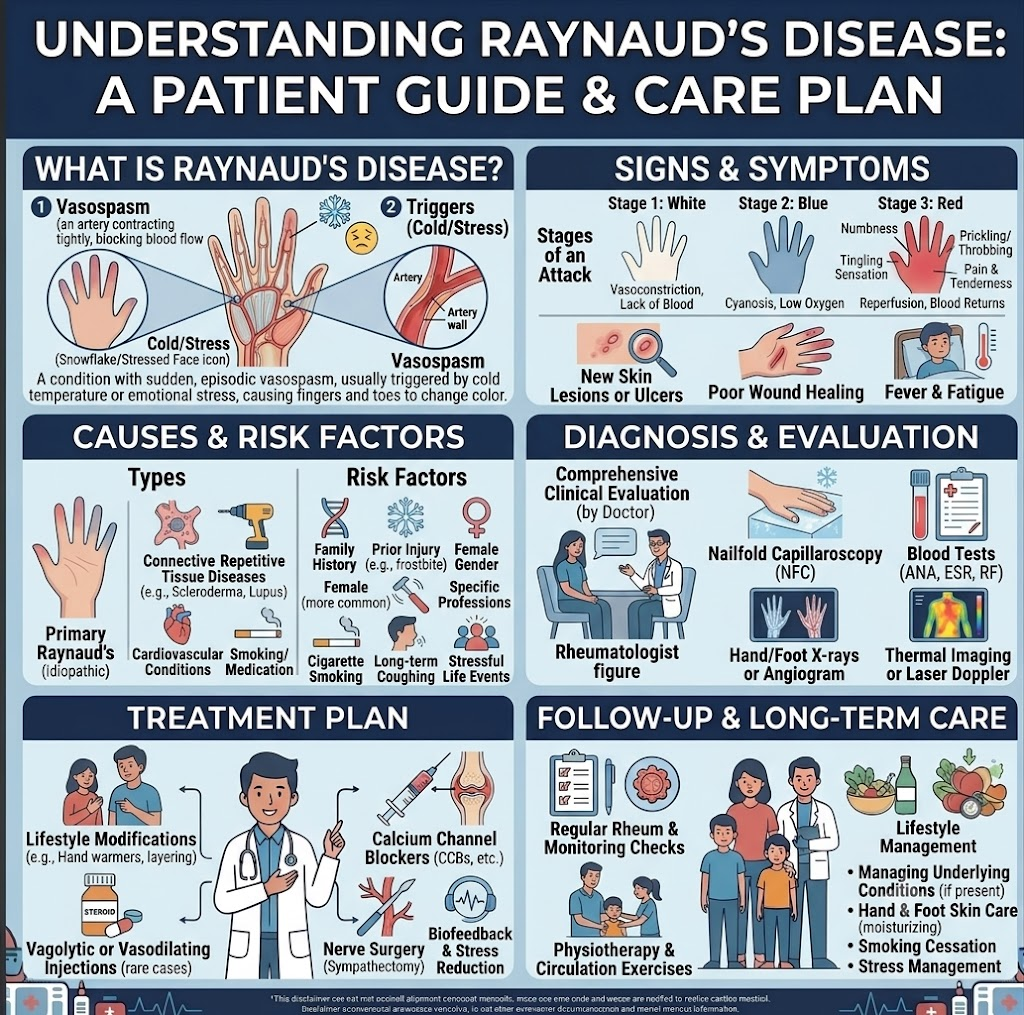
Raynaud's (pronounced ray-NOSE) disease is a common condition where certain parts of the body, most often the fingers and toes, become numb and cold in response to cold temperatures or stress. This happens because the small blood vessels supplying blood to the skin temporarily narrow, a process called vasospasm, limiting blood flow. While it typically affects fingers and toes, Raynaud's can also occur in areas like the nose, lips, ears, and even nipples. There are two main types: Primary Raynaud's (Raynaud's disease) is the most common and generally milder form, not linked to another health issue. Secondary Raynaud's (Raynaud's phenomenon) is less common but usually more serious, developing due to an underlying medical condition. Women are more frequently affected, and it tends to be more prevalent in colder climates. For most people, Raynaud's is not disabling but can significantly impact daily quality of life.
Understanding the Condition
Raynaud's Disease: Understanding and Managing Cold Sensitivity
Understanding the Condition
Common Symptoms
Cold Fingers or Toes: Affected areas feel distinctly cold to the touch, often much colder than the rest of the body.
Skin Color Changes: During an attack, skin typically turns white due to lack of blood flow, then often blue as oxygen depletes. As blood flow returns with warming, the area may turn red. These color changes can be more or less noticeable depending on your natural skin tone.
Numbness, Tingling, or Pain: A feeling of numbness or a prickly, 'pins and needles' sensation is common. Upon warming or as stress eases, stinging pain, throbbing, or tingling may occur as blood flow improves.
Swelling: Affected areas may swell slightly as blood circulation returns after an attack. The return of normal blood flow can take up to 15 minutes.
Consultation Guide
Which Specialist to Meet
Before your visit, make a detailed list of all your symptoms, including what triggers them, how long they last, and how severe they are. Note any other health conditions you have and all medications you are currently taking (prescription, over-the-counter, vitamins, and supplements). Be prepared to discuss your family's medical history. Compile a list of questions you have for your doctor.
Book a doctor visit near me
Your doctor will discuss your symptoms, medical history, and family history. They will also perform a physical examination.
Avoiding Triggers: Stop smoking, as nicotine constricts blood vessels. Discuss with your doctor if any of your current medications (e.g., some cold remedies, certain blood pressure medications, or migraine drugs) might be worsening your symptoms. Avoid vibrating tools or repetitive hand motions if they are known triggers for you. (Duration: Ongoing)
Regular Exercise: Engage in moderate physical activity to improve overall circulation. (Duration: Ongoing)
Blood Vessel Relaxers: Oral medications are prescribed to help widen small blood vessels, improving blood flow. These are often used for more persistent or severe symptoms. (Duration: As prescribed, often long-term)
Avoid Smoking: Nicotine constricts blood vessels, directly worsening Raynaud's symptoms.
Manage Emotional Stress: Identify and reduce sources of stress. Practice relaxation techniques regularly to prevent stress-induced attacks.
Stay Active: Regular, gentle movement like arm and hand circles can help promote better circulation to your extremities.
Regular Medical Check-ups: Maintain regular visits with your doctor, especially if you have secondary Raynaud's, to monitor the underlying condition and track your Raynaud's symptoms and their management.
Diligent Skin Care: Protect affected areas from injury. Inspect fingers and toes daily for any signs of sores, cuts, or infections, which require prompt medical attention due to reduced blood flow.
Medication Adherence: If medications are prescribed, take them consistently and exactly as directed by your doctor to manage symptoms and prevent complications.
Consultation Guide
Raynaud's (pronounced ray-NOSE) disease is a common condition where certain parts of the body, most often the fingers and toes, become numb and cold in response to cold temperatures or stress. This happens because the small blood vessels supplying blood to the skin temporarily narrow, a process called vasospasm, limiting blood flow. While it typically affects fingers and toes, Raynaud's can also occur in areas like the nose, lips, ears, and even nipples. There are two main types: Primary Raynaud's (Raynaud's disease) is the most common and generally milder form, not linked to another health issue. Secondary Raynaud's (Raynaud's phenomenon) is less common but usually more serious, developing due to an underlying medical condition. Women are more frequently affected, and it tends to be more prevalent in colder climates. For most people, Raynaud's is not disabling but can significantly impact daily quality of life.
You should start by consulting your primary care doctor. Depending on the suspected cause and severity, they may refer you to a rheumatologist (a specialist in autoimmune and inflammatory conditions, especially if secondary Raynaud's is suspected) or a vascular specialist (a doctor specializing in blood vessel diseases).
Preparations Before Your Visit
Diagnostic Procedures
What to Expect
This test involves examining the tiny blood vessels (capillaries) at the base of your fingernails. It helps your doctor distinguish between primary and secondary Raynaud's, as certain changes in these vessels are associated with underlying conditions like scleroderma.
What to Expect
The doctor will apply a drop of oil to the skin around your fingernails to make the capillaries clearer. They will then use a special magnifying tool, like a microscope or ophthalmoscope, to closely observe these vessels. This procedure is painless and usually takes only a few minutes.
If secondary Raynaud's is suspected, blood tests are performed to check for specific antibodies or inflammatory markers that could indicate an autoimmune disease (e.g., lupus, rheumatoid arthritis) or other conditions often linked to secondary Raynaud's.
What to Expect
A healthcare professional will draw a small sample of blood, typically from a vein in your arm. You might feel a brief pinch or pressure. The blood sample is then sent to a laboratory for analysis.
Cold Stimulation Test
This test measures how your fingers react to cold temperatures and how quickly they warm up. It helps confirm an exaggerated response to cold.
What to Expect
Your hands will be submerged in cold water for a short period. Afterwards, your finger temperatures will be monitored to see how long it takes for them to return to their normal warmth.
Treatment Options
Medications
Topical Treatments: Creams or ointments that can be applied directly to affected areas to improve blood flow. (Duration: As prescribed)
Procedures & Therapies
Nerve Block Injections: In severe cases, injections may be given to block the nerves that control the narrowing of blood vessels in the affected area, providing temporary relief. (Duration: Temporary relief, may require repeat injections)
Chemical Sympathectomy: A more lasting procedure where a chemical is injected to disable specific nerves responsible for blood vessel constriction. (Duration: Longer-lasting relief than a nerve block, but not always permanent)
Surgical Procedures
Sympathectomy: Rarely, surgery may be performed to cut or disable the nerves that signal blood vessels to constrict. This is typically reserved for very severe cases unresponsive to other treatments and where there's a risk of tissue damage. (Duration: Potentially long-term relief, but involves surgical risks)
Prevention & Long-Term Wellbeing
You will have a conversation with your doctor about your experiences with cold sensitivity, any other health issues, and your lifestyle. The doctor will likely examine your hands and feet to look for any visible signs or changes.
Nailfold Capillaroscopy
Home Remedies & Lifestyle Changes
Keeping Warm: Protect your extremities (hands, feet, ears, nose) with warm clothing, gloves, socks, and hats, even indoors. Use hand and foot warmers when exposed to cold. Warm your car before driving. Avoid cold air conditioning. (Duration: Ongoing)
Managing Stress: Since emotional stress can trigger attacks, practice relaxation techniques such as deep breathing, meditation, or yoga to reduce stress levels. (Duration: Ongoing)
Prevention
Dress in Layers: Always bundle up in cold weather. Wear a hat, scarf, warm socks, boots, and two sets of mittens or gloves. Consider thermal underwear. A coat with snug cuffs helps protect hands.
Protect Indoors: Wear socks or slippers at home. Use gloves, mittens, or oven mitts when handling frozen foods or reaching into a refrigerator. Some find wearing mittens and socks to bed helpful in winter.
Adjust Environment: Set air conditioning to a warmer temperature. Use insulated drinking glasses to prevent hands from feeling cold.
Tags & Topics
Notice an error or need an update?
Help us keep medical information accurate. Report incorrect info or suggest an edit.


