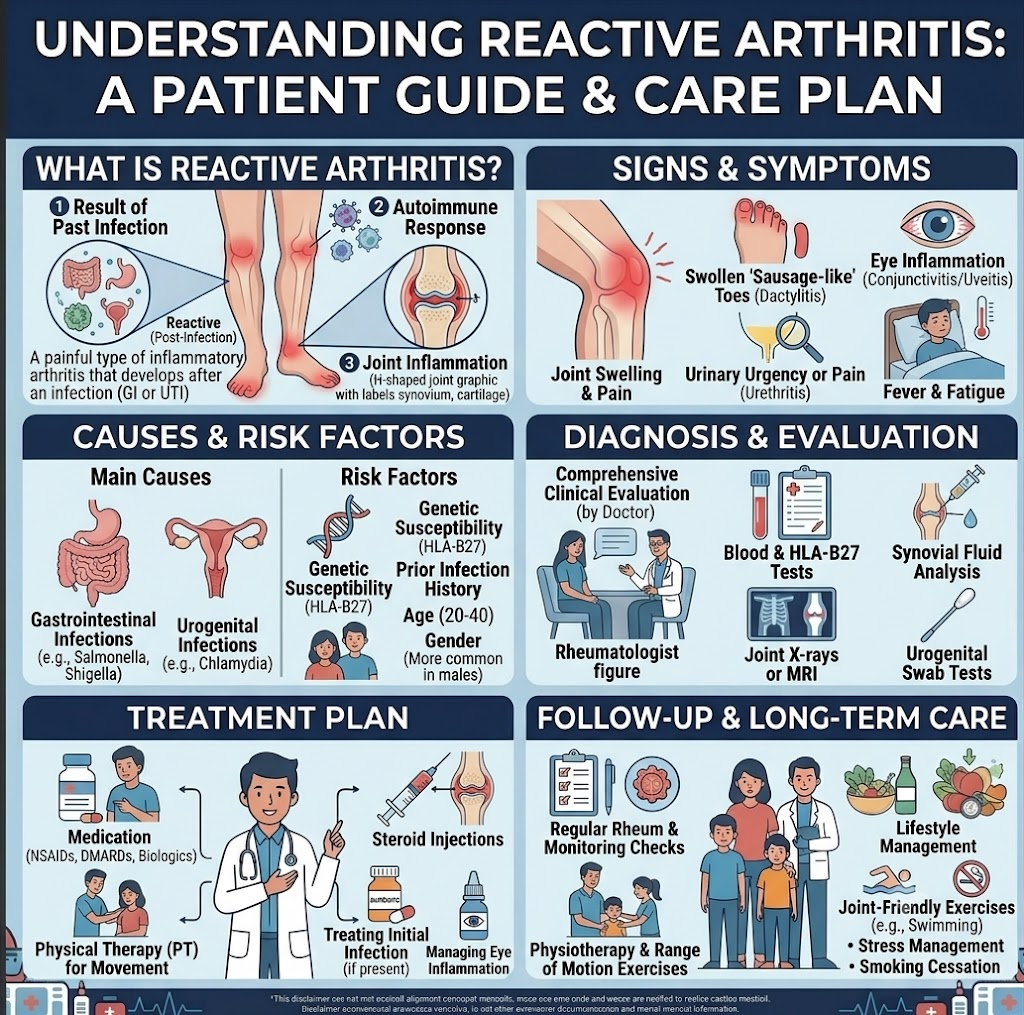
Reactive arthritis is a painful form of joint inflammatory disease that develops in response to an infection elsewhere in the body. The triggering infection most commonly begins in the digestive system, genitals, or urinary tract. Although the joint itself is not infected, the body's immune system overreacts to the initial infection, causing joint inflammation, swelling, and stiffness, particularly in the lower limbs. For most individuals, this condition is temporary and resolves within 12 months, though symptoms can flare up periodically during this time.
Understanding the Condition
Understanding Reactive Arthritis: Causes, Symptoms, and Recovery
Understanding the Condition
Reactive arthritis is a painful form of joint inflammatory disease that develops in response to an infection elsewhere in the body. The triggering infection most commonly begins in the digestive system, genitals, or urinary tract. Although the joint itself is not infected, the body's immune system overreacts to the initial infection, causing joint inflammation, swelling, and stiffness, particularly in the lower limbs. For most individuals, this condition is temporary and resolves within 12 months, though symptoms can flare up periodically during this time.
Common Symptoms
Joint Pain and Swelling: Pain, redness, and swelling most commonly affect the knees, ankles, and feet. This discomfort is often asymmetrical, meaning it may affect only one side of the body.
Eye Inflammation (Conjunctivitis): Patients may experience redness, irritation, watering, itching, or a burning sensation in one or both eyes.
Urinary Tract Problems: Inflammation of the urethra can lead to increased frequency of urination, an urgent need to urinate, and a burning sensation during urination.
Sausage-like Swelling of Digits (Dactylitis): In some cases, entire fingers or toes can swell severely, giving them a sausage-like appearance.
Lower Back and Spinal Stiffness: Inflammation can occur at the joints where the spine connects to the pelvis, leading to persistent lower back pain and stiffness, especially in the morning.
Skin and Mouth Lesions: Minor, painless mouth ulcers or scaly rashes can develop, particularly on the palms of the hands or the soles of the feet.
Consultation Guide
Which Specialist to Meet
You will primary meet with a Rheumatologist, a medical specialist who diagnoses and treats autoimmune and musculoskeletal diseases. Depending on your symptoms, you may also see a Gastroenterologist (digestive system specialist), a Urologist (urinary tract specialist), or an Ophthalmologist (eye health specialist).
Preparations Before Your Visit
Before your visit, write down all symptoms you are experiencing, even if they seem unrelated. Create a timeline of any recent illnesses, stomach bugs, diarrhea, or genital infections within the last four weeks. List all medications, supplements, and vitamins you currently take, and note any family history of autoimmune or joint diseases.
Book a doctor visit near me
Disease-Modifying Antirheumatic Drugs: These prescription medications help suppress the overactive immune system, preventing chronic joint damage and easing persistent symptoms. (Duration: Prescribed for several months to over a year for individuals with severe, long-lasting symptoms.)
Targeted Antibiotics: Antibiotics do not cure joint inflammation itself, but they are prescribed to eliminate any active, ongoing bacterial infection that triggered the reactive arthritis. (Duration: Typically a 1-to-2-week course, depending on the specific bacterial infection detected.)
Therapies and Home Remedies
Physical Therapy: A customized physical therapy program focuses on targeted stretching and strengthening exercises to maintain joint flexibility, build surrounding muscle support, and ease stiffness. (Duration: Often recommended for 4 to 12 weeks of guided professional sessions, transitioning into a lifelong home exercise routine.)
Ice and Heat Application: Applying cold packs to swollen joints helps numb sharp pain and reduce active inflammation, while warm compresses or baths can relax stiff muscles around the joint. (Duration: Used at home for 15 to 20 minutes at a time as needed throughout the duration of joint symptoms.)
Monitor and Track Flare-Ups: Keep a symptom diary detailing daily pain levels, stiffness duration, and physical activities to help your healthcare team identify triggers and optimize your ongoing treatment plan.
Consultation Guide
This procedure extracts a small sample of fluid from an inflamed joint to rule out other potential causes of arthritis, such as gout or a direct bacterial infection within the joint.
You will be asked to provide a clean-catch urine sample in a sterile cup. For swabs, a healthcare provider will gently use a soft cotton-tipped applicator to collect a cell sample from your throat, urethra, or cervix. Swabbing may cause momentary discomfort but is over in seconds.
Practice Safe Sex: Use barrier protection, such as condoms, consistently and correctly to prevent sexually transmitted infections, which are a leading cause of reactive arthritis.
Engage in Low-Impact Exercise: Incorporate joint-friendly physical activities like swimming, water aerobics, or stationary cycling into your routine to keep joints lubricated and mobile without excessive impact.
Implement Joint Protection Strategies: Maintain a healthy body weight to reduce structural stress on your knees, ankles, and feet. Use ergonomic tools and maintain good posture to minimize strain on your back and joints.
Diagnostic Procedures
These laboratory tests check for markers of systemic inflammation, detect antibodies indicating a recent infection, and screen for the HLA-B27 gene, which is commonly linked to reactive arthritis.
What to Expect
A clinical practitioner will clean a site on your arm, wrap an elastic band around your upper arm to locate a vein, and insert a small needle to draw a vial of blood. You may feel a brief pinch or sting. The procedure takes less than five minutes.
Arthrocentesis (Joint Fluid Analysis)
What to Expect
The medical professional will sterilize and numb the skin over your joint using a local anesthetic. They will then insert a needle into the joint space to withdraw fluid. You may feel a sensation of pressure or mild pinching during the fluid extraction.
Imaging Studies (X-Rays or MRI)
X-rays help rule out other forms of arthritis and look for signs of joint damage or bone changes. An MRI may be used to detect early joint inflammation or soft tissue changes in greater detail.
What to Expect
For an X-ray, you will be asked to hold still in specific positions while the machine takes images. It is completely painless and takes only a few minutes. For an MRI, you will lie flat on a motorized table that slides into a large, tunnel-like machine. The procedure is painless but noisy, and you will be provided with earplugs or headphones. It typically takes 15 to 45 minutes.
Infection Swabs and Urine Tests
These tests screen for active bacterial infections in the urethra, cervix, or throat, identifying the original bacterial trigger.
What to Expect
Practice Safe Food Handling: Prevent gastrointestinal infections by cooking meat and poultry to recommended internal temperatures, thoroughly washing raw produce, keeping raw foods separate from cooked foods, and avoiding unpasteurized dairy.
Treatment Options
Medications
Nonsteroidal Anti-inflammatory Drugs: These medications reduce joint inflammation, pain, and swelling during active flares. (Duration: Taken daily or as needed during the acute phase of the disease, typically lasting a few weeks to several months.)
Corticosteroids: Powerful anti-inflammatory medications that can be injected directly into severe, swollen joints or taken orally to suppress widespread inflammation quickly. (Duration: Typically restricted to short-term use, spanning from a single injection to a few weeks of oral therapy, to minimize systemic side effects.)
Tags & Topics
Notice an error or need an update?
Help us keep medical information accurate. Report incorrect info or suggest an edit.


