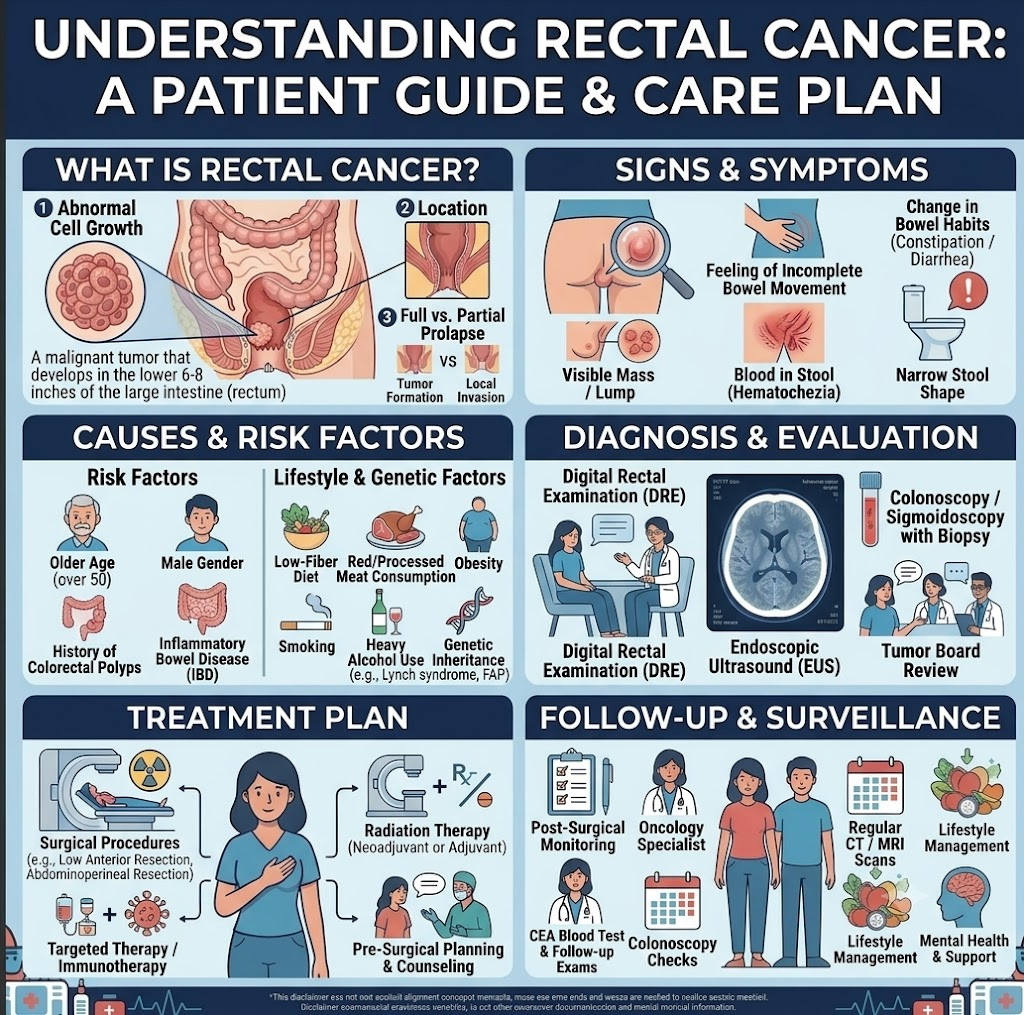
Rectal cancer is a type of cancer that begins as a growth of cells in the rectum, which is the final section of the large intestine, connecting to the anus. While often grouped with colon cancer as 'colorectal cancer,' the rectum's location in a confined space near other organs makes its treatment distinct and often more complex. Treatment typically involves surgery to remove the cancer, combined with other approaches like chemotherapy, radiation, targeted therapy, or immunotherapy.
Understanding the Condition
Common Symptoms
Change in Bowel Habits: This can mean new or worsening diarrhea, constipation, or needing to pass stool more often.
Incomplete Bowel Emptying: A persistent feeling that your bowel hasn't fully emptied after a bowel movement.
Abdominal Pain: Discomfort or cramping in the belly area.
Rectal Bleeding: Blood that may appear bright red, dark maroon, or mixed with stool, making it look dark.
Narrow Stools: Stools that are thinner than usual.
Unexplained Weight Loss: Losing weight without actively trying.
Weakness or Fatigue: Feeling unusually tired or lacking energy.
Lump in the Rectum: This might be detected during a physical examination by a doctor.
Consultation Guide
Which Specialist to Meet
If you experience any concerning symptoms, it's important to consult with a healthcare professional promptly. Start with your primary care doctor. They may refer you to a gastroenterologist (a specialist in digestive diseases), a colorectal surgeon, an oncologist (a cancer specialist), or a radiation oncologist.
Preparations Before Your Visit
Before your visit, write down all your symptoms, including when they started and how often they occur. List all medications, vitamins, and supplements you currently take. Note your personal and family medical history, especially any history of cancer or polyps. Prepare a list of questions you want to ask your doctor.
Book a doctor visit near me
Palliative Care: Focuses on relieving symptoms and improving quality of life throughout the illness. (Duration: Ongoing, as needed.)
Consultation Guide
Quick, may cause brief pressure.
Regular Colorectal Cancer Screening: Regular screenings, such as colonoscopy or flexible sigmoidoscopy, are vital for finding and removing precancerous growths (polyps) before they turn into cancer. Discuss with your doctor when to begin, often recommended around age 45 or earlier if you have risk factors.
Diagnostic Procedures
Rectal Cancer: Understanding, Diagnosis, and Management
Understanding the Condition
Rectal cancer is a type of cancer that begins as a growth of cells in the rectum, which is the final section of the large intestine, connecting to the anus. While often grouped with colon cancer as 'colorectal cancer,' the rectum's location in a confined space near other organs makes its treatment distinct and often more complex. Treatment typically involves surgery to remove the cancer, combined with other approaches like chemotherapy, radiation, targeted therapy, or immunotherapy.
Physical Exam (including Digital Rectal Exam)
A doctor manually checks for lumps or abnormalities in the rectum.
What to Expect
Blood Tests (Complete Blood Count - CBC and CEA test)
Measures blood cells (CBC for general health/anemia) and a tumor marker (CEA, for monitoring).
What to Expect
A standard blood draw from your arm.
Flexible Sigmoidoscopy
Views the rectum and lower colon with a flexible tube and camera.
What to Expect
Bowel prep (enemas). A tube inserted into the rectum. Mild cramping possible.
Views the entire large intestine with a flexible tube and camera; allows polyp/biopsy removal.
What to Expect
Strict bowel prep, usually sedation. A tube inserted into the rectum.
Removal of a tissue sample for microscopic examination to confirm cancer.
What to Expect
Performed during a sigmoidoscopy or colonoscopy, often unfelt with sedation.
CT Scan (Computed Tomography)
Uses X-rays for detailed cross-sectional images to show tumor size and spread.
What to Expect
Lie on a table, possibly with contrast dye injection; must stay still.
MRI (Magnetic Resonance Imaging)
Uses magnets and radio waves for detailed soft tissue images, crucial for local tumor assessment.
What to Expect
Lie in a noisy tube-shaped machine; must stay very still.
PET Scan (Positron Emission Tomography)
Uses a tracer to detect areas of high metabolic activity, indicating potential cancer spread.
What to Expect
Tracer injection, then lie on a table in the scanner.
Ileoanal Anastomosis (J-Pouch) Surgery: Removes colon and rectum, creating an internal pouch from small intestine connected to the anus. (Duration: Often 2-3 stages over several months.)
Treatment Options
Surgical Procedures
Cytoreductive Surgery (CRS): Extensive surgery to remove visible cancer spread within the abdomen. (Duration: Lengthy hospital stay, prolonged recovery (weeks-months).)
Medications
Chemotherapy: Drugs that kill fast-growing cancer cells, given before or after surgery. (Duration: Cycles over several months (e.g., 3-6 months).)
Targeted Therapy: Drugs that block specific pathways essential for cancer growth. (Duration: Ongoing, as long as effective.)
Immunotherapy: Boosts the body's immune system to fight cancer. (Duration: Ongoing, potentially months to years.)
Therapies
Radiation Therapy: Uses high-energy beams (external or internal) to destroy cancer cells. (Duration: Daily sessions over several weeks (e.g., 5-6 weeks).)
Hyperthermic Intraperitoneal Chemotherapy (HIPEC): Heated chemotherapy applied directly to the abdominal cavity after CRS. (Duration: Single session, 1-2 hours, performed during surgery.)
Regular Follow-ups: After treatment, ongoing medical check-ups and imaging are essential to monitor for recurrence or new cancers.
Palliative Care Integration: Palliative care can continue post-treatment, offering support for managing side effects, pain, and improving overall quality of life.
Support Groups: Connecting with others who have experienced rectal cancer can provide emotional support and practical advice.
Prevention & Long-Term Wellbeing
Local Excision: Removes small, early-stage tumors through the anus, preserving the rectum. (Duration: Quick recovery, typically a few days to a week.)
Low Anterior Resection (LAR): Removes the cancerous part of the rectum, reconnecting the colon to the anus. Often minimally invasive. (Duration: Hospital stay 5-10 days; full recovery weeks to months.)
Abdominoperineal Resection (APR): For very low tumors, removes the rectum, anus, and surrounding tissue, requiring a permanent colostomy. (Duration: Hospital stay 7-14 days; full recovery several months.)
Colostomy or Ileostomy: Creates an opening in the abdomen (stoma) to divert stool into an external pouch. (Duration: Temporary (weeks-months) or permanent (lifelong).)
Prevention
Maintain a Healthy Diet: Focus on a diet rich in fruits, vegetables, and whole grains. Limit red meat, processed meats, and highly processed foods.
Engage in Regular Physical Activity: Aim for at least 30 minutes of moderate-intensity exercise on most days of the week. Even small amounts of activity contribute to better health.
Achieve and Maintain a Healthy Weight: Work with a healthcare professional to achieve or maintain a healthy body weight. Excess weight is linked to an increased risk of colorectal cancer.
Limit Alcohol Consumption: If you choose to drink alcohol, do so in moderation: up to one drink per day for women and up to two drinks per day for men.
Quit Smoking: Smoking increases the risk of many cancers, including rectal cancer. Seek support from your healthcare team for strategies and aids to help you quit.
Long-Term Monitoring and Support
Tags & Topics
Notice an error or need an update?
Help us keep medical information accurate. Report incorrect info or suggest an edit.


