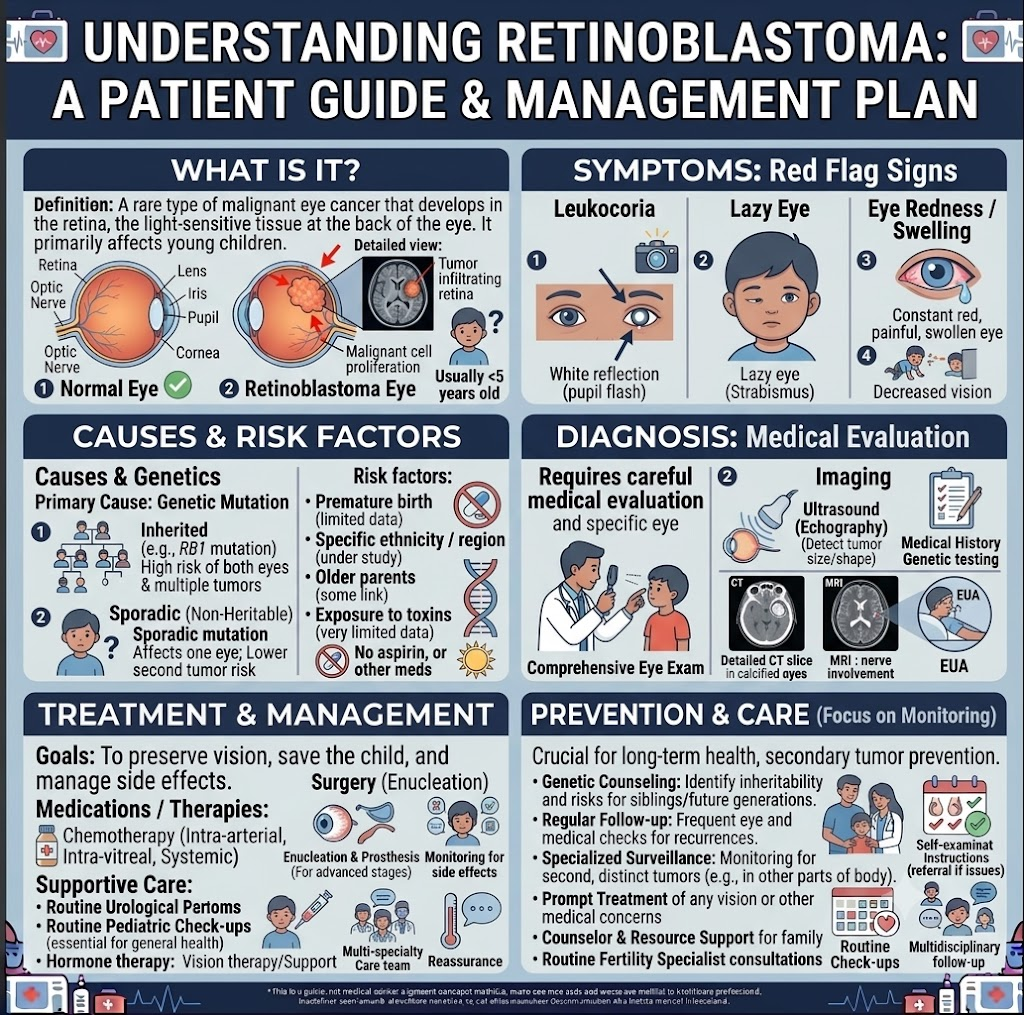
Retinoblastoma is an eye cancer beginning in the retina, the light-sensing lining at the back of the eye that sends visual signals to the brain. It typically affects young children, often before age two, usually in one eye but sometimes both. The cancer results from DNA changes in eye cells, causing uncontrolled growth. While the exact cause isn't always known, the outlook is generally very good, and most treatments avoid eye removal.
Understanding the Condition
Retinoblastoma: Understanding a Childhood Eye Cancer
Understanding the Condition
Common Symptoms
White Pupil (Leukocoria): A white or 'cat's eye' reflection in the center of the eye, especially noticeable in flash photographs or when a light is shone into the eye.
Consultation Guide
Retinoblastoma is an eye cancer beginning in the retina, the light-sensing lining at the back of the eye that sends visual signals to the brain. It typically affects young children, often before age two, usually in one eye but sometimes both. The cancer results from DNA changes in eye cells, causing uncontrolled growth. While the exact cause isn't always known, the outlook is generally very good, and most treatments avoid eye removal.
Eye Redness: Persistent redness of the eye without clear cause.
Eye Swelling: Noticeable swelling around the eye.
Crossed Eyes (Strabismus): Eyes that appear to be looking in different directions.
Vision Loss: Difficulty seeing, which can be hard to detect in very young children but may be suspected if a child struggles to track objects.
Consultation Guide
Which Specialist to Meet
You should consult a pediatrician first for any concerns. They may then refer you to an ophthalmologist (an eye specialist), a pediatric oncologist (a cancer specialist for children), or a genetic counselor if there's a family history.
Preparations Before Your Visit
Before your visit, make note of any changes you've observed in your child's eyes, including when they started and how often they occur. Gather any relevant family medical history, especially regarding eye conditions or cancers.
Book a doctor visit near me
Diagnostic Procedures
This imaging test uses high-frequency sound waves to create pictures of structures inside the eye and surrounding tissues. It's a safe, low-power procedure with no known risks.
What to Expect
A healthcare professional applies gel to the eyelid or surrounding area, then gently moves a small handheld device (transducer) over it. The transducer sends sound waves to create images on a monitor. The procedure is quick and painless. Sedation might be used for very young children to ensure clear images. No special preparation is typically needed.
CT Scan (Computed Tomography Scan)
A CT scan uses specialized X-ray equipment and a computer to create detailed cross-sectional images of bones, blood vessels, and soft tissues. These images offer more detail than standard X-rays, crucial for evaluating tumor size and potential spread.
What to Expect
Your child will lie on a narrow table that slides into a large scanning machine. The machine rotates, taking multiple X-ray images. Remaining still is essential, often requiring sedation for infants and young children. The scan is painless. No specific fasting is required for an eye CT, but follow provided instructions.
Eye Exam under Anesthesia
For young children, a comprehensive eye exam to diagnose retinoblastoma often requires general anesthesia. This allows the ophthalmologist to thoroughly examine the retina using specialized instruments for precise tumor mapping.
What to Expect
Genetic Counseling and Testing: If retinoblastoma runs in your family, genetic counseling and testing can identify specific DNA changes increasing risk. This informs family planning and guides early screening for at-risk children.
Treatment Options
Your child will receive medication to sleep comfortably. An anesthesiologist will monitor vital signs. The ophthalmologist will use light and magnifying lenses to inspect the eye's interior, assessing tumors, the optic nerve, and surrounding structures. The procedure is brief, followed by recovery. Fasting before anesthesia is required; specific instructions will be provided.
Surgical Procedures
Eye Removal (Enucleation): For large, advanced tumors or when vision is already lost, surgical removal of the affected eye may be necessary to prevent cancer spread. An artificial eye is later fitted. (Duration: A single surgery, with healing and prosthetic fitting over several weeks to months.)
Therapies
External Beam Radiation Therapy: High-energy beams precisely target cancer cells in the eye from outside the body, damaging their genetic material to stop growth while minimizing harm to healthy tissues. (Duration: Typically administered over several weeks, with short daily sessions on weekdays.)
Brachytherapy (Internal Radiation): A small, radioactive implant is placed directly on or near the tumor. This delivers a high dose of radiation precisely to the cancer, sparing nearby healthy tissue. (Duration: The implant may remain for days to a few months, with radiation dissipating over time.)
Medications
Chemotherapy: Powerful drugs are used to kill fast-growing cancer cells throughout the body. Chemotherapy can shrink tumors, enhance other treatments, or destroy any cancer cells that may have spread. (Duration: Varies based on drugs, cancer stage, and response, often involving cycles over several months to a year.)
Regular Follow-up Eye Exams: Post-treatment, frequent eye exams are vital to monitor for cancer recurrence or new tumors, especially during the first few years. The schedule is customized to the child's treatment plan.
Monitoring for Other Cancers (Inherited Forms): Children with inherited retinoblastoma face an increased lifetime risk of other cancers, including bone, bladder, breast, Hodgkin lymphoma, lung, pineoblastoma, and soft tissue sarcoma. Ongoing vigilance and screening are important.
Prevention & Long-Term Wellbeing
Prevention
Tags & Topics
Notice an error or need an update?
Help us keep medical information accurate. Report incorrect info or suggest an edit.


