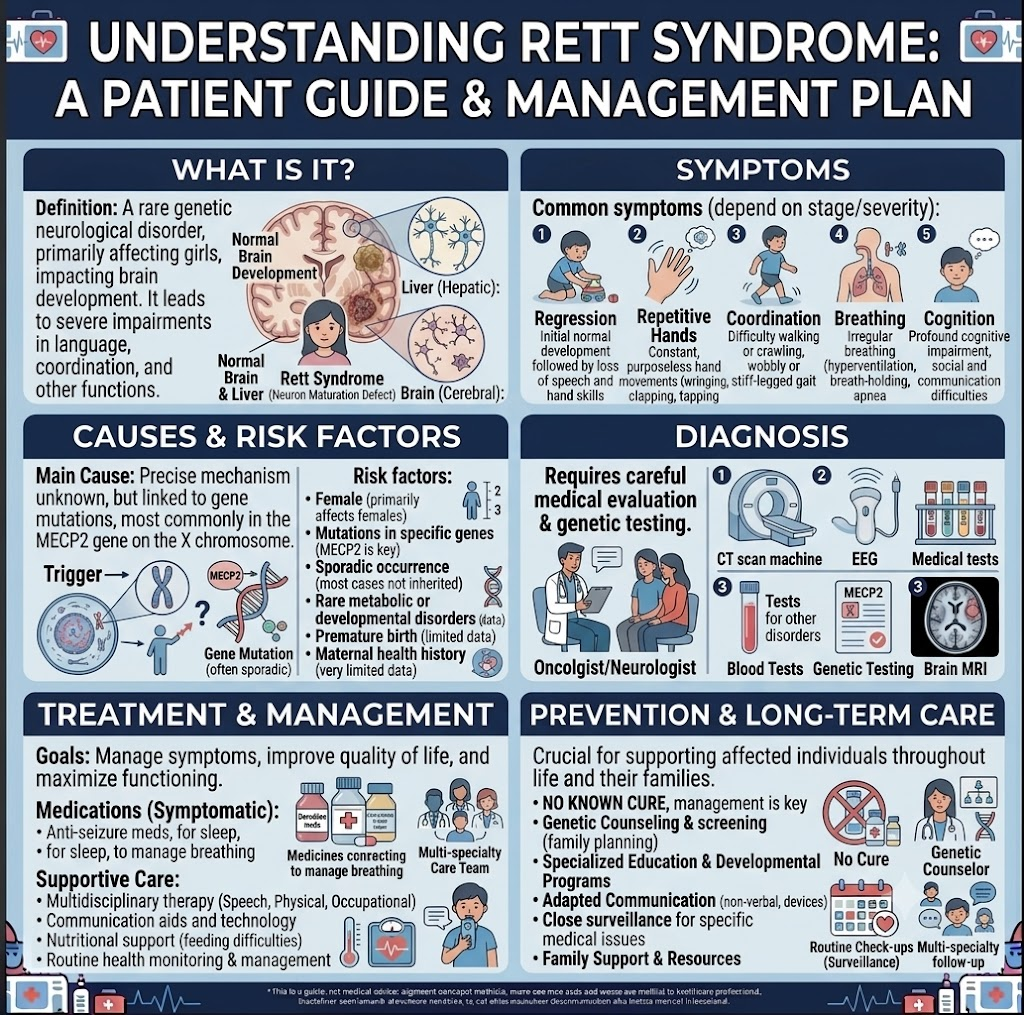
Rett syndrome is a rare, severe genetic brain disorder that primarily affects girls. It disrupts normal brain development, leading to a progressive loss of motor skills, language, and purposeful hand use. Most babies develop typically for the first six months before showing signs of regression, losing skills they once had. Over time, children experience increasing difficulties with movement, coordination, communication, and may develop seizures and intellectual disabilities. Although there's no cure, treatment focuses on managing symptoms and improving quality of life.
Understanding the Condition
Rett Syndrome: A Guide for Non-Medical Persons
Understanding the Condition
Rett syndrome is a rare, severe genetic brain disorder that primarily affects girls. It disrupts normal brain development, leading to a progressive loss of motor skills, language, and purposeful hand use. Most babies develop typically for the first six months before showing signs of regression, losing skills they once had. Over time, children experience increasing difficulties with movement, coordination, communication, and may develop seizures and intellectual disabilities. Although there's no cure, treatment focuses on managing symptoms and improving quality of life.
Common Symptoms
Early Development Regression: After 6-18 months of seemingly normal development, a child may lose skills like crawling, walking, talking, or using their hands. This regression can happen quickly over weeks or months.
Unusual Hand Movements: Purposeful hand use is replaced by repetitive movements such as hand-wringing, squeezing, clapping, tapping, or putting hands to the mouth. These are often the most noticeable signs.
Movement and Coordination Difficulties: Challenges with balance and coordination can lead to an unsteady, wide-based, or stiff walk. Muscle stiffness or floppiness may also occur.
Communication Problems: Children often lose the ability to speak, have difficulty with eye contact, and struggle with social interaction. They may become less responsive to others.
Seizures: Epileptic seizures are common and can range from subtle staring spells to more severe convulsions.
Breathing Irregularities: Periods of rapid breathing (hyperventilation), holding breath, or gasping may occur while awake, but typically not during sleep.
Sleep Disturbances: Irregular sleep patterns, including difficulty falling or staying asleep, are common.
Digestive Issues: Constipation and gastroesophageal reflux disease (GERD) are frequently observed.
Growth Delays: Growth of the head, feet, and hands may slow down, leading to smaller-than-average size.
Scoliosis: Curvature of the spine (scoliosis) is common and can worsen with age.
Intellectual Disability: Most individuals with Rett syndrome experience varying degrees of intellectual disability.
Consultation Guide
Which Specialist to Meet
If you notice developmental delays or a loss of skills in your child, particularly after an initial period of typical development, consult a pediatrician. They may refer you to specialists such as a neurologist (brain and nervous system), geneticist (inherited conditions), developmental pediatrician (child development), physical therapist, occupational therapist, or speech-language pathologist.
Preparations Before Your Visit
Before your visit, gather your child's medical records, a detailed list of their symptoms and when they started, any changes in behavior or physical abilities, and a list of questions you have for the doctor. Observing and noting your child's daily routines and challenges can also be helpful.
Book a doctor visit near me
Regular Medical Check-ups: Frequent visits with various specialists (neurologist, cardiologist, orthopedist, gastroenterologist) to monitor health, manage symptoms, and prevent complications.
Adaptive Equipment: Use of wheelchairs, walkers, communication devices, and other assistive technologies to support mobility, communication, and independence.
Consultation Guide
Genetic testing examines your DNA, the chemical blueprint for your body, to identify specific changes (mutations) in genes that may cause conditions like Rett syndrome. It plays a vital role in confirming a diagnosis.
Diagnostic Procedures
What to Expect
A small sample of your child's blood is typically collected, similar to a routine blood test. This sample is then sent to a lab for analysis. Sometimes, a cheek swab may be used instead. The process itself has minimal physical risk, and results are usually available in a few weeks, interpreted by a genetic counselor.
EEG (Electroencephalogram)
An EEG is a test that measures and records the electrical activity of the brain. Brain cells communicate using electrical impulses, which an EEG captures as wavy lines. This test is crucial for detecting seizures or unusual brain activity often associated with neurological disorders.
What to Expect
Small metal discs, called electrodes, will be painlessly attached to your child's scalp with a sticky paste. Your child will need to relax, and may be asked to close their eyes, breathe deeply, or look at flashing lights. Sometimes, the test is done while sleeping. The recording typically takes 30 to 60 minutes, but can be longer if continuous monitoring is needed. It's a non-invasive procedure.
CT Scan (Computed Tomography Scan)
A CT scan is an advanced imaging test that uses X-rays and computer technology to create detailed cross-sectional pictures, or 'slices,' of the body's bones, blood vessels, and soft tissues. These images offer more detail than standard X-rays and can help assess brain structure.
What to Expect
Your child will lie on a motorized table that slides into a large, donut-shaped machine. The machine will rotate around the body as it takes images. Your child will need to stay still during the scan, which may take several minutes. For some scans, a special dye (contrast material) might be given orally or through an IV to make certain areas clearer. The procedure is generally quick and painless.
A urinalysis is a common test that examines a urine sample to detect and manage a wide range of conditions, including urinary tract infections, kidney issues, or metabolic problems that could influence overall health.
What to Expect
Your child will be asked to provide a urine sample. For infants and young children, a collection bag might be used, or a catheter may be necessary. The sample is then analyzed in a lab, where technicians check its appearance, concentration, and content (such as protein, sugar, or blood cells). The process of providing the sample is quick and usually involves no discomfort beyond the need to urinate.
Digestive Medications: For managing constipation, acid reflux, or other gastrointestinal issues. (Duration: As needed, long-term)
Treatment Options
Therapies
Physical Therapy: Helps improve movement, balance, flexibility, and maintain mobility. Includes exercises to prevent scoliosis and muscle stiffness. (Duration: Ongoing throughout life)
Occupational Therapy: Aids in developing or regaining skills for daily living, such as feeding, dressing, and purposeful hand use, often through adaptive strategies. (Duration: Ongoing throughout life)
Speech and Language Therapy: Focuses on developing non-verbal communication skills, such as using eye-tracking devices, picture boards, or gestures, to help express needs and interact. (Duration: Ongoing throughout life)
Music Therapy and Hydrotherapy: Can help improve social skills, relaxation, motor coordination, and mood through engaging activities. (Duration: Regular sessions, as needed)
Medications
Anti-seizure Medications: Used to manage and reduce the frequency and severity of seizures. (Duration: Long-term, as prescribed)
Sleep Aids: Medications to help improve sleep patterns and address insomnia. (Duration: Short-term or intermittent, as prescribed)
Bracing and Surgery: Braces may be used to help with scoliosis or foot problems. In some cases, surgery may be necessary to correct severe scoliosis or other orthopedic issues. (Duration: As needed, potentially a one-time procedure with ongoing follow-up)
Prevention & Long-Term Wellbeing
Dietary Management: A high-calorie, nutritious diet, often including supplements, to ensure adequate weight gain and growth. (Duration: Ongoing throughout life)
Feeding Assistance: May involve strategies for slower eating, specialized utensils, or in severe cases, a feeding tube inserted into the stomach (gastrostomy) to ensure proper nutrition. (Duration: As needed, potentially long-term)
Orthopedic Management
Long-Term Monitoring & Care
Nutritional Monitoring: Ongoing assessment of dietary intake and growth to ensure proper nutrition and prevent complications like bone thinning.
Bone Health Management: Monitoring for osteoporosis and implementing strategies like calcium and vitamin D supplementation, and weight-bearing exercises to maintain bone density.
Family Support and Education: Connecting with support groups and educational resources for families facing Rett syndrome helps cope with challenges and access valuable information and community.
Respite Care: Providing temporary relief for primary caregivers to manage stress and prevent burnout.
Tags & Topics
Notice an error or need an update?
Help us keep medical information accurate. Report incorrect info or suggest an edit.


