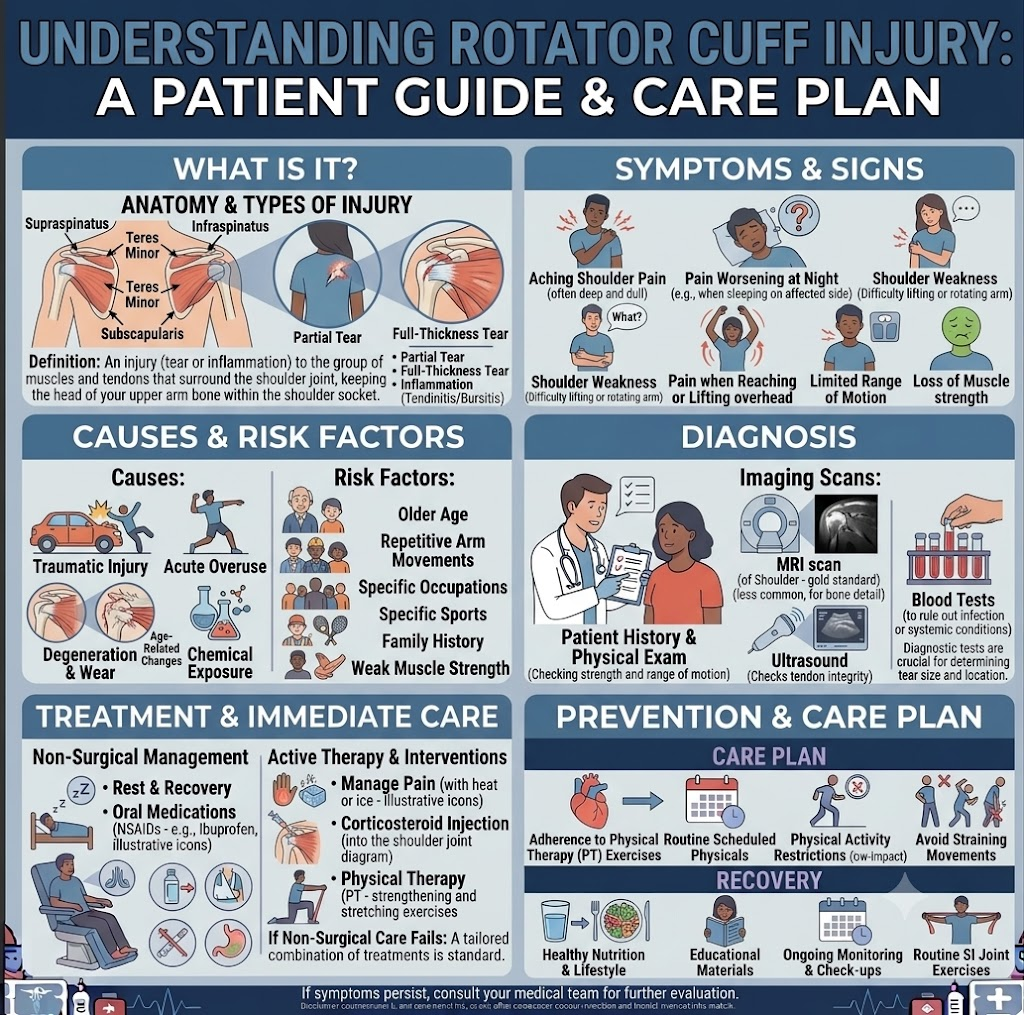
The rotator cuff is a crucial group of muscles and tendons surrounding your shoulder joint. They act like a strong anchor, keeping the upper arm bone securely in its shallow shoulder socket and enabling a wide range of arm movements. A rotator cuff injury, which can range from inflammation to a tear, often causes a persistent, dull ache in the shoulder that can worsen, especially at night. These injuries are common, particularly as people get older, or in individuals whose jobs or sports involve repeated overhead arm motions, such as painters, carpenters, or baseball players. If left untreated, a rotator cuff injury can lead to ongoing pain, permanent loss of shoulder movement, or significant weakness.
Understanding the Condition
Rotator Cuff Injury: Understanding Your Shoulder Pain
Understanding the Condition
Common Symptoms
Dull, Deep Shoulder Ache: Pain is typically felt as a persistent, dull ache deep within the shoulder.
Disturbed Sleep: The shoulder pain often intensifies at night, making it difficult to sleep, especially when lying on the affected side.
Difficulty with Arm Movements: It may become hard to perform everyday tasks like combing your hair, reaching behind your back, or lifting objects.
Arm Weakness: You might experience noticeable weakness in the affected arm, making it challenging to lift or rotate it.
Before your visit, make a list of your symptoms, including when they started, what makes them better or worse, and how they affect your daily life. Be prepared to discuss your medical history, any previous injuries, and medications you are currently taking. Write down any questions you have for your doctor to ensure all your concerns are addressed.
Book a doctor visit near me
Pain Relievers: Over-the-counter pain medications can help manage pain and reduce inflammation. (Duration: Short-term use, as directed by your doctor, to manage symptoms.)
Consultation Guide
The rotator cuff is a crucial group of muscles and tendons surrounding your shoulder joint. They act like a strong anchor, keeping the upper arm bone securely in its shallow shoulder socket and enabling a wide range of arm movements. A rotator cuff injury, which can range from inflammation to a tear, often causes a persistent, dull ache in the shoulder that can worsen, especially at night. These injuries are common, particularly as people get older, or in individuals whose jobs or sports involve repeated overhead arm motions, such as painters, carpenters, or baseball players. If left untreated, a rotator cuff injury can lead to ongoing pain, permanent loss of shoulder movement, or significant weakness.
Silent Injuries: Some rotator cuff injuries, particularly tears, may not cause immediate pain, becoming evident only through weakness or limited movement.
Consultation Guide
Which Specialist to Meet
You should first consult your family doctor for short-term shoulder pain. They can assess your condition and, if needed, refer you to a specialist. For ongoing or more severe problems, you might see an orthopedic surgeon (a bone and joint specialist) or a physical therapist. If you experience sudden weakness in your arm immediately after an injury, seek medical attention right away.
Preparations Before Your Visit
An X-ray is a quick, painless imaging test that uses a small amount of radiation to create pictures of the bones inside your body. It's often used to rule out other causes of shoulder pain, such as fractures or arthritis, but doesn't clearly show soft tissues like tendons.
Diagnostic Procedures
What to Expect
You will be asked to remove any jewelry or metal objects and to position your shoulder in different ways while standing or lying down. The X-ray technician will step behind a protective screen while the images are taken. The procedure is brief and generally takes only a few minutes, with no discomfort during the scan itself.
An ultrasound, also called sonography, uses high-frequency sound waves to create real-time images of the soft tissues in your shoulder, including muscles, tendons, and ligaments. It's effective at identifying inflammation, fluid collections, and tears in the rotator cuff tendons.
What to Expect
You will lie down, and a clear gel will be applied to your shoulder area. A handheld device called a transducer will be gently pressed against your skin and moved around the shoulder. You may be asked to move your arm in different directions during the scan. The procedure is painless and usually takes about 15-30 minutes.
Magnetic Resonance Imaging (MRI)
An MRI uses powerful magnets and radio waves to produce very detailed images of the soft tissues in your shoulder. It can clearly show the extent of rotator cuff tears, as well as inflammation or damage to surrounding structures that X-rays cannot visualize.
What to Expect
You will lie on a movable table that slides into a large, tunnel-shaped machine. It's important to remain still during the scan. The MRI machine can be noisy, so you will likely be offered earplugs or headphones. The procedure typically takes between 30 to 60 minutes. If you are anxious about enclosed spaces, discuss this with your doctor beforehand, as sedatives can sometimes be provided.
Treatment Options
Rest and Ice: Avoiding activities that aggravate your shoulder pain and applying ice packs to the affected area to reduce swelling and pain. (Duration: As needed for acute pain, typically for a few days to a week.)
Medications
Cortisone Shots: Injections of a powerful anti-inflammatory medication directly into the shoulder joint to relieve pain and reduce swelling. They often include a local anesthetic for immediate relief. (Duration: Pain relief can last for weeks to several months. The number of shots given in a year is generally limited due to potential side effects.)
Therapies
Physical Therapy: A tailored program of exercises designed to improve the flexibility, strength, and range of motion of your shoulder muscles. It is often the first line of treatment and crucial for recovery. (Duration: Typically several weeks to months, depending on the severity of the injury and your progress.)
Surgical Procedures
Rotator Cuff Repair (Arthroscopic or Open): For torn tendons, this surgery reattaches the damaged tendon to the bone. Arthroscopic repair uses small incisions and a camera, while open repair involves a larger incision. The goal is to restore the normal anatomy and function of the rotator cuff. (Duration: A single procedure, followed by a rehabilitation period typically lasting 4-6 months, including physical therapy.)
Tendon Transfer: If a rotator cuff tendon is severely damaged and cannot be repaired, a healthy tendon from a nearby area (like the chest or back) is moved and attached to the upper arm bone to take over the function of the damaged tendon. (Duration: A single procedure, followed by an extensive rehabilitation period that can last 6-12 months.)
Reverse Shoulder Replacement (Reverse Arthroplasty): This surgery is typically used for severe rotator cuff tears, especially when accompanied by arthritis or if previous repairs have failed. The normal ball-and-socket structure of the shoulder is 'reversed' using artificial parts, allowing the large deltoid muscle to move the arm instead of the rotator cuff. (Duration: A single procedure, followed by a recovery and physical therapy period of several months.)
Follow-Up Care: Regular check-ups with your doctor or physical therapist, especially after an injury or surgery, are essential to monitor your recovery, ensure proper healing, and address any new concerns.
Continue Home Exercise Program: Even after formal physical therapy ends, consistently perform the recommended home exercises to maintain shoulder strength, flexibility, and range of motion, which helps prevent re-injury and promotes long-term shoulder health.
Prevention & Long-Term Wellbeing
Traditional Shoulder Replacement (Anatomic Arthroplasty): In this procedure, the damaged parts of the shoulder joint (the ball of the upper arm bone and the socket of the shoulder blade) are replaced with implants that mimic their natural shape. This is typically done when the rotator cuff tendons are healthy, but the joint itself is severely damaged, often due to arthritis. (Duration: A single procedure, followed by a recovery and physical therapy period of several months.)
Prevention
Age-Related Awareness: Be mindful that the risk of rotator cuff injuries increases with age as tendons naturally wear down. People over 50 are more susceptible, so proactive care is important.
Modify Repetitive Overhead Activities: If your job (e.g., carpentry, painting) or hobbies (e.g., baseball, tennis, weightlifting) involve repeated overhead arm motions, take frequent breaks, use proper technique, and incorporate strengthening exercises to protect your shoulders.
Strengthen Shoulder Muscles: Engage in regular exercises that build strength and flexibility in your shoulder and surrounding muscles. This helps stabilize the joint and support the rotator cuff.
Proper Lifting Techniques: Always use correct body mechanics when lifting heavy objects. Bend your knees, keep the object close to your body, and avoid twisting or sudden jerky movements that can strain your shoulders.
Long-Term Monitoring
Tags & Topics
Notice an error or need an update?
Help us keep medical information accurate. Report incorrect info or suggest an edit.


