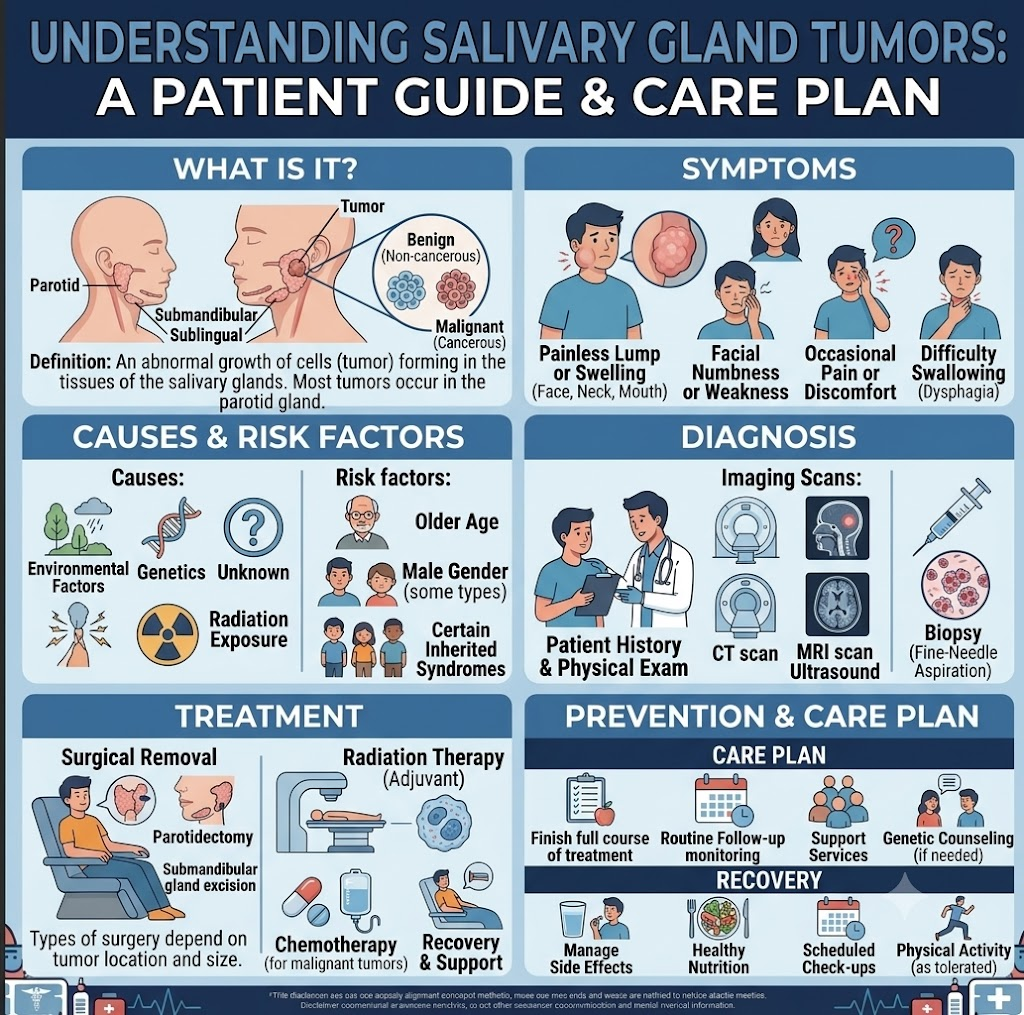
Salivary gland tumors are unusual growths of cells that develop in the salivary glands. These glands produce saliva, which is vital for digestion, keeping the mouth moist, and maintaining healthy teeth. While there are three main pairs of salivary glands (parotid, sublingual, and submandibular) located under and behind the jaw, along with many smaller ones throughout the mouth and throat, these tumors are rare. Most often, they occur in the parotid glands, and importantly, the majority of these are not cancerous. For every five parotid gland tumors, typically only one is found to be malignant. Tumors form when salivary gland cells undergo changes in their DNA, leading to uncontrolled growth. Cancerous tumors can spread to other body parts if not treated.
Understanding the Condition
Common Symptoms
Lump or Swelling: A noticeable lump or swelling on or near the jaw, in the neck, or inside the mouth.
Facial Weakness: Weakness in the muscles on one side of the face.
Facial Numbness: A feeling of numbness in a specific part of the face.
Persistent Pain: Ongoing discomfort or pain located near a salivary gland.
Difficulty Opening Mouth: Trouble opening the mouth completely or widely.
Swallowing Issues: Difficulty or pain when swallowing food or liquids.
Consultation Guide
Which Specialist to Meet
If you experience any concerning symptoms, your first step should be to consult your primary care doctor. They may refer you to an ear, nose, and throat (ENT) specialist, also known as an otolaryngologist, or a head and neck surgeon for further evaluation. If a tumor is found to be cancerous, an oncologist (cancer specialist) will also be part of your care team.
Preparations Before Your Visit
Before your appointment, prepare a list of your symptoms, including when they started and how they've progressed. Gather details about your medical history, any medications you're taking, and previous treatments. It's also helpful to write down any questions you have for the doctor.
Book a doctor visit near me
Palliative Care: Specialized medical care focused on relieving pain and other symptoms of a serious illness, as well as helping patients cope with treatment side effects. It aims to improve the quality of life for patients and their families and is offered alongside other treatments. (Duration: Ongoing, provided as needed throughout the course of the illness and treatment.)
Symptom Awareness: Be vigilant and promptly report any new or returning symptoms—such as lumps, pain, changes in facial sensation or movement, or swallowing difficulties—to your healthcare provider.
Consultation Guide
Home Enteral Nutrition (Tube Feeding): A method of delivering liquid nutrition directly to the stomach or small intestine via a tube for individuals who cannot consume enough food or drink orally, often due to swallowing difficulties caused by the tumor or its treatment. (Duration: Can be short-term for a few days or weeks, or long-term depending on the patient's nutritional needs and recovery.)
Diagnostic Procedures
Salivary Gland Tumors: Understanding, Diagnosis, and Treatment
Understanding the Condition
Salivary gland tumors are unusual growths of cells that develop in the salivary glands. These glands produce saliva, which is vital for digestion, keeping the mouth moist, and maintaining healthy teeth. While there are three main pairs of salivary glands (parotid, sublingual, and submandibular) located under and behind the jaw, along with many smaller ones throughout the mouth and throat, these tumors are rare. Most often, they occur in the parotid glands, and importantly, the majority of these are not cancerous. For every five parotid gland tumors, typically only one is found to be malignant. Tumors form when salivary gland cells undergo changes in their DNA, leading to uncontrolled growth. Cancerous tumors can spread to other body parts if not treated.
A procedure where a long, thin needle is used to extract a small sample of cells or tissue from the suspicious area. This sample is then sent to a laboratory for detailed examination under a microscope to check for signs of cancer or other conditions.
What to Expect
You will lie still while the doctor cleans and numbs the skin over the area with a local anesthetic. They will then guide a needle through the skin and into the lump, often using imaging (like ultrasound) to ensure precise placement. You might feel some pressure or a brief, sharp sensation. Once the sample is collected, the needle is removed, and pressure is applied to prevent bruising. The procedure is typically quick, and you can usually go home the same day.
CT Scan (Computed Tomography Scan)
A specialized imaging technique that uses multiple X-ray beams and computer processing to create detailed cross-sectional images (like slices) of bones, blood vessels, and soft tissues inside the body. It provides more detail than standard X-rays and is crucial for diagnosing diseases, injuries, and planning treatments.
What to Expect
You will lie on a narrow table that slides into a large, donut-shaped machine. The machine will rotate around you, taking X-rays from different angles. You will need to remain very still during the scan, and you might hear humming or clicking noises. Sometimes, a contrast dye is injected into a vein to highlight certain structures; you might feel a warm flush from this. The entire scan usually takes 10 to 30 minutes and is generally painless.
Regular Follow-ups: After treatment, it's crucial to attend all scheduled follow-up appointments with your medical team. These visits often include physical exams and imaging tests to monitor for any signs of recurrence or new tumor development.
Treatment Options
Surgical Procedures
Tumor Removal Surgery: The most common treatment, especially for salivary gland tumors. A surgeon carefully removes the tumor, often along with some surrounding healthy tissue to ensure all abnormal cells are gone. If the tumor is cancerous, nearby lymph nodes may also be removed. (Duration: The surgical procedure typically lasts several hours, followed by a recovery period of days to weeks depending on the extent of the surgery.)
Radiation Therapy: This treatment uses high-energy beams, such as X-rays or protons, precisely targeted at the tumor to destroy cancer cells by damaging their genetic material. It can be delivered externally (from a machine outside the body) or internally (with a small, temporary implant near the tumor). It's often used after surgery for cancerous tumors or as a primary treatment if surgery isn't an option. (Duration: Typically administered 5 days a week for several weeks, with each session lasting a few minutes.)
Drug-Based Treatments
Chemotherapy: A drug treatment that utilizes powerful chemicals to kill fast-growing cells throughout the body, particularly cancer cells. It is usually reserved for advanced or metastatic salivary gland cancers, where the cancer has spread beyond the original site, and can be used alone or in combination with other drugs. (Duration: Administered in cycles, usually over several weeks to months, with rest periods in between to allow the body to recover.)
Minimize Unnecessary Radiation Exposure: While medical radiation is sometimes essential, discuss the risks and benefits of radiation treatments, especially those to the head and neck, with your healthcare provider to ensure it's medically necessary.
Practice Workplace Safety: If your occupation involves exposure to certain chemicals (e.g., in rubber manufacturing or nickel industries), strictly follow safety protocols and use appropriate protective equipment to minimize risks.
Long-Term Monitoring and Support
Prevention & Long-Term Wellbeing
Prevention
Avoid Tobacco Use: Quitting smoking or avoiding tobacco products significantly reduces the risk of developing many types of cancer, including some salivary gland tumors. If you smoke, seek support to quit.
Maintain Overall Health: Adopting a healthy lifestyle with a balanced diet, regular physical activity, and effectively managing any other chronic health conditions contributes positively to your overall wellbeing and recovery.
Tags & Topics
Notice an error or need an update?
Help us keep medical information accurate. Report incorrect info or suggest an edit.


