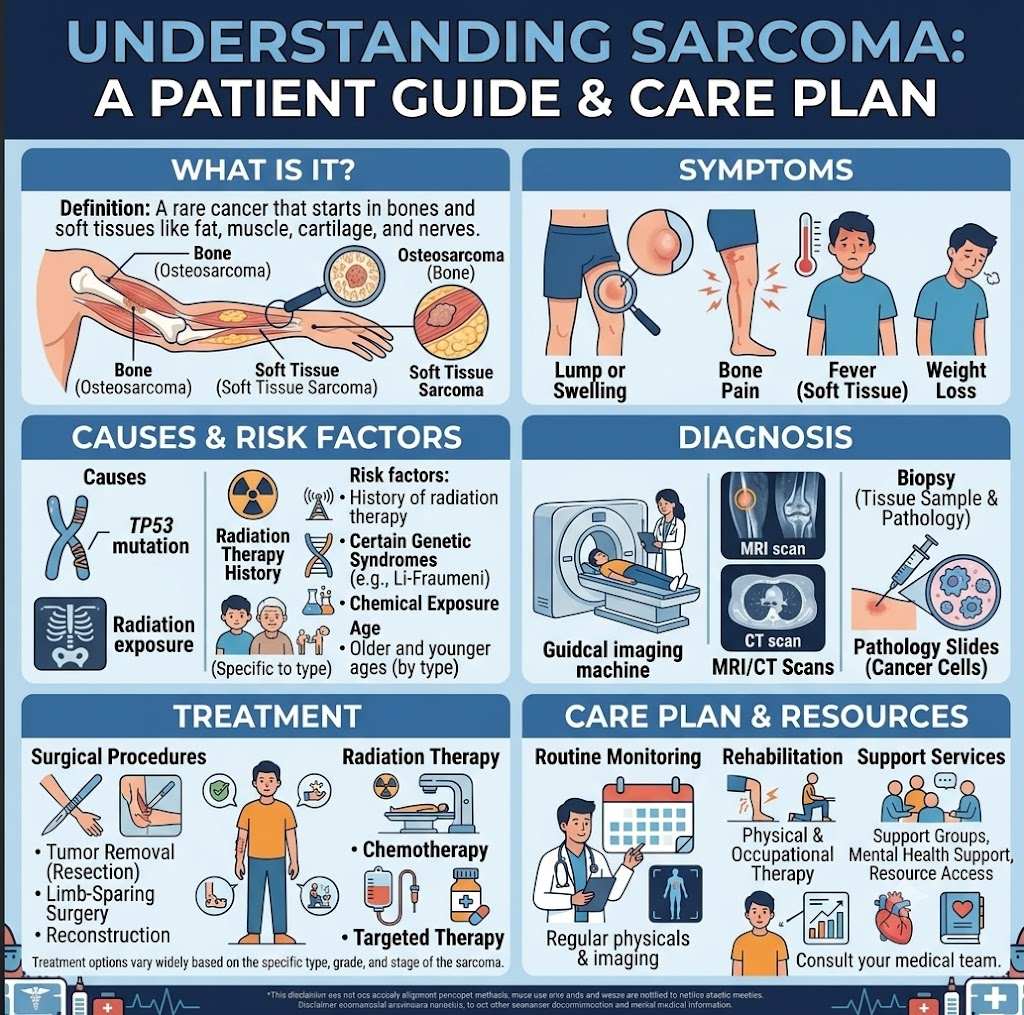
Sarcoma refers to a diverse group of cancers that originate in the body's bones and soft tissues. Soft tissues include vital structures such as muscle, fat, blood vessels, nerves, tendons, and joint linings, which connect, support, and surround other body parts. Sarcomas can develop in nearly any part of the body, and their treatment is highly individualized, depending on the specific type of sarcoma, its location, and other factors.
Understanding the Condition
Sarcoma: Understanding Bone and Soft Tissue Cancers
Understanding the Condition
Common Symptoms
Before your appointment, prepare a detailed list of your symptoms, including when they started and how they have changed. Compile a complete list of all medications, vitamins, and supplements you take, along with your full medical history and any family history of cancer. Be ready to discuss your general health and ask any questions you have.
Book a doctor visit near me
Symptom Awareness: Staying vigilant for any new or concerning symptoms, such as a new lump, unexplained pain, or weight loss, and promptly reporting them to your doctor is crucial.
Consultation Guide
Noticeable Lump: A lump that can be felt through the skin, which may or may not cause pain.
Unexplained Bone Fracture: A bone that breaks without a clear cause, such as from a minor injury or no injury at all.
Abdominal Pain: Persistent or unexplained pain in the belly area.
Unintended Weight Loss: Losing weight without trying or a clear reason.
Consultation Guide
Which Specialist to Meet
Diagnostic Procedures
A doctor will carefully examine your body, feeling for lumps, swelling, or other abnormalities.
What to Expect
Your doctor will visually inspect and manually feel the affected area and potentially other parts of your body. This is a non-invasive procedure.
Uses low doses of radiation to create images of bones and can sometimes show soft tissue abnormalities.
What to Expect
You will be asked to position yourself on a table or stand, and a machine will take images of the suspicious area. The procedure is quick and generally painless.
CT Scan (Computed Tomography)
Combines multiple X-ray images to create detailed cross-sectional views of bones, soft tissues, and blood vessels.
What to Expect
You will lie on a motorized table that slides into a large, donut-shaped machine. You may receive an injection of a contrast dye to enhance the images. You will need to remain still, and the machine may make some noise.
MRI (Magnetic Resonance Imaging)
Uses powerful magnets and radio waves to generate very detailed images of soft tissues, bones, and internal organs.
What to Expect
You will lie on a table that slides into a long, narrow tube. The machine can be quite noisy, so you might be offered headphones. You may also receive an injection of contrast dye. It's important to stay very still throughout the scan.
PET Scan (Positron Emission Tomography)
Detects metabolically active cells, which can help identify cancer cells and assess if cancer has spread.
What to Expect
You will receive an intravenous injection of a small amount of radioactive sugar. After a short waiting period for the substance to travel through your body, you will lie on a table that moves through a scanner. The scan is painless, but you must remain still.
Biopsy (Needle or Surgical)
The definitive diagnostic test where a small sample of the suspicious tissue is removed and examined under a microscope by a pathologist.
What to Expect
Genetic Counseling and Testing: If there is a family history of inherited syndromes linked to an increased risk of sarcoma, genetic counseling can help assess personal risk and guide screening strategies.
Post-Radiation Monitoring: Individuals who have received radiation therapy for other cancers should undergo regular monitoring, as radiation can increase the risk of developing a secondary sarcoma later.
Lymphedema Management: For those with lymphedema, a condition involving swelling due to lymphatic system blockage, diligent management and monitoring are important, as it can increase the risk of a rare type of sarcoma called angiosarcoma.
Imaging Surveillance: Periodic imaging tests, such as X-rays, CT scans, or MRI scans, will be conducted to check for any signs of the cancer returning or spreading to other parts of the body.
Treatment Options
Sarcoma refers to a diverse group of cancers that originate in the body's bones and soft tissues. Soft tissues include vital structures such as muscle, fat, blood vessels, nerves, tendons, and joint linings, which connect, support, and surround other body parts. Sarcomas can develop in nearly any part of the body, and their treatment is highly individualized, depending on the specific type of sarcoma, its location, and other factors.
Begin by consulting your primary care doctor. They may refer you to an oncologist (a cancer specialist), an orthopedic oncologist (a specialist in bone and soft tissue cancers), or a surgical oncologist for further evaluation and treatment.
Preparations Before Your Visit
Surgical Procedures
Limb-Sparing Surgery: Removing the tumor and reconstructing the bone or soft tissue to preserve the affected arm or leg, often using bone grafts or prosthetic implants. (Duration: A single, complex procedure with an extended recovery and rehabilitation period of several months.)
Medication-Based Therapies
Chemotherapy: Uses powerful medications, given orally or intravenously, to kill fast-growing cancer cells throughout the body. (Duration: Administered in cycles over several months, with breaks between cycles for recovery.)
Targeted Therapy: Medications designed to specifically block certain molecules involved in cancer cell growth and spread, often with fewer side effects than traditional chemotherapy. (Duration: Can be ongoing for many months or years, depending on the patient's response and tolerance.)
Immunotherapy: Treatments that harness and boost the body's own immune system to recognize and attack cancer cells. (Duration: Administered in cycles, potentially for months or years, depending on the specific drug and patient response.)
Physical and Occupational Therapy: Helps patients regain strength, mobility, and function after surgery or other treatments, and adapt to any physical changes. (Duration: Ongoing as needed, typically spanning weeks to many months, tailored to individual recovery.)
Psychological and Emotional Support: Seeking support from counselors, support groups, or mental health professionals can help individuals and their families cope with the emotional and psychological challenges associated with cancer and its treatment.
Prevention & Long-Term Wellbeing
For a needle biopsy, local anesthesia will numb the area, and a thin needle, guided by imaging like ultrasound or CT, will collect tissue. You may feel pressure. For a surgical biopsy, it's done under local or general anesthesia; an incision is made to remove a larger tissue sample or the entire tumor. Recovery varies depending on the type and location of the biopsy.
Tumor Removal (Resection): Surgical removal of the cancerous tumor along with a margin of healthy tissue surrounding it to ensure all cancer cells are removed. (Duration: A single procedure, followed by a recovery period typically lasting several weeks to months.)
Amputation: Removal of an arm or leg if the tumor is very large, has spread extensively, or cannot be removed safely while preserving the limb. (Duration: A single procedure requiring significant recovery and a prolonged rehabilitation period, including prosthetic fitting if desired.)
External Beam Radiation: Uses high-energy beams directed from outside the body to target and destroy cancer cells while minimizing damage to surrounding healthy tissue. (Duration: Typically administered in daily sessions over several weeks.)
Brachytherapy (Internal Radiation): Involves placing radioactive sources directly into or very close to the tumor for a localized, high dose of radiation. (Duration: May involve a short hospital stay, with temporary implants removed after a few days, or permanent implants that remain in place.)
Prevention and Risk Management
Immune System Health: Maintaining a strong immune system through healthy lifestyle choices is crucial, especially for individuals with compromised immunity, as it can help reduce the risk of certain virus-linked sarcomas.
Long-Term Wellbeing and Monitoring
Regular Follow-up Appointments: Consistent scheduled visits with your oncology team are essential to monitor for any signs of sarcoma recurrence or the development of new sarcomas.
Healthy Lifestyle Choices: Adopting a balanced diet, engaging in regular physical activity as tolerated, maintaining a healthy weight, and avoiding tobacco and excessive alcohol consumption support overall health and recovery.
Tags & Topics
Notice an error or need an update?
Help us keep medical information accurate. Report incorrect info or suggest an edit.


