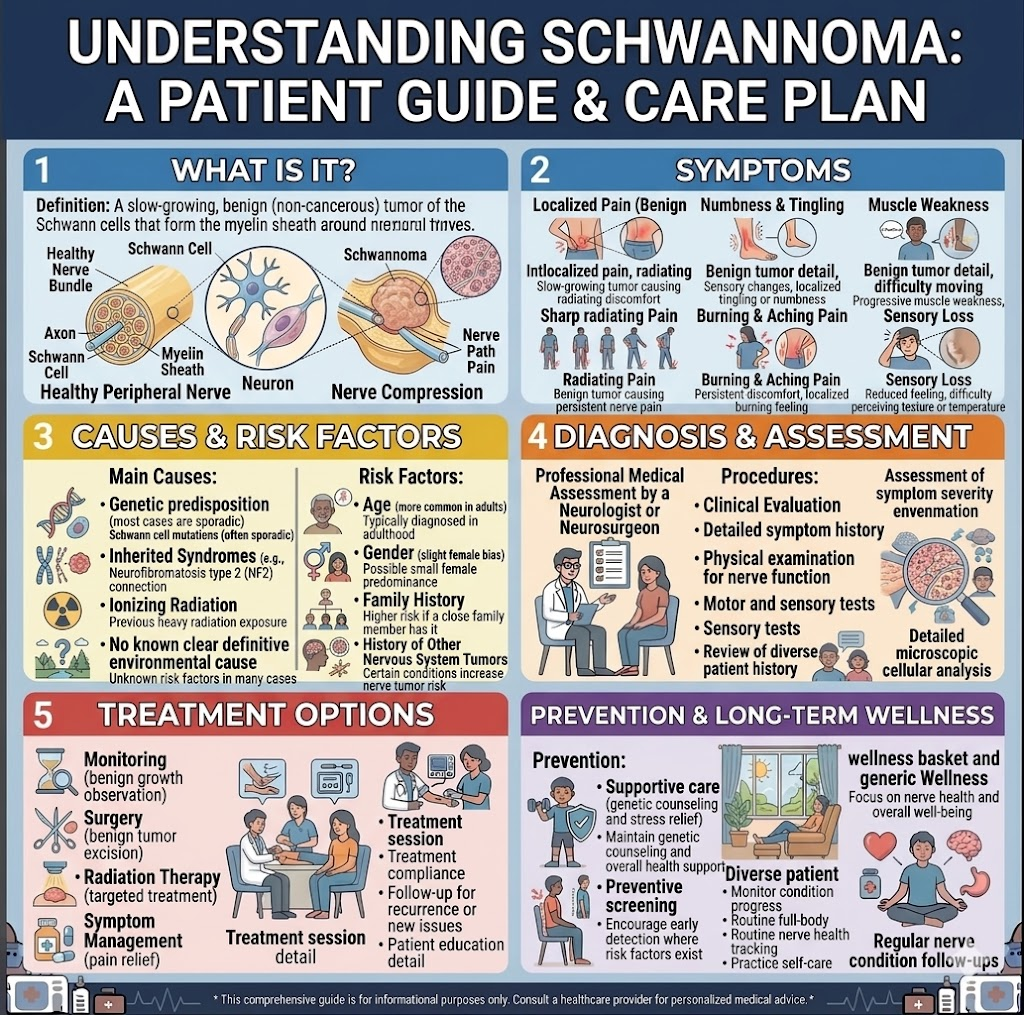
Schwannomas are generally non-cancerous (benign) growths that develop on the protective covering of nerves anywhere in your body. They are the most common type of benign peripheral nerve tumor in adults. These slow-growing tumors usually originate from a single bundle of nerve fibers and push other nerve fibers aside. While typically harmless, if a schwannoma grows large, it can press on nerves, potentially leading to symptoms like nerve damage or loss of muscle control.
Understanding the Condition
Schwannoma: Understanding a Common Nerve Tumor
Understanding the Condition
Schwannomas are generally non-cancerous (benign) growths that develop on the protective covering of nerves anywhere in your body. They are the most common type of benign peripheral nerve tumor in adults. These slow-growing tumors usually originate from a single bundle of nerve fibers and push other nerve fibers aside. While typically harmless, if a schwannoma grows large, it can press on nerves, potentially leading to symptoms like nerve damage or loss of muscle control.
Common Symptoms
Painless Lump: A noticeable, often soft and movable, lump or swelling under the skin, most commonly observed in an arm or leg.
Numbness or Tingling: Sensations such as 'pins and needles,' numbness, or a burning feeling in the area served by the affected nerve due to compression.
Muscle Weakness or Loss of Control: Difficulty moving a limb, or a noticeable weakening of muscles if the tumor affects a nerve responsible for muscle movement.
Before your appointment, be prepared to discuss all your symptoms, including when they started and how they impact your daily life. Provide your complete medical history, a list of all current medications, and any questions you have for your doctor. They will conduct a general physical exam and a neurological exam to assess your reflexes, sensation, and muscle strength.
Book a doctor visit near me
Watchful Waiting: For small, slow-growing schwannomas that are not causing any significant symptoms or problems, doctors may recommend regular monitoring. This involves periodic check-ups and imaging scans (like MRI) to track the tumor's size and growth rate, ensuring it doesn't become problematic or grow quickly. (Duration: Ongoing, with regular follow-up appointments, typically every 6-12 months.)
Surgical Removal: If the schwannoma is growing, causing bothersome symptoms, or is located in a critical area, surgical removal is often recommended. Surgeons meticulously remove the tumor while aiming to preserve the unaffected bundles of nerve fibers to minimize potential nerve damage and restore function. (Duration: Varies depending on tumor size and location; recovery can take several weeks to months, often followed by physical therapy.)
Pain and Symptom Management: Working with your healthcare team to manage any ongoing pain, numbness, or other symptoms is important. This might involve medications, nerve blocks, or other supportive treatments tailored to your specific needs.
Consultation Guide
Localized Pain: Although often painless initially, larger tumors can cause discomfort or pain in the specific area where the tumor is located.
Consultation Guide
Which Specialist to Meet
The EMG involves two main parts: a needle EMG and a nerve conduction study. For the needle EMG, a tiny needle electrode is gently inserted into several muscles to record their electrical activity at rest and during contraction. This might cause mild discomfort or a brief twitching sensation. For the nerve conduction study, small adhesive electrodes are placed on your skin over certain nerves. Brief, mild electrical pulses are then sent through these electrodes to measure the speed and strength of nerve signals. You may feel a tingling or 'zap' sensation. The entire procedure can take 30 to 90 minutes.
Diagnostic Procedures
CT Scan (Computerized Tomography)
A CT scan uses specialized X-ray equipment and computer processing to create detailed cross-sectional images, or 'slices,' of bones, blood vessels, and soft tissues inside your body. These images are more detailed than standard X-rays and help doctors locate tumors and assess their size.
What to Expect
You will lie on a movable table that slides into a large, doughnut-shaped machine. You'll need to stay very still during the scan, which is painless and typically lasts 15-30 minutes. You might hear humming or clicking sounds. In some cases, a special dye (contrast material) may be given intravenously to highlight certain structures or the tumor more clearly.
Electromyography (EMG) with Nerve Conduction Study
EMG is a diagnostic procedure used to assess the health of your muscles and the nerve cells that control them (motor neurons). It helps reveal nerve dysfunction, muscle dysfunction, or problems with how nerves communicate with muscles.
What to Expect
Treatment Options
Preparations Before Your Visit
Observation and Monitoring
Conventional Radiation Therapy: This treatment uses high-energy beams, such as X-rays or proton beams, precisely aimed at the tumor to stop its growth or shrink it. It is considered when surgery is not feasible or too risky due to the tumor's location, or as an alternative treatment option. (Duration: Typically delivered in multiple short sessions over several weeks.)
Stereotactic Radiosurgery (SRS): SRS is a highly advanced and precise form of radiation therapy that delivers focused, high doses of radiation to the tumor in one to five sessions. It uses 3D imaging to accurately target the tumor, minimizing radiation exposure to surrounding healthy tissue. It is not traditional surgery as there is no incision. (Duration: Usually a single session for tumors in the brain or spine, or 3-5 sessions for tumors located in other parts of the body.)
Regular Follow-Up: Whether undergoing watchful waiting or post-treatment, consistent follow-up appointments with your doctor are crucial. This includes neurological exams and periodic imaging scans to monitor for any changes or recurrence of the schwannoma.
Physical and Occupational Therapy: If a schwannoma has led to nerve damage, muscle weakness, or reduced function, therapy can help restore strength, mobility, and fine motor skills, improving daily activities and overall quality of life.
Prevention & Long-Term Wellbeing
Long-Term Management and Support
Maintain Overall Health: Adopting a healthy lifestyle, including a balanced diet, regular exercise, and avoiding tobacco, supports your general well-being and can aid in recovery, though it doesn't prevent schwannomas from forming.
Emotional Well-being: Dealing with a medical condition can be stressful. Seeking support from family, friends, support groups, or mental health professionals can provide emotional comfort and help you cope with the challenges.
Tags & Topics
Notice an error or need an update?
Help us keep medical information accurate. Report incorrect info or suggest an edit.


