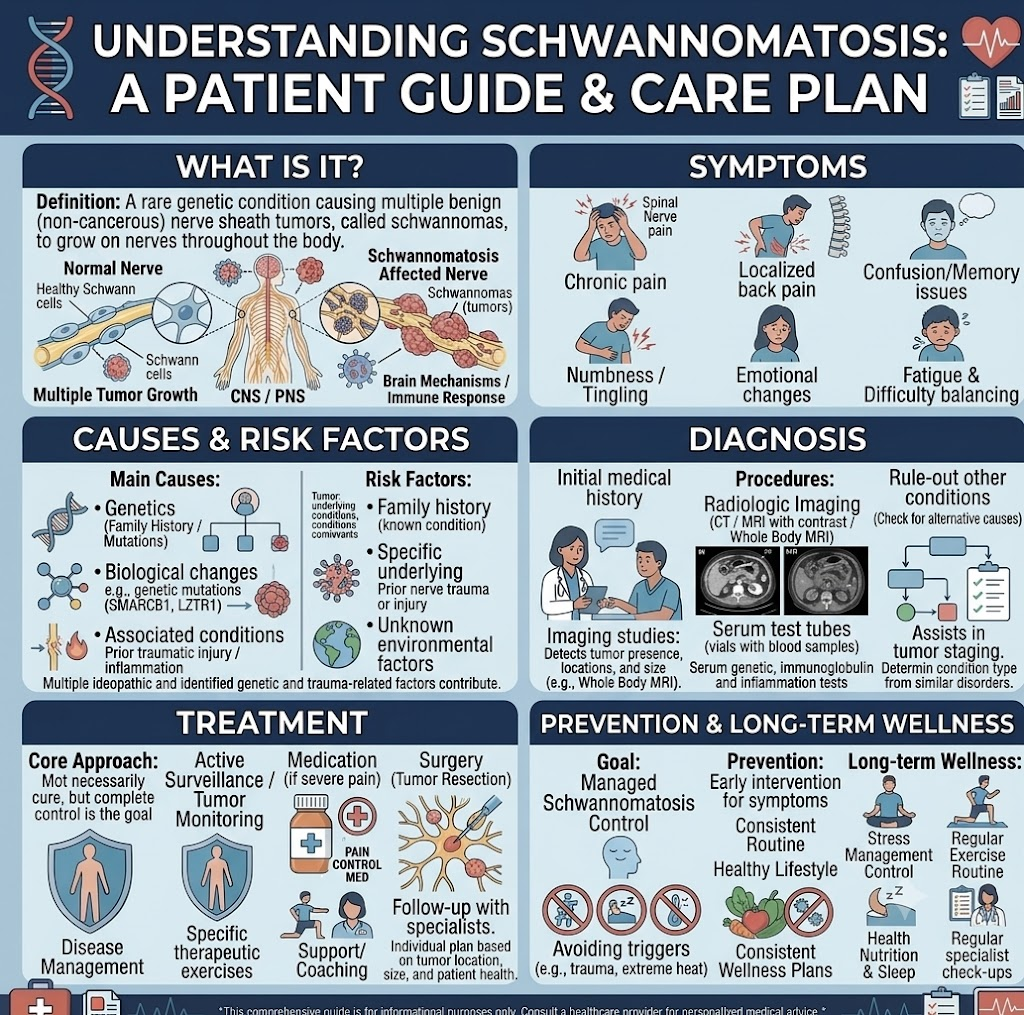
Schwannomatosis is a rare condition characterized by the growth of slow-growing, usually non-cancerous tumors on nerve tissue. These tumors, called schwannomas, can appear on nerves in the ears, brain, spine, and eyes, as well as on nerves outside the brain and spinal cord (peripheral nerves). Typically diagnosed in early adulthood, schwannomatosis has three main types, each linked to a specific altered gene. While the tumors are generally benign, they can cause symptoms such as pain, hearing loss, and balance issues, with treatment focusing on managing these symptoms.
Understanding the Condition
Schwannomatosis: Understanding a Rare Nerve Condition
Understanding the Condition
Schwannomatosis is a rare condition characterized by the growth of slow-growing, usually non-cancerous tumors on nerve tissue. These tumors, called schwannomas, can appear on nerves in the ears, brain, spine, and eyes, as well as on nerves outside the brain and spinal cord (peripheral nerves). Typically diagnosed in early adulthood, schwannomatosis has three main types, each linked to a specific altered gene. While the tumors are generally benign, they can cause symptoms such as pain, hearing loss, and balance issues, with treatment focusing on managing these symptoms.
Common Symptoms
Hearing and Balance Issues (NF2-related type): The most common symptoms of NF2-related schwannomatosis arise from tumors in both ears (acoustic neuromas or vestibular schwannomas). These benign tumors grow on the nerve that connects the inner ear to the brain, affecting both sound and balance. Symptoms often begin in the late teens or early adulthood and can include gradual hearing loss, ringing in the ears (tinnitus), and poor balance.
Nerve-related Symptoms (All types): Tumors can also develop on other nerves throughout the body. Depending on the location, these can lead to numbness or weakness in the arms or legs, persistent pain, poor balance, facial muscle weakness (facial drop), and changes in vision or the development of cataracts.
Headaches: Headaches can be a symptom, especially if tumors affect nerves in the brain or spine.
Consultation Guide
Which Specialist to Meet
You should consult with a team of specialists, which may include a neurologist (nerve doctor), a neurosurgeon (brain and spine surgeon), an otolaryngologist (ear, nose, and throat specialist), an ophthalmologist (eye doctor), a pain management specialist, an audiologist (hearing specialist), and a genetic counselor.
Preparations Before Your Visit
Before your visit, compile a detailed medical history, including all your symptoms and when they started. List any medications or supplements you are taking. Gather any previous medical records or test results relevant to your condition. Prepare a list of questions to ask your doctor about diagnosis, treatment options, and long-term outlook.
Book a doctor visit near me
Tumor Removal Surgery: If tumors cause significant symptoms, grow rapidly, or press on vital nerves, surgery may be performed to remove them. The goal is to remove as much of the tumor as possible while preserving surrounding healthy nerve tissue. This is especially challenging for tumors on critical nerves. (Duration: Recovery typically takes several weeks to months, depending on tumor size and location)
Regular Medical Check-ups: Consistent follow-up appointments with your medical team are crucial to monitor tumor growth, assess symptoms, and manage complications. This often includes regular MRI scans, hearing tests, and vision checks.
Genetic Counseling: For individuals with schwannomatosis, genetic counseling can provide valuable information about the inheritance patterns of the condition, assess risks for family members, and discuss family planning options.
Support Groups: Connecting with others who have schwannomatosis can provide emotional support, shared experiences, and practical advice for living with the condition. Patient advocacy organizations often offer resources for finding support networks.
Consultation Guide
Genetic testing involves examining your DNA to identify specific altered genes that may cause schwannomatosis. This testing can help confirm the diagnosis and determine the type of schwannomatosis, which is important for understanding inheritance patterns and potential risks for family members.
Assistive Devices: Utilize assistive listening devices, visual aids, or mobility aids as needed to adapt to any sensory or physical challenges caused by the condition, enhancing independence and safety.
Diagnostic Procedures
Brain Magnetic Resonance Imaging (MRI)
A brain MRI is a diagnostic test that uses a powerful magnet and radio waves to create highly detailed images of your brain, and sometimes your neck and spine. It does not use radiation and is very effective at detecting tumors and other changes in soft tissues.
What to Expect
You will lie on a movable table that slides into a large, tube-shaped machine. The machine makes loud knocking or humming noises during the scan, so you may be offered earplugs or headphones. You must remain very still for the duration of the scan, which can last from 30 minutes to an hour or more. Some people might find the enclosed space uncomfortable. A special dye, called contrast, may be injected into a vein to help highlight certain structures.
Brain Computerized Tomography (CT) Scan
A brain CT scan uses X-rays and computer technology to create detailed cross-sectional images (slices) of your head, including the brain, bones, and blood vessels. It provides quick images and is useful for detecting issues like bleeding, swelling, or tumors.
What to Expect
You will lie on a table that slides into a large, doughnut-shaped machine. The scanner rotates around you, taking multiple X-ray images. The procedure is usually quick, typically lasting only a few minutes. You may be asked to hold your breath briefly at certain times. Similar to an MRI, a contrast dye might be used to enhance the visibility of specific tissues or blood vessels, which is given through an IV.
What to Expect
A small sample of your DNA will be collected, most commonly through a blood draw or a cheek swab. These procedures carry very little physical risk. The sample is then sent to a lab for analysis. Before and after the test, you will likely meet with a genetic counselor to discuss the implications of the results for you and your family.
Treatment Options
Pain Management: Managing pain is crucial. This can involve over-the-counter pain relievers, prescription medications, nerve blocks, physical therapy, occupational therapy, and working with a pain specialist. Lifestyle adjustments and stress reduction techniques can also help. (Duration: Ongoing as needed)
Hearing Aids: For mild to moderate hearing loss, conventional hearing aids can amplify sounds and improve communication. (Duration: Ongoing as needed)
Physical and Occupational Therapy: Therapies can help improve balance, strength, and coordination affected by nerve damage or muscle weakness. Occupational therapy can assist with daily living activities. (Duration: Varies based on individual needs, often several weeks to months)
Surgical Procedures
Cochlear Implants: For severe hearing loss that isn't helped by hearing aids, a cochlear implant is an electronic device surgically placed in the inner ear. It bypasses damaged parts of the ear to directly stimulate the hearing nerve, sending signals to the brain. (Duration: Surgery followed by several months of rehabilitation and training to learn to interpret the sounds)
Stereotactic Radiosurgery (SRS): This is a non-surgical procedure that uses highly focused radiation beams to treat tumors in the brain, spine, or other body areas. It precisely targets the tumor while minimizing damage to surrounding healthy tissue, aiming to stop tumor growth or shrink it. (Duration: Typically a single session for brain/spine tumors, or 3-5 sessions for tumors elsewhere in the body)
External Beam Radiation Therapy: This therapy uses high-energy beams directed at the tumor from a machine outside the body. It damages the genetic material of tumor cells, preventing them from growing and dividing. (Duration: Varies depending on the tumor, usually several weeks of daily treatments)
Holistic Pain Management: Beyond medication, explore complementary approaches such as mindfulness, meditation, acupuncture, massage, or gentle exercise to help manage chronic pain and improve overall quality of life.
Prevention & Long-Term Wellbeing
Long-Term Monitoring and Support
Tags & Topics
Notice an error or need an update?
Help us keep medical information accurate. Report incorrect info or suggest an edit.


