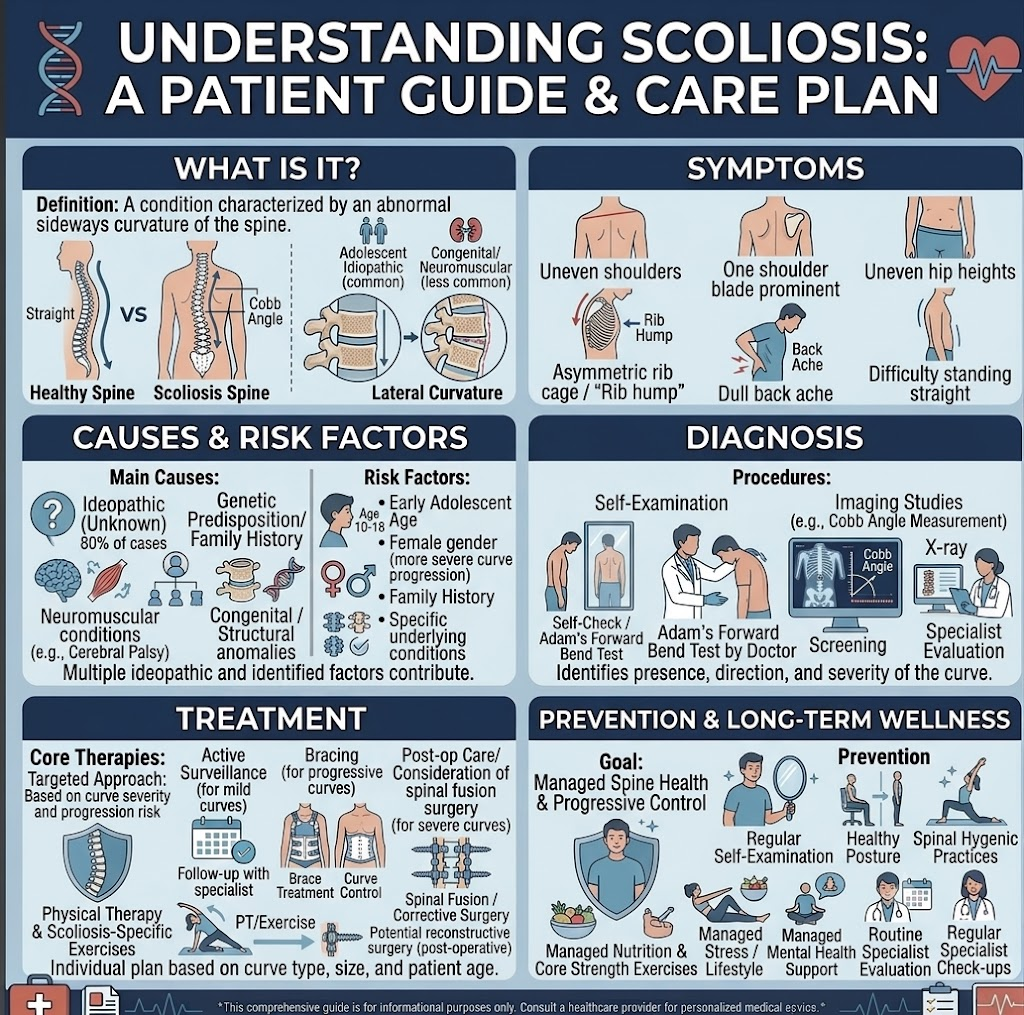
Scoliosis is a condition where the spine, or backbone, curves sideways. Instead of being straight from top to bottom, it develops an S- or C-shaped curve. This condition is most often noticed in children and teenagers, usually after age 10. While most cases are mild and don't require extensive treatment, some curves can worsen as a child grows, potentially leading to pain or even breathing difficulties if the curve becomes severe enough to press on the lungs. For many, simple observation by healthcare professionals is sufficient, but some children may need a brace or, in more severe cases, surgery to correct the curve. The exact cause of the most common type of scoliosis in children is unknown, though it can sometimes run in families.
Understanding the Condition
Scoliosis: A Guide to Spinal Curvature
Understanding the Condition
Common Symptoms
Uneven Shoulders: One shoulder appears higher than the other.
Prominent Shoulder Blade: One shoulder blade sticks out more than the other.
Uneven Waistline: The curve of the waist appears uneven or lopsided.
Higher Hip: One hip seems to be higher than the other.
Rib Hump: One side of the rib cage may push forward or stick out more prominently.
Asymmetrical Back: When bending forward, one side of the back may appear higher or more noticeable than the other.
Changes in Posture: General changes in how a person stands or carries themselves.
Consultation Guide
Which Specialist to Meet
Consultation Guide
Scoliosis is a condition where the spine, or backbone, curves sideways. Instead of being straight from top to bottom, it develops an S- or C-shaped curve. This condition is most often noticed in children and teenagers, usually after age 10. While most cases are mild and don't require extensive treatment, some curves can worsen as a child grows, potentially leading to pain or even breathing difficulties if the curve becomes severe enough to press on the lungs. For many, simple observation by healthcare professionals is sufficient, but some children may need a brace or, in more severe cases, surgery to correct the curve. The exact cause of the most common type of scoliosis in children is unknown, though it can sometimes run in families.
Start with your child's pediatrician or primary care doctor. If scoliosis is suspected, they may refer you to an orthopedic specialist, particularly a pediatric orthopedist, who specializes in bone and joint conditions in children. If nerve or muscle conditions are thought to be a cause, a neurologist might also be involved.
Preparations Before Your Visit
Before your visit, gather any notes about when you first noticed changes, any discomfort your child experiences, and a brief family medical history. It's helpful if your child wears loose, comfortable clothing to allow for a thorough physical examination of their back. Prepare a list of questions you have for the doctor.
Book a doctor visit near me
Diagnostic Procedures
An X-ray is a quick and painless imaging test that uses a small amount of radiation to create pictures of the bones inside the body. It helps doctors visualize the spine's structure, measure the curve, and monitor its progression over time. Dense materials like bones appear white, while air in the lungs appears black, and muscles/fat show up as shades of gray.
What to Expect
Your child will be asked to stand or lie down in specific positions, often holding still for a few seconds while the X-ray machine captures images. You might be given a lead apron to wear for protection if you are assisting your child. The process is generally quick, lasting only a few minutes.
Neurological examination
A neurological exam checks the function of the nervous system, which includes the brain, spinal cord, nerves, and muscles. This exam helps doctors determine if there's an underlying nerve or muscle condition contributing to scoliosis.
What to Expect
A healthcare professional will ask about your child's medical history and perform various tests. These might include checking reflexes, muscle strength, balance, coordination, sensation, and mental status. The exam can involve simple tasks like walking in a straight line, touching your nose, or responding to light touches. It is usually painless and can take anywhere from a few minutes to an hour or more.
Treatment Options
Observation and Monitoring
Regular Check-ups: For mild curves, especially in growing children, doctors often recommend simply monitoring the spine's curve through regular physical exams and X-rays. This helps track if the curve is worsening. (Duration: A few times a year, often until growth stops.)
Non-Surgical Treatment
Bracing: If a child's curve is moderate and still growing, a custom-made back brace may be prescribed. The brace doesn't correct an existing curve but helps prevent it from getting worse. It is worn under clothes and is typically rigid, though flexible options exist. (Duration: Usually worn for many hours a day, often until the child stops growing (typically 2-5 years).)
Surgical Procedures
Spinal Fusion: For severe curves that are progressing or causing significant problems, spinal fusion surgery may be recommended. The surgeon connects two or more vertebrae (spinal bones) using bone grafts, often reinforced with metal rods, screws, or plates, to prevent movement between them and straighten the spine. The bones then fuse into one solid unit over time. (Duration: Surgery typically takes several hours. Recovery can involve several days in the hospital, followed by a few months of limited activity, with full fusion taking 6-12 months.)
Vertebral Body Tethering (VBT): This is a newer, less invasive surgical option for some growing children with specific types of curves. Small screws are placed along the outside edge of the spinal curve, and a strong, flexible cord is threaded through them. When tightened, the cord helps straighten the spine. The goal is to allow continued growth on the shorter side of the spine, further correcting the curve over time while preserving more spinal flexibility than fusion. (Duration: Surgery typically takes several hours. Recovery involves a few days in the hospital, followed by several weeks to months of rehabilitation and activity restrictions. The spine continues to correct as the child grows.)
Regular Screenings: Be observant of your child's posture and appearance, especially during growth spurts. School screenings or regular check-ups with a pediatrician can help identify early signs of scoliosis when treatment is most effective.
Post-Treatment Follow-up: Even after treatment like bracing or surgery, continued follow-up with a healthcare professional is important to monitor the spine's health, especially during growth years and into adulthood.
Seek Support: Living with scoliosis, especially during formative years, can be emotionally challenging. Connecting with support groups, therapists, or trusted family and friends can provide valuable emotional support and coping strategies.
Prevention & Long-Term Wellbeing
Physical Activity and Lifestyle
Maintain an Active Lifestyle: Regular exercise and physical activity are generally encouraged for children with scoliosis, unless specifically advised otherwise by a doctor. Strengthening core muscles can help support the spine.
Non-Medicinal Pain Relief: For mild discomfort, methods such as heat packs, gentle stretching, and over-the-counter pain relievers (as directed by a doctor) can provide relief. Physical therapy may also be beneficial in strengthening muscles and improving posture.
Long-Term Monitoring
Tags & Topics
Notice an error or need an update?
Help us keep medical information accurate. Report incorrect info or suggest an edit.


