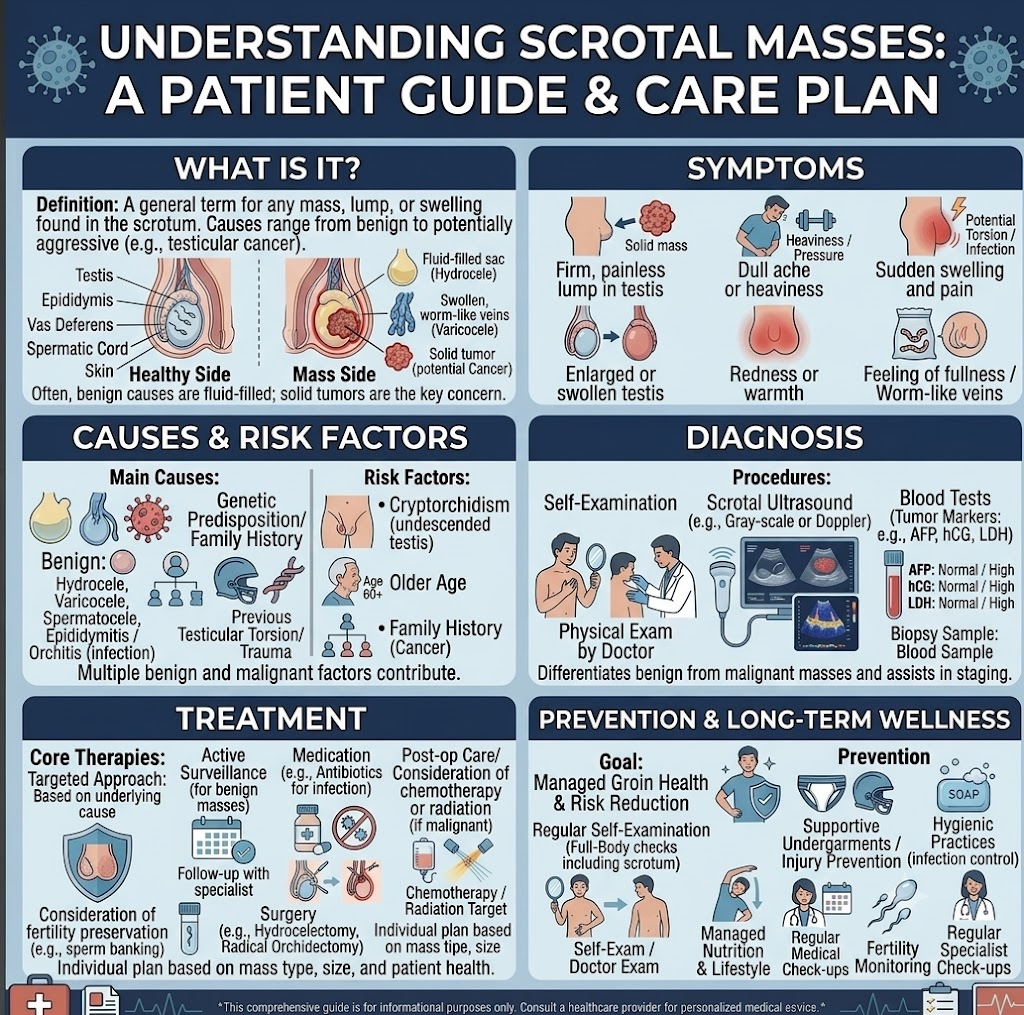
Scrotal masses are any abnormal lumps or swelling in the scrotum, the protective sac of skin that holds the testicles. These masses can be due to fluid buildup, abnormal tissue growth, or inflamed areas. It's crucial to have any scrotal mass evaluated by a healthcare professional immediately, even if it's painless, as some could indicate cancer or other conditions affecting testicle health and function.
Understanding the Condition
Scrotal Masses: Understanding Lumps and Swelling
Understanding the Condition
Common Symptoms
Unusual Lump: Any new or different lump in the scrotum.
Sudden or Dull Pain: Sharp, sudden pain or a persistent, dull ache and heaviness in the scrotum.
Spreading Pain: Discomfort that extends into the groin, lower stomach, or lower back.
Infection Signs: If an infection is present, symptoms might also include fever, chills, or burning during urination.
Consultation Guide
Which Specialist to Meet
You should first see your primary care doctor for any new scrotal mass. They may refer you to a urologist, a doctor specializing in the urinary and male reproductive systems, for further evaluation.
Preparations Before Your Visit
Before your visit, be prepared to discuss your symptoms, their duration, and any recent injuries or sexual activity. You might be asked to provide a urine sample. Wear comfortable clothing for a physical examination.
Book a doctor visit near me
This lab test examines your urine for signs of infection, blood, or other abnormalities that could indicate underlying health issues contributing to your symptoms.
Pain Relief and Support: Over-the-counter pain relievers, supportive underwear, and ice packs can help manage mild discomfort and swelling. (Duration: As needed for symptom management.)
Mass Removal/Repair: Surgery may remove symptomatic cysts (spermatocele), drain excess fluid (hydrocele), repair enlarged veins (varicocele), or correct hernias. For testicular cancer, the affected testicle is surgically removed (orchiectomy). (Duration: A single procedure; recovery varies from a few days to several weeks.)
Emergency Surgery for Testicular Torsion: This is an urgent surgery to untwist the spermatic cord and restore blood flow to the testicle, critical to prevent testicle loss. (Duration: A single emergency procedure, critical within hours of symptom onset.)
Consultation Guide
Mumps Vaccination: Getting vaccinated against mumps can prevent mumps orchitis, a common viral cause of testicular inflammation.
Diagnostic Procedures
Scrotal masses are any abnormal lumps or swelling in the scrotum, the protective sac of skin that holds the testicles. These masses can be due to fluid buildup, abnormal tissue growth, or inflamed areas. It's crucial to have any scrotal mass evaluated by a healthcare professional immediately, even if it's painless, as some could indicate cancer or other conditions affecting testicle health and function.
Testicle/Epididymis Changes: A tender, swollen, or hardened testicle or epididymis (the comma-shaped tube behind the testicle).
Scrotal Swelling: General swelling of the scrotum.
Skin Color Change: A noticeable change in the color of the scrotal skin.
Nausea/Vomiting: Upset stomach or throwing up.
Ultrasound (Sonography)
An ultrasound uses sound waves to create live images of internal structures like testicles and surrounding tissues, helping doctors determine if a mass is solid or fluid-filled and its exact location.
What to Expect
You will lie on an exam table. A technician will apply a special gel to your scrotum, then press a small handheld device (transducer) against the skin, moving it around to capture images. You might feel slight pressure, but it’s generally painless. The procedure typically takes 15-30 minutes and requires no special preparation.
Urinalysis (Urine Test)
What to Expect
You will be given a sterile cup and asked to provide a urine sample. Follow instructions for a 'midstream clean catch' to ensure the sample is not contaminated. This usually involves cleaning the genital area, starting to urinate into the toilet, then collecting the middle portion of urine. The sample is sent to a lab for analysis. No restrictions are typically needed before this test.
CT Scan (Computed Tomography)
A CT scan uses specialized X-ray equipment and computer processing to create detailed cross-sectional images (slices) of your body, including bones, blood vessels, and soft tissues. It provides more detailed views than standard X-rays and can help assess the extent of a mass or rule out other conditions.
What to Expect
You will lie on a motorized table that slides into a large, doughnut-shaped machine. The scanner will rotate around you, taking X-ray images. You may hear humming or clicking noises and be asked to hold your breath. Sometimes, a contrast dye (given orally or intravenously) is used to enhance image detail, which may require you to fast for a few hours before. The procedure takes 10-30 minutes.
Blood tests can check for markers associated with certain cancers (like testicular cancer) or signs of infection and inflammation, providing important information for diagnosis.
What to Expect
A healthcare professional will draw a small sample of blood, usually from a vein in your arm, using a needle. You may feel a brief pinch or sting. The sample is then sent to a lab for analysis. This is a quick procedure, and generally no special preparation is needed, though some specific tests may require fasting.
Monthly Self-Exams: Regularly check your testicles for any lumps, swelling, or changes in size or texture. This helps in early detection, which can improve treatment outcomes.
Regular Health Checkups: Discuss any concerns about your scrotal health during your routine doctor visits. Your doctor can perform a physical exam to check for abnormalities.
Safe Sex Practices: Using condoms can help prevent sexually transmitted infections that can lead to epididymitis or orchitis.
Follow-up for Specific Conditions: If you have a history of an undescended testicle or testicular cancer, regular follow-up appointments and imaging may be recommended due to increased risk.
Treatment Options
Medications
Antibiotics: Prescribed to clear bacterial infections causing inflammation, such as epididymitis. (Duration: Typically 7-14 days, complete the full course as prescribed.)
Anti-inflammatory Medications: These medications help reduce swelling and pain from inflammation. (Duration: Varies based on the condition, usually for a few days to weeks.)
Surgical Procedures
Chemotherapy: This treatment uses powerful medications, often given intravenously, to kill fast-growing cancer cells throughout the body. (Duration: Cycles over several weeks or months, depending on the type and stage of cancer.)
Radiation Therapy: This treatment uses high-energy beams, typically X-rays, precisely aimed at cancer cells to destroy their genetic material and prevent growth. It can be given externally or through internal implants. (Duration: Daily sessions over several weeks, or as a single implant, depending on the type and stage of cancer.)
Prevention & Long-Term Wellbeing
Home Remedies and Lifestyle Adjustments
Prevention
Tags & Topics
Notice an error or need an update?
Help us keep medical information accurate. Report incorrect info or suggest an edit.


