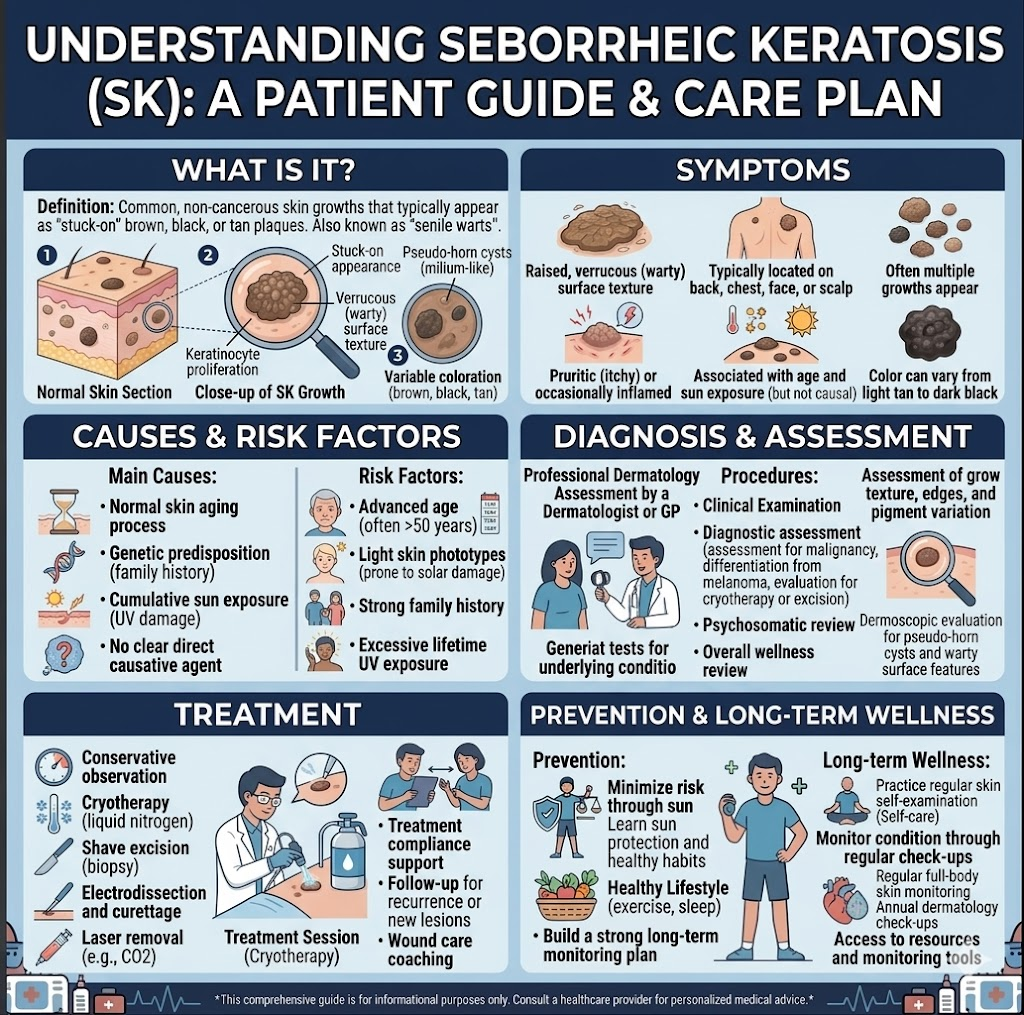
Seborrheic keratosis (pronounced: seb-o-REE-ik ker-uh-TOE-sis) is a very common type of non-cancerous skin growth. These growths frequently appear as people get older. They are harmless, not contagious, and usually don't require treatment unless they become irritated or are a cosmetic concern. While the exact cause isn't fully known, they often run in families, suggesting a genetic link.
Understanding the Condition
Understanding the Condition
Common Symptoms
Appearance: Waxy, scaly, or slightly raised spots on the skin.
Color: Usually brown, black, or light tan, but can vary.
Texture: Can look as if they were 'stuck on' or 'dripped' onto the skin, like candle wax.
Shape and Size: Typically round or oval, ranging from small to over an inch (2.5 cm) across.
Location: Most commonly found on the face, neck, chest, back, or other parts of the body.
Growth Pattern: Develop gradually, either as a single growth or in clusters.
Irritation: May become itchy or irritated, especially when rubbed by clothing.
Bleeding: Can bleed if scratched or irritated.
Consultation Guide
Which Specialist to Meet
You should consult a general practitioner (GP) for an initial assessment. If the growth is suspicious or requires removal, your GP may refer you to a dermatologist, a doctor specializing in skin conditions.
Preparations Before Your Visit
Before your visit, it's helpful to note when you first noticed the growth, if it has changed in size or appearance, and any symptoms like itching, pain, or bleeding. Avoid applying makeup or lotions to the affected area on the day of your appointment to allow for a clear examination.
Book a doctor visit near me
Consultation Guide
Seborrheic keratosis (pronounced: seb-o-REE-ik ker-uh-TOE-sis) is a very common type of non-cancerous skin growth. These growths frequently appear as people get older. They are harmless, not contagious, and usually don't require treatment unless they become irritated or are a cosmetic concern. While the exact cause isn't fully known, they often run in families, suggesting a genetic link.
Understanding Family History: Be aware that if close family members have many seborrheic keratoses, you may be more likely to develop them too. This is a common, inherited tendency and not a cause for alarm.
Cosmetic Removal Consideration: Since these growths are benign, treatment is typically not medically necessary. However, if they cause discomfort, are frequently irritated, or if you find them aesthetically bothersome, removal is an option. Discuss the best removal method and potential scarring with your doctor.
Diagnostic Procedures
A skin biopsy is a procedure to remove a small sample of skin for laboratory testing, helping doctors diagnose or rule out skin conditions, including cancer. The type of biopsy depends on the growth's characteristics and location.
What to Expect
The area will be cleaned and numbed with a local anesthetic injection. You may feel pressure but typically no pain during the sample removal. After the procedure, the site will be bandaged, and you'll receive care instructions. Mild soreness or bruising is common. Specific biopsy types include:* **Shave Biopsy:** A sterile blade shaves off the growth's surface. Stitches are usually not needed. The wound heals like a scrape in 1-3 weeks.* **Punch Biopsy:** A small, circular tool removes a deeper core of skin. Stitches may be needed, removed in 1-2 weeks. A small scar may result.* **Excisional Biopsy:** The entire growth and some surrounding healthy skin are cut out with a scalpel. Stitches are always needed, removed in 1-2 weeks, leaving a linear scar.
When to Seek Medical Advice: Always consult a doctor if you are concerned about any skin growth, especially if it changes quickly, bleeds without injury, or looks unusual. It's better to have any suspicious lesion checked by a professional for proper diagnosis.
Treatment Options
Medical Procedures for Removal
Cryotherapy: Freezing the growth with a very cold substance, such as liquid nitrogen, causing it to blister and fall off. (Duration: Quick procedure; the treated area heals within 1-3 weeks.)
Electrocautery and Curettage: Using heat from an electrical current to burn the growth's surface, often combined with scraping it off with a special spoon-shaped instrument (curette), after numbing the area. (Duration: Minutes per growth; the wound typically heals in 1-3 weeks.)
Shave Excision: Surgically shaving off the growth with a scalpel after numbing the area. A flat, light scar may remain. (Duration: Quick procedure; the wound heals within 1-2 weeks.)
Laser Therapy: Using focused light energy to vaporize or break down the cells of the growth. (Duration: Treatment time varies; healing can take 1-3 weeks.)
Prescription Topical Preparations: Certain creams or solutions might be prescribed to slowly reduce the thickness or appearance of very thin or early seborrheic keratoses by encouraging skin cell turnover. (Duration: Requires daily application for several weeks to months, with varying results.)
Prevention & Long-Term Wellbeing
Prevention and Long-Term Wellbeing
Monitoring Skin Changes: Regularly examine your skin for new growths or changes in existing ones. Pay attention to any spots that grow rapidly, bleed, don't heal, or develop irregular colors or borders. While seborrheic keratoses are harmless, these changes can sometimes be signs of more serious conditions like skin cancer.
Managing Irritation: If a seborrheic keratosis becomes itchy or irritated by clothing, gentle cleansing and moisturizing can help. Wearing loose-fitting clothing in affected areas can also reduce friction. Avoid picking or scratching the growths, as this can lead to bleeding, infection, or further irritation.
Tags & Topics
Notice an error or need an update?
Help us keep medical information accurate. Report incorrect info or suggest an edit.


