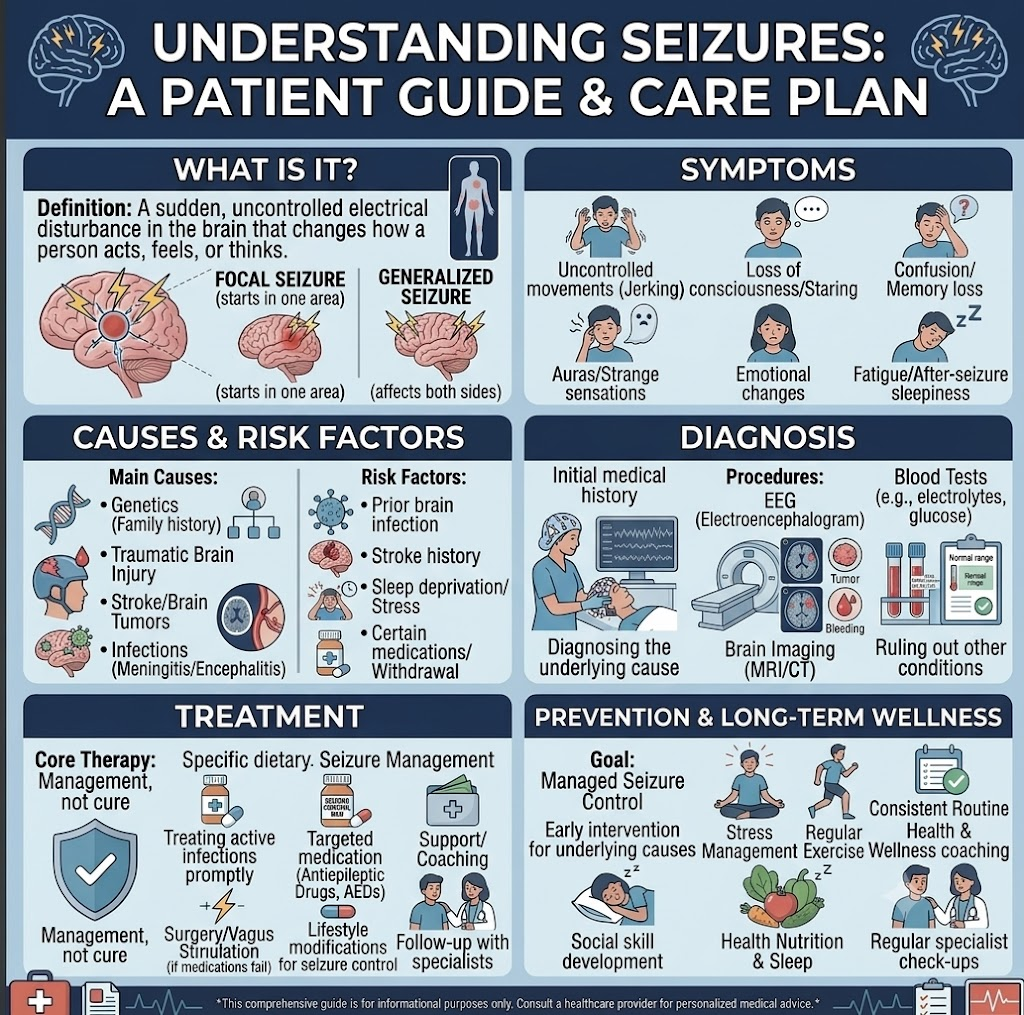
A seizure is a sudden, uncontrolled burst of electrical activity in the brain that can cause changes in behavior, movements, feelings, and awareness. Epilepsy is diagnosed when someone has two or more seizures at least 24 hours apart without a clear underlying cause. However, not all seizures mean a person has epilepsy. Most seizures last from 30 seconds to two minutes. A seizure lasting longer than five minutes is a medical emergency.
Understanding the Condition
Understanding Seizures
Understanding the Condition
Common Symptoms
Short-lived Confusion: A brief period of disorientation or muddled thinking.
Staring Spell: Appearing to stare blankly into space, often unresponsive to surroundings.
Uncontrollable Jerking Movements: Sudden, rhythmic, and unstoppable jerking of the arms and legs or other body parts.
Loss of Consciousness or Awareness: Passing out or being unaware of what is happening around you.
Changes in Thinking or Emotions: These can include feelings of fear, anxiety, or a sense of already having experienced the current moment (deja vu).
Focal Seizures with Impaired Awareness: These seizures begin in one area of the brain and involve a change or loss of consciousness, often described as a dream-like state. The person may appear awake but stare blankly, make repetitive movements like hand rubbing or mouth movements, or walk in circles. They often won't remember the seizure.
Focal Seizures without Impaired Awareness: Starting in one brain area, these seizures do not cause loss of consciousness. They can alter emotions (anger, joy, sadness), or change how things look, smell, feel, taste, or sound. Other symptoms might include trouble speaking, jerking of a specific body part, tingling, dizziness, or seeing flashing lights.
Consultation Guide
Which Specialist to Meet
You should first consult your primary care doctor, who may then refer you to a neurologist (a specialist in brain and nervous system disorders).
Preparations Before Your Visit
Before your visit, keep a detailed diary of your seizures, noting the date, time, duration, specific symptoms, and any potential triggers. Make a list of all medications, vitamins, and supplements you take. Write down any questions you have. It can be helpful to bring a family member or friend who has witnessed your seizures to provide additional information.
Book a doctor visit near me
A Brain CT (Computerized Tomography) scan uses X-rays and a computer to create detailed cross-sectional images of your head, including your brain, skull, blood vessels, and soft tissues. It's often used for quick imaging after head injuries or for sudden stroke symptoms.
The doctor will ask about your medical history and then perform various tests to check your physical and mental status. This may include testing your balance, coordination, reflexes, sensation, muscle strength, memory, and speech. The exam can take from a few minutes to over an hour, depending on your symptoms.
Positron Emission Tomography (PET) Scan
Regular Medical Check-ups: Maintain regular appointments with your healthcare provider to monitor seizure control, adjust medications, and address any side effects or new symptoms.
Consultation Guide
A seizure is a sudden, uncontrolled burst of electrical activity in the brain that can cause changes in behavior, movements, feelings, and awareness. Epilepsy is diagnosed when someone has two or more seizures at least 24 hours apart without a clear underlying cause. However, not all seizures mean a person has epilepsy. Most seizures last from 30 seconds to two minutes. A seizure lasting longer than five minutes is a medical emergency.
A neurological exam assesses how well different parts of your nervous system (brain, spinal cord, nerves, muscles) are functioning. It helps your healthcare team identify nervous system conditions and their causes.
Diagnostic Procedures
EEG (Electroencephalogram)
An EEG is a test that records the electrical activity of your brain. Brain cells communicate through electrical impulses, and this test captures these signals as wavy lines, which can reveal unusual patterns associated with seizures or other brain conditions.
What to Expect
Small metal discs (electrodes) will be attached to your scalp. You'll lie still while the device records your brain's electrical activity. You might be asked to breathe deeply, look at a flashing light, or be sleep-deprived before the test, as these can sometimes trigger seizure activity. The test is generally painless.
What to Expect
You will lie on a narrow table that slides into a large, doughnut-shaped machine. You must remain still during the scan. Sometimes, a special dye (contrast) is injected into a vein to highlight specific areas or blood vessels. The scan is quick and painless, though you may hear whirring noises from the machine.
Brain Magnetic Resonance Imaging (MRI)
A Brain MRI uses powerful magnets and radio waves to produce highly detailed images of your brain, and sometimes your neck and spine. It can detect subtle changes in brain tissue that may not be visible on a CT scan.
What to Expect
You will lie on a table that slides into a long, tube-shaped scanner. The machine makes loud knocking or thumping noises during the scan, so you will be offered earplugs or headphones. You must remain very still. Some people find the enclosed space uncomfortable. A contrast dye may be used. It is generally safe and uses no radiation.
Lumbar Puncture (Spinal Tap)
A lumbar puncture involves collecting a sample of cerebrospinal fluid (CSF), which surrounds your brain and spinal cord. This fluid can be tested to diagnose serious infections (like meningitis), bleeding around the brain, or certain neurological diseases.
What to Expect
You will typically lie on your side with your knees drawn up to your chest, or sit and lean forward. The doctor will clean your lower back and inject a numbing medicine. A thin needle will then be inserted between two bones in your lower spine to collect the fluid. You might feel some pressure. After the procedure, you may be advised to lie flat for a period to prevent a headache.
Neurological Examination
What to Expect
A PET scan is an imaging test that shows the metabolic or biochemical activity of your body's tissues and organs. It uses a radioactive 'tracer' drug to highlight areas of unusual activity, which can help detect diseases, sometimes before they appear on other imaging tests.
What to Expect
A small amount of a radioactive tracer will be injected into a vein, usually in your arm. You'll wait for the tracer to be absorbed by your body, which can take up to an hour. Then, you'll lie on a narrow table that slides into a doughnut-shaped scanner. You must remain very still for about 30 minutes while the scanner takes detailed images.
SPECT Scan (Single-Photon Emission Computerized Tomography)
A SPECT scan is an imaging test that uses a radioactive substance and a special camera to create 3D pictures. Unlike many other scans that show organ structure, a SPECT scan can show how well your organs are working, for example, blood flow to the brain or heart.
What to Expect
A small amount of a radioactive tracer will be injected into a vein. After a waiting period for the tracer to circulate, you will lie on a table while a camera rotates around your body to capture images. You need to remain still during the scanning process. The procedure is generally painless.
Treatment Options
Medications
Anti-Seizure Medications: These daily medications help reduce the frequency and severity of seizures by stabilizing brain electrical activity. Your doctor will work with you to find the most effective medication with the fewest side effects. (Duration: Long-term, potentially lifelong, depending on seizure control.)
Surgical Procedures
Deep Brain Stimulation (DBS): Electrodes are surgically implanted in specific areas of the brain and connected to a small, pacemaker-like device placed under the skin in the chest. This device sends controlled electrical impulses to regulate brain activity and reduce seizures. (Duration: Permanent implant, requires ongoing programming and adjustments by a specialist.)
Vagus Nerve Stimulation (VNS): A device is surgically implanted under the skin in the chest and connected to the left vagus nerve in the neck. It sends regular electrical impulses along the nerve to the brain, which can help reduce seizure frequency and severity. (Duration: Permanent implant, requires ongoing programming and adjustments by a specialist.)
Dietary Therapies: For some individuals, particularly children, specific diets like the ketogenic diet (high-fat, low-carbohydrate) can help control seizures when medications are not fully effective. This must be managed under medical supervision. (Duration: Varies; often starts for a short period, then may continue long-term as part of management.)
Trigger Avoidance: Identifying and avoiding personal triggers (e.g., lack of sleep, alcohol, flashing lights) can significantly reduce seizure frequency. (Duration: Lifelong management.)
Maintain a Seizure Diary: Continue to track seizures, potential triggers, and medication effectiveness to help your doctor optimize your treatment plan.
Prioritize Safety: Take precautions to prevent injury during a seizure. This includes avoiding activities like swimming alone or driving until cleared by your doctor. Discuss home safety modifications, like using shower chairs or padding sharp furniture corners.
Address Mental Health: People with seizures are more prone to depression, anxiety, or other mental health conditions. Seek support or counseling as needed, as this is a vital part of overall well-being and seizure management.
Pregnancy Planning: If you are pregnant or planning to become pregnant, consult your healthcare provider. Seizures during pregnancy can pose risks, and some anti-seizure medications may need adjustment to ensure safety for both you and your baby.
Prevention & Long-Term Wellbeing
Therapies and Lifestyle Changes
Prevention and Risk Reduction
Prioritize Adequate Sleep: Lack of sleep is a common seizure trigger. Establish and maintain a consistent sleep schedule to help prevent seizures.
Avoid Alcohol and Illicit Drugs: Both alcohol misuse and the use of street drugs can trigger seizures. Abstinence is recommended.
Manage Flashing Lights: If you are sensitive to flashing lights (photosensitive epilepsy), avoid environments with such lights or take protective measures like wearing specialized glasses.
Long-Term Monitoring and Support
Tags & Topics
Notice an error or need an update?
Help us keep medical information accurate. Report incorrect info or suggest an edit.


