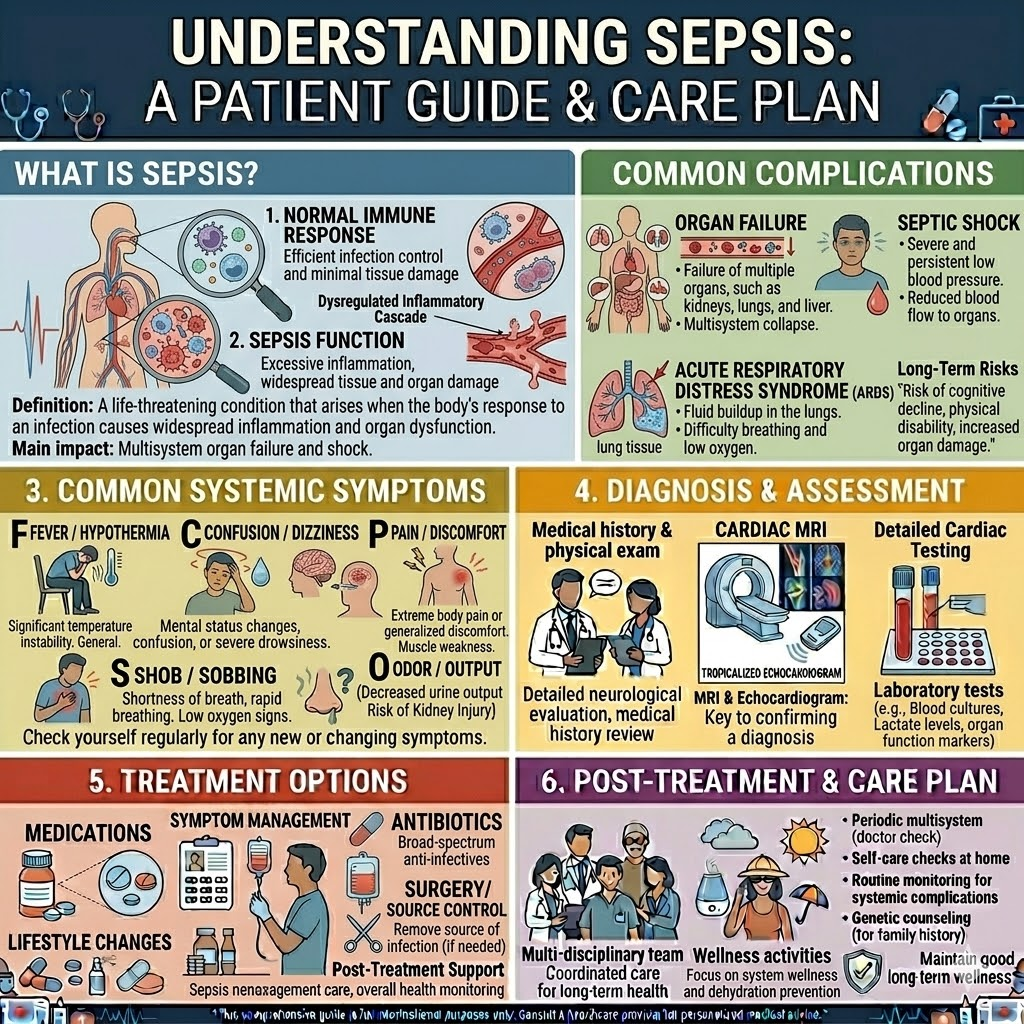
Sepsis is a serious, life-threatening condition where your body responds improperly to an infection. Instead of effectively fighting the invading germs, your body's immune system overreacts, mistakenly attacking and damaging its own organs. This can cause organs to work poorly. If sepsis worsens, it can lead to septic shock, a dramatic and dangerous drop in blood pressure that can severely damage vital organs like the lungs, kidneys, and liver, potentially leading to death. Early recognition and prompt treatment significantly improve the chances of survival.
Understanding the Condition
Sepsis: A Body's Dangerous Response to Infection
Understanding the Condition
Common Symptoms
Non-Specific Symptoms: Sepsis symptoms can be general and vary widely among individuals, presenting differently in adults and children, making them hard to pinpoint initially.
Emergency Symptoms: Confusion, mental changes, or unusually fast breathing are critical signs that require immediate emergency medical attention.
Septic Shock Signs: If sepsis progresses to septic shock, a key indicator is a dramatic and dangerous drop in blood pressure, alongside other severe symptoms.
Consultation Guide
Which Specialist to Meet
For initial symptoms or a worsening infection that concerns you, consult a general practitioner or seek immediate emergency care. If sepsis is diagnosed, a team of specialists may be involved, including critical care physicians, infectious disease specialists, and organ-specific specialists (e.g., kidney, lung, or heart specialists) depending on the organs affected.
Preparations Before Your Visit
Before your visit, prepare a detailed list of all your symptoms, including when they started and how they've changed. Mention any recent infections, injuries, or existing medical conditions, and all medications you are currently taking, including over-the-counter drugs and supplements.
Book a doctor visit near me
Consultation Guide
Sepsis is a serious, life-threatening condition where your body responds improperly to an infection. Instead of effectively fighting the invading germs, your body's immune system overreacts, mistakenly attacking and damaging its own organs. This can cause organs to work poorly. If sepsis worsens, it can lead to septic shock, a dramatic and dangerous drop in blood pressure that can severely damage vital organs like the lungs, kidneys, and liver, potentially leading to death. Early recognition and prompt treatment significantly improve the chances of survival.
Diagnostic Procedures
CT Scan (Computed Tomography Scan)
A CT scan is an advanced imaging test that uses X-rays and computer processing to create detailed cross-sectional pictures, or 'slices,' of your bones, blood vessels, and soft tissues. It provides much more detail than standard X-rays and can help diagnose disease or injury in almost any part of the body, including identifying sources of infection or organ damage related to sepsis.
What to Expect
You will lie on a movable table that slides into a large, donut-shaped scanner. You might hear buzzing or clicking sounds. Depending on the area being scanned, you may receive a special dye (contrast medium) by injection, orally, or as an enema, to help certain structures show up more clearly. You'll need to lie still during the scan, which typically takes a few minutes.
Liver function tests are blood tests that measure the levels of specific enzymes and proteins in your blood. These tests help assess the health of your liver, determine if it's damaged or inflamed, and how well it's performing its essential functions, such as producing proteins and clearing waste products like bilirubin. Abnormal levels can indicate liver issues, which can occur during sepsis.
What to Expect
A healthcare professional will draw a small sample of blood, usually from a vein in your arm, using a needle. The process is quick and generally involves a brief prick or sting. You may be asked to fast (not eat or drink) for a certain period before the test, depending on the specific tests ordered.
Ultrasound (Sonography)
An ultrasound uses high-frequency sound waves to create real-time images of structures inside your body. It's a safe procedure that helps visualize organs, blood vessels, and soft tissues, aiding in the diagnosis of various conditions, including identifying sources of infection or assessing organ health without using radiation.
What to Expect
You will lie on an examination table. A clear gel will be applied to the skin over the area to be examined. A technician or doctor will then press a small handheld device called a transducer against your skin, moving it around. The transducer sends and receives sound waves, and the images are displayed on a monitor. The procedure is generally painless, though there might be some pressure from the transducer.
A urinalysis is a comprehensive test of your urine to detect and monitor a wide range of health conditions, including urinary tract infections (UTIs), kidney disease, and diabetes. It involves checking the urine's appearance, concentration, and content (such as protein, sugar, blood cells, and bacteria). In sepsis, it can help identify a urinary source of infection or assess kidney function.
What to Expect
You will be asked to provide a urine sample in a sterile cup. For the most accurate results, a 'midstream clean catch' method is often requested, where you clean the genital area, start urinating into the toilet, then collect the middle portion of urine into the cup, and finish urinating into the toilet. The sample is then sent to a lab for analysis.
An X-ray is a quick and painless imaging test that uses electromagnetic radiation to create pictures of the inside of your body, particularly bones. Denser materials like bones appear white, while air in the lungs appears black, and soft tissues like fat and muscle appear as shades of gray. X-rays are useful for detecting bone fractures, pneumonia, or other issues in the chest and other areas that could be a source of infection or impacted by sepsis.
What to Expect
You will be positioned in front of an X-ray machine. The technician may ask you to stand, sit, or lie down in different positions. You might wear a lead apron to protect certain parts of your body from radiation. You'll need to remain still for a few seconds while the X-ray is taken. The procedure is painless and very brief.
Treatment Options
Medications
Targeted Anti-Infectives: Broad-spectrum medications are started quickly to fight the infection causing sepsis. Once the specific germ is identified, the medication may be adjusted to a more targeted type. These include antibiotics for bacterial infections, antivirals for viral infections, or antifungals for fungal infections. (Duration: Typically administered intravenously (IV) for several days to weeks, depending on the severity of the infection and the patient's response.)
Therapies
Fluid and Organ Support: Intravenous fluids are given to maintain blood pressure and hydration. Medications may be used to help normalize blood pressure, support heart function, or assist with breathing. Oxygen therapy might also be provided to ensure adequate oxygen delivery to organs. (Duration: Ongoing throughout the critical phase of sepsis, potentially for days to weeks, as organ function stabilizes.)
Extracorporeal Membrane Oxygenation (ECMO): ECMO is a life-support technique used when the heart and/or lungs are too sick to work on their own. Blood is pumped outside the body to an artificial lung machine that removes carbon dioxide and adds oxygen, returning oxygen-rich blood to the body. This allows the heart and lungs to rest and heal. (Duration: Used as a short-term measure, typically days to several weeks, until the patient's own heart and lungs recover enough to function independently.)
Surgical Procedures
Prompt Infection Treatment: Address any infection or non-healing wound promptly by seeking medical attention. Untreated infections are the most common trigger for sepsis.
Vaccinations and Hygiene: Stay up-to-date on recommended vaccinations, such as for flu and pneumonia, to reduce the risk of severe infections. Practice good hand hygiene to prevent the spread of germs.
Prevention & Long-Term Wellbeing
Infection Source Removal: If the infection causing sepsis is localized (e.g., an abscess, infected wound, or infected organ), a procedure may be necessary to drain pus, remove infected tissue, or surgically repair the source of the infection. (Duration: A one-time surgical or procedural intervention, with recovery lasting days to weeks depending on the complexity.)
Prevention
Post-Sepsis Follow-Up Care: After recovering from sepsis, regular follow-up appointments with your doctor are crucial to monitor your recovery, assess for any lasting organ damage, and manage potential long-term complications, such as physical weakness, fatigue, or cognitive changes.
Healthy Lifestyle Support: Maintain a healthy lifestyle, including a balanced diet, regular exercise (as advised by your doctor), and avoiding smoking and excessive alcohol, to support overall health and recovery.
Tags & Topics
Notice an error or need an update?
Help us keep medical information accurate. Report incorrect info or suggest an edit.


