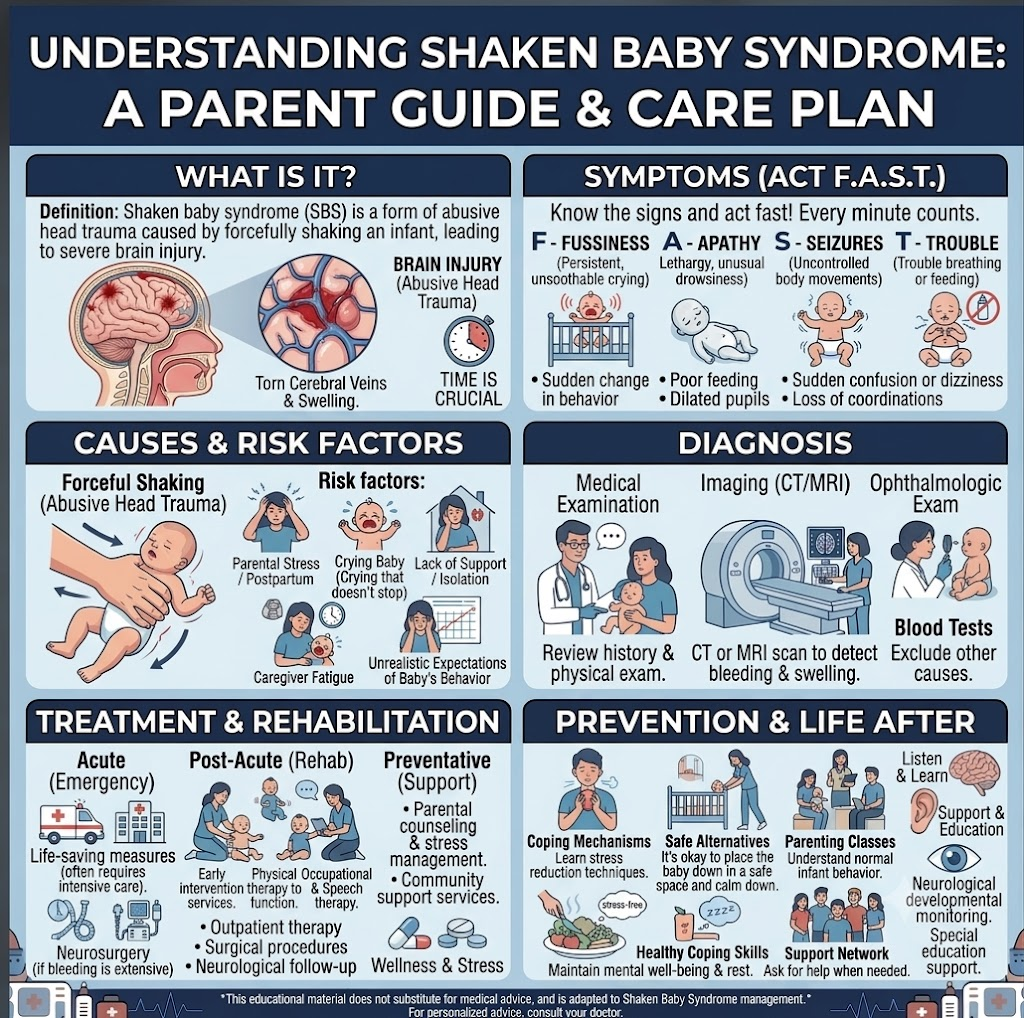
Shaken baby syndrome is a severe brain injury that happens when an infant or toddler is forcefully shaken. This violent shaking causes the baby's delicate brain to violently move back and forth inside the skull. Because babies have weak neck muscles and heavy heads, this motion leads to bruising, swelling, and bleeding in and around the brain. This form of child abuse, also known as abusive head trauma, can damage or destroy brain cells, leading to permanent brain damage or even death. It is usually caused by frustration or anger, often when a child won't stop crying. It is important to understand that shaken baby syndrome is preventable and is not caused by gentle bouncing, playing, or minor falls. Help is available for parents and caregivers to prevent this serious injury.
Understanding the Condition
Shaken Baby Syndrome: Understanding a Serious Brain Injury in Infants
Understanding the Condition
Common Symptoms
Behavioral Changes: Extreme fussiness or irritability, difficulty staying awake, or unusual sluggishness.
Feeding and Breathing Issues: Poor eating habits or breathing difficulties.
Skin Appearance: Pale or discolored skin.
Internal Injuries (often not visible): While a child may sometimes have facial bruising, many serious injuries are internal and not immediately obvious. These can include bleeding inside the brain and eyes, damage to the spinal cord, and fractures of bones like the ribs, skull, or legs.
Consultation Guide
Which Specialist to Meet
If you suspect Shaken Baby Syndrome, immediate emergency medical care is crucial. The initial evaluation will typically involve emergency room doctors and pediatricians. Following stabilization, a team of specialists may be involved, including a neurologist (brain specialist), ophthalmologist (eye specialist), orthopedist (bone specialist), and child development specialists for long-term care. Social workers and child protection agencies are also essential for investigation and support.
Preparations Before Your Visit
If you suspect a child has been shaken, seek emergency medical care immediately. Do not delay. When you arrive, be prepared to provide as many details as possible about the incident, the child's symptoms, and any recent behaviors. Your honest and complete information is vital for diagnosis and appropriate care.
Book a doctor visit near me
Consultation Guide
Shaken baby syndrome is a severe brain injury that happens when an infant or toddler is forcefully shaken. This violent shaking causes the baby's delicate brain to violently move back and forth inside the skull. Because babies have weak neck muscles and heavy heads, this motion leads to bruising, swelling, and bleeding in and around the brain. This form of child abuse, also known as abusive head trauma, can damage or destroy brain cells, leading to permanent brain damage or even death. It is usually caused by frustration or anger, often when a child won't stop crying. It is important to understand that shaken baby syndrome is preventable and is not caused by gentle bouncing, playing, or minor falls. Help is available for parents and caregivers to prevent this serious injury.
Diagnostic Procedures
An X-ray is a quick, painless imaging test that uses a small amount of radiation to create pictures of the structures inside the body, particularly bones. It is used to detect fractures in the skull, ribs, or other bones that might be present but not visible externally, which can be signs of physical abuse.
What to Expect
The child will be positioned on a table, and a trained technologist will use an X-ray machine to take images. It is painless, but the child will need to stay still for brief moments. Protective shields may be used over sensitive areas. The entire process is usually very quick, often taking only a few minutes.
CT Scan (Computed Tomography Scan)
A CT scan uses a series of X-rays from different angles combined with computer processing to create detailed cross-sectional 'slice' images of the body. For suspected brain injuries, a brain CT scan provides quick and detailed views of the brain and skull, helping to identify bleeding, swelling, or fractures within these areas.
What to Expect
The child lies on a motorized table that slides into a large, donut-shaped scanner. The machine makes some noise during the scan. For a brain CT, the head is carefully positioned. In some cases, a special dye (contrast) may be injected into a vein to highlight specific blood vessels or tissues. The scan is relatively quick, usually taking only a few minutes. Infants and young children may require mild sedation to ensure they remain still enough for clear images.
Brain MRI (Magnetic Resonance Imaging)
A Brain MRI is a diagnostic test that uses a powerful magnetic field and radio waves, rather than X-rays, to create highly detailed images of the brain, spinal cord, and surrounding soft tissues. It can reveal more subtle injuries, swelling, bleeding, and other abnormalities in the brain that might not be visible on a CT scan.
What to Expect
The child lies on a movable bed that slides into a long, tube-shaped machine. The MRI machine makes loud banging and humming noises, so ear protection will be provided. It is crucial for the child to remain perfectly still during the scan, which can take 30 to 60 minutes or longer. For infants and young children, sedation or general anesthesia is often necessary to ensure they stay still enough for clear, accurate images. The procedure itself is painless and does not involve radiation.
Eye Exam (Ophthalmological Exam)
A specialized examination performed by an eye doctor (ophthalmologist) to check for retinal hemorrhages (bleeding in the back of the eye). These hemorrhages are a very strong indicator of Shaken Baby Syndrome and are often present even when there are no external signs of injury.
What to Expect
Eye drops will be used to dilate the child's pupils, which may temporarily blur their vision and make their eyes sensitive to light. The ophthalmologist will then use special lights and lenses to look into the back of the child's eyes. The exam is non-invasive, but the bright lights can be uncomfortable for the child.
Treatment Options
Emergency and Medical Care
Emergency Stabilization: Immediate medical attention focuses on stabilizing the child's condition, which may involve ensuring clear breathing, managing swelling in the brain, and controlling any seizures. This critical care is essential for survival and to prevent further damage. (Duration: Immediate, ongoing as needed in an intensive care setting, typically days to weeks.)
Neurosurgery: In severe cases, surgery may be necessary to relieve dangerous pressure on the brain. This could involve draining accumulated blood (hematoma) or addressing skull fractures. A neurosurgeon will determine if and when this procedure is required. (Duration: One-time procedure, followed by an extensive recovery and rehabilitation period.)
Long-Term Management of Complications
Medication for Seizures: If the brain injury results in seizures, specific medications will be prescribed by a neurologist to control and prevent them. Dosing will be adjusted based on the child's needs and response. (Duration: Long-term, potentially lifelong, as determined by a neurologist.)
Rehabilitative Therapies: Children often require various therapies to address the physical, cognitive, and developmental impacts of brain injury. This includes physical therapy (to improve movement), occupational therapy (to help with daily activities), and speech therapy (for communication and feeding difficulties). (Duration: Ongoing, potentially lifelong, tailored to the child's progress and needs.)
Vision Rehabilitation and Aids: For children experiencing partial or total blindness due to the injury, specialists provide interventions such as low-vision aids, adaptive strategies, and vision therapy to maximize any remaining vision and support overall development. (Duration: Ongoing, as needed throughout the child's life.)
Developmental and Educational Support: Programs are designed to support children with delayed development, learning difficulties, or behavioral issues resulting from brain injury. This includes early intervention services and individualized education plans to help them reach their full potential. (Duration: Long-term, throughout childhood and adolescence.)
Prevention & Long-Term Wellbeing
Prevention Strategies
Understand Infant Crying and Manage Stress: Educate parents and caregivers about normal infant crying patterns, effective techniques to soothe a crying baby (e.g., feeding, changing, rocking, white noise), and healthy strategies for managing personal stress and frustration. Recognize that extreme frustration can lead to harmful actions.
Set Realistic Expectations for Babies: Help parents understand typical infant development and behaviors. Unrealistic expectations about a baby's sleep, feeding, or crying can increase frustration and the risk of abuse.
Educate All Caregivers: Ensure everyone who cares for your child – including babysitters, family members, and partners – is fully aware of the dangers of shaking a baby and knows how to respond safely and calmly to a crying infant. Emphasize that shaking a child is never acceptable.
Seek Support for At-Risk Individuals: Encourage and provide resources for parents and caregivers who are experiencing challenges such as depression, substance misuse, domestic violence, or unstable family situations to seek professional help. Early intervention can prevent tragic outcomes.
Long-Term Wellbeing for Survivors
Continuous Medical and Therapeutic Care: Ensure children who survive Shaken Baby Syndrome receive ongoing medical monitoring and consistent access to necessary therapies (physical, occupational, speech), developmental specialists, and educational support to manage lifelong conditions like seizures, cerebral palsy, vision impairment, or learning disabilities.
Psychological Support for Families: Provide counseling and support groups for families coping with the significant emotional, physical, and financial challenges of caring for a child with long-term disabilities resulting from brain injury. This support helps families navigate the complexities of their child's care and their own well-being.
Tags & Topics
Notice an error or need an update?
Help us keep medical information accurate. Report incorrect info or suggest an edit.


