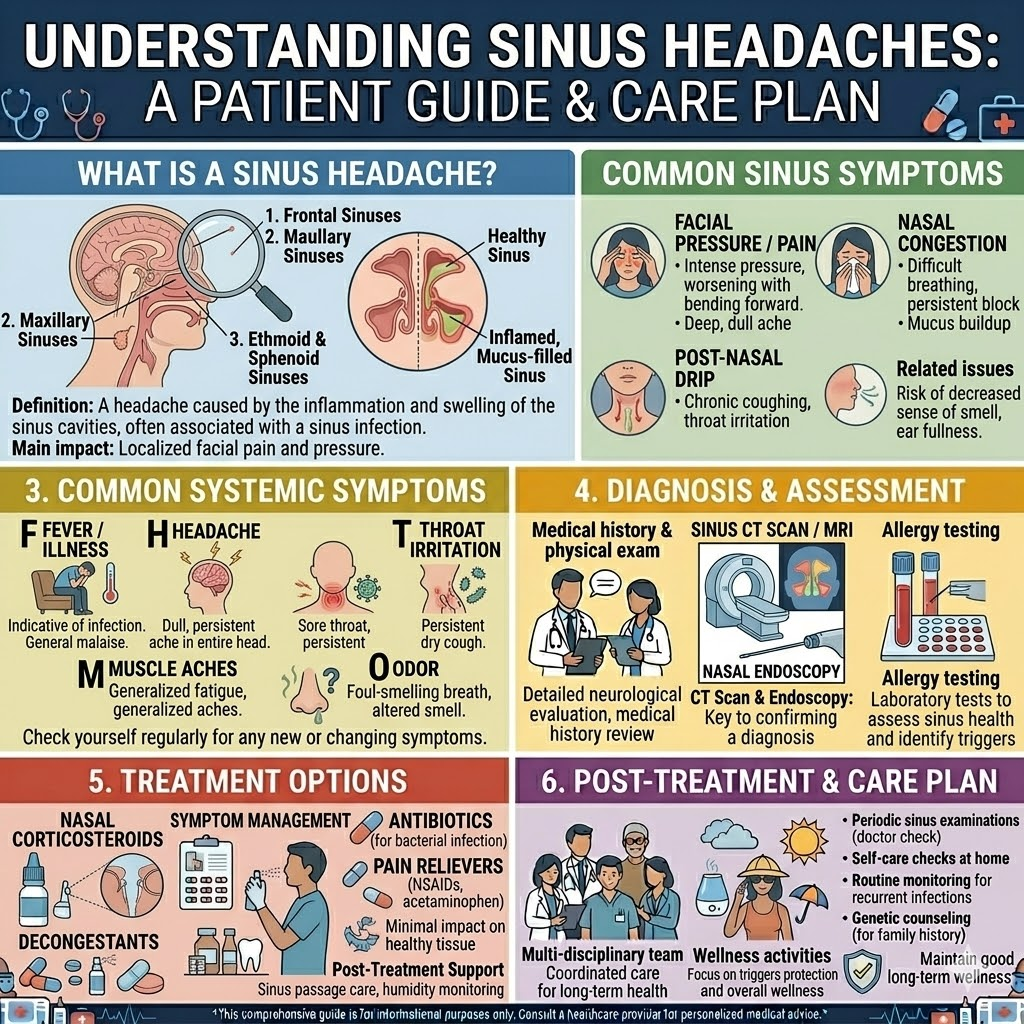
Many people describe a specific type of headache as a 'sinus headache,' feeling pressure and pain around their eyes, cheeks, and forehead, often with a throbbing sensation. While true sinus headaches are caused by inflammation or infection of the sinuses (sinusitis), this type of pain is very frequently a symptom of a migraine. In fact, studies show that most individuals seeking care for perceived sinus headaches are actually experiencing migraines, which can mimic sinus issues. Correctly identifying the cause is crucial for effective treatment, as treatments for migraines and actual sinus problems are very different.
Understanding the Condition
Understanding Headaches: When 'Sinus' Pain is Really a Migraine
Understanding the Condition
Many people describe a specific type of headache as a 'sinus headache,' feeling pressure and pain around their eyes, cheeks, and forehead, often with a throbbing sensation. While true sinus headaches are caused by inflammation or infection of the sinuses (sinusitis), this type of pain is very frequently a symptom of a migraine. In fact, studies show that most individuals seeking care for perceived sinus headaches are actually experiencing migraines, which can mimic sinus issues. Correctly identifying the cause is crucial for effective treatment, as treatments for migraines and actual sinus problems are very different.
Common Symptoms
Facial Pressure and Pain: A feeling of fullness, pressure, or aching around the eyes, cheeks, or forehead.
Throbbing Head Pain: Pain that feels like a pulsing or throbbing sensation in the head.
Pain Worsening When Bending Forward: Discomfort or pain that increases when leaning down or changing head position.
Nasal Congestion: A stuffy nose, often accompanied by a runny nose with clear, watery discharge.
Fatigue: General tiredness or a feeling of low energy.
Fever (for true sinusitis): An elevated body temperature, more common with actual sinus infections.
Nausea or Vomiting (often migraine): Feeling sick to your stomach or actually throwing up; commonly associated with migraines, less so with true sinusitis.
Sensitivity to Light or Sound (often migraine): Increased discomfort or pain when exposed to bright lights or loud noises; a hallmark symptom of migraines.
Longer Duration (for true sinusitis): Headaches that persist for several days or longer, often pointing to an ongoing sinus issue. Migraines typically last hours to a day or two.
Consultation Guide
Which Specialist to Meet
Start by consulting your primary care physician, who can assess your symptoms and medical history. If your headaches are frequent, severe, or difficult to diagnose, your doctor may refer you to a neurologist (a specialist in brain and nervous system disorders) or an ear, nose, and throat (ENT) specialist, particularly if true sinus issues are suspected.
Preparations Before Your Visit
Before your appointment, keep a detailed headache diary for a few weeks. Record the date, time, severity, specific symptoms (e.g., facial pressure, throbbing, nausea, light sensitivity), potential triggers, and how long each headache lasts. Also, make a list of all medications you currently take and prepare any questions you have for the doctor.
Book a doctor visit near me
Your doctor will ask detailed questions about your symptoms, medical history, and lifestyle. They will perform a physical exam, which may include checking your face for tenderness, looking inside your nose, and a basic neurological examination to check reflexes, balance, and coordination. This helps distinguish between true sinus issues and other headache types.
During this visit, you will answer questions about your headache patterns, other symptoms you experience, and your general health. The physical exam is non-invasive and typically involves your doctor gently pressing on your face and forehead, looking in your nose with a small light, and performing simple tests of your nervous system function.
CT Scan (Computerized Tomography)
A CT scan is an imaging test that uses a series of X-rays taken from different angles to create detailed cross-sectional images, or 'slices,' of the bones, blood vessels, and soft tissues inside your body. For headaches, a CT scan can help identify or rule out structural problems in the sinuses or brain, such as severe sinus infections, tumors, or other abnormalities that might be causing your symptoms. It provides more detail than standard X-rays.
Diagnostic Procedures
Medical History and Physical Examination
What to Expect
What to Expect
You will lie on a movable table that slides into a large, doughnut-shaped machine. The machine will rotate around you, taking X-ray images. You will need to remain very still during the scan, and you might hear humming or clicking noises. In some cases, a contrast dye may be injected into a vein to highlight certain structures; you might feel a brief warm sensation. The procedure is generally painless and takes about 10-30 minutes.
Medications (for Migraines Misdiagnosed as Sinus Headaches)
Treatment Options
Pain Relievers and Warm Compresses: Over-the-counter pain medications can help manage discomfort. Applying a warm, moist cloth to your face can help relieve pressure. (Duration: As needed during a headache episode.)
Rest and Hydration: Getting adequate rest in a dark, quiet room and staying well-hydrated can significantly help, especially for migraine-related headaches. (Duration: As needed during a headache episode and as part of daily wellness.)
Saline Nasal Rinses: Using a saline rinse can help clear nasal passages and relieve sinus congestion if true sinusitis is present. (Duration: Once or twice daily during periods of congestion.)
Medications (for True Sinusitis-Related Headaches)
Decongestants: These medications help reduce swelling in nasal passages, easing pressure. Available as oral pills or nasal sprays. (Duration: Short-term use, typically 3-7 days for nasal sprays to avoid rebound congestion.)
Nasal Corticosteroids: Prescription nasal sprays that reduce inflammation in the sinuses. (Duration: Often daily for several weeks to months, or as directed by a physician.)
Antibiotics: If a bacterial sinus infection is confirmed by a doctor, a course of antibiotics may be prescribed to eliminate the infection. (Duration: Typically 7-14 days, as prescribed by your doctor.)
Acute Migraine Medications: These medications are taken at the onset of a migraine to stop it from progressing. Examples include specific pain relievers (e.g., nonsteroidal anti-inflammatory drugs), triptan-like drugs, or newer calcitonin gene-related peptide (CGRP) inhibitors. (Duration: As needed, during a migraine attack, typically no more than a few days per week to avoid medication overuse headaches.)
Preventive Migraine Medications: For frequent or severe migraines, daily medications may be prescribed to reduce the frequency and severity of attacks. These can include certain blood pressure medications, antidepressants, anti-seizure medications, or CGRP inhibitors. (Duration: Daily, long-term, potentially for months or years, under medical supervision.)
Procedures and Therapies
Sinus Procedures: For chronic or recurrent sinusitis that doesn't respond to medication, procedures like balloon sinuplasty (to open sinus passages) or endoscopic sinus surgery (to remove blockages) may be considered. (Duration: One-time procedure, with potential for follow-up care.)
Injections or Nerve Blocks (for Migraine): Certain injections, such as botulinum toxin or nerve blocks, can be used to prevent or reduce chronic migraine frequency. (Duration: Repeated every 10-12 weeks for botulinum toxin, or as needed for nerve blocks.)
Regular Follow-ups with Your Doctor: Schedule routine appointments to discuss your headache management plan, assess treatment effectiveness, and make any necessary adjustments.
Continue Headache Diary: Maintaining a headache diary over time helps you and your doctor track progress, identify new triggers, and fine-tune your treatment approach.
Understand Your Condition: Educating yourself about your specific headache type (migraine vs. true sinusitis) empowers you to manage it more effectively and recognize when to seek medical attention.
Prevention & Long-Term Wellbeing
Home Remedies and Lifestyle Adjustments
Prevention Strategies
Identify and Avoid Triggers: Keep a headache diary to identify foods, environmental factors, stress, or other specific situations that might trigger your headaches, and then try to avoid them.
Manage Stress: Incorporate stress-reducing techniques into your daily routine, such as meditation, yoga, deep breathing exercises, or regular physical activity.
Maintain Regular Sleep Habits: Go to bed and wake up at consistent times, even on weekends, to regulate your body's natural rhythms. Ensure you get enough sleep.
Stay Hydrated and Eat Regularly: Drink plenty of water throughout the day and avoid skipping meals to help prevent headache onset.
Manage Allergies: If allergies contribute to sinus congestion, work with your doctor to manage them effectively, potentially with antihistamines or allergy shots.
Avoid Environmental Irritants: Steer clear of strong odors, smoke, and other air pollutants that can irritate sinuses or trigger headaches.
Long-Term Monitoring and Support
Tags & Topics
Notice an error or need an update?
Help us keep medical information accurate. Report incorrect info or suggest an edit.


