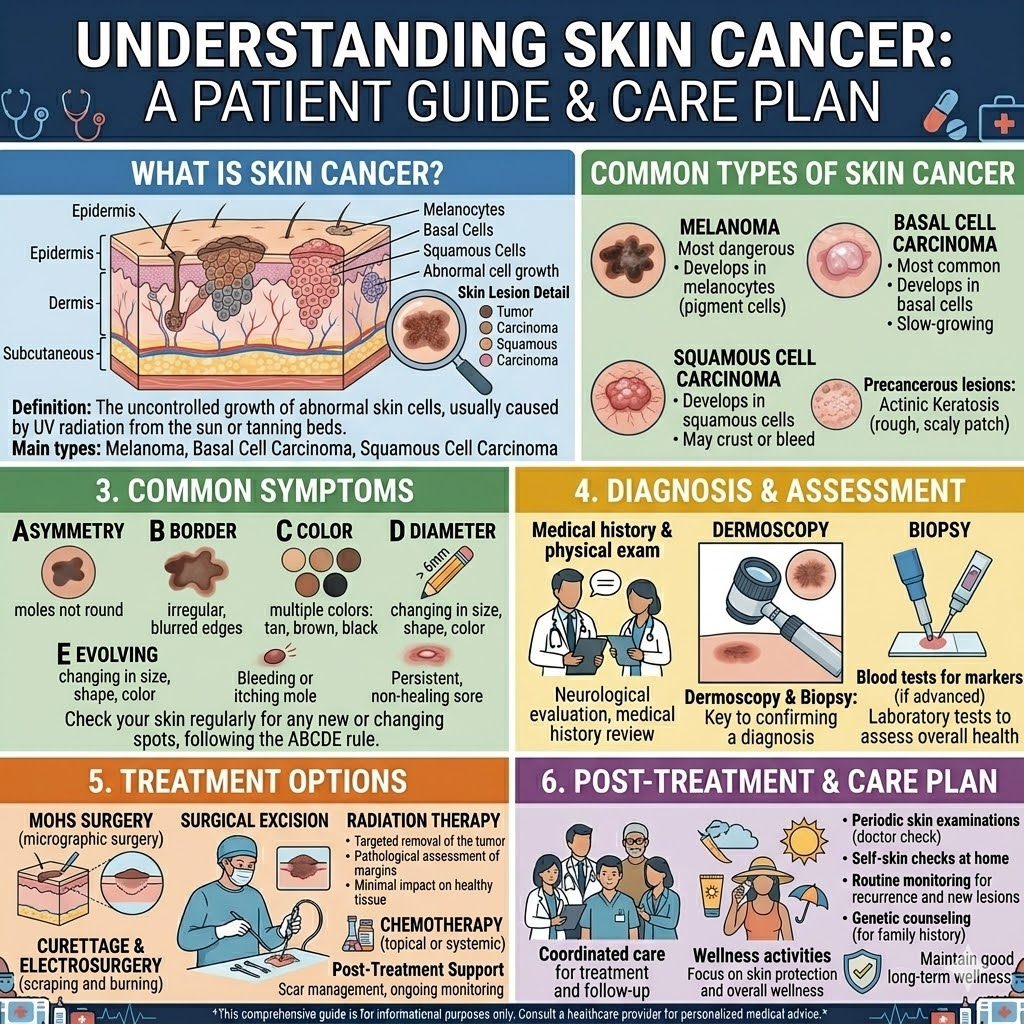
Skin cancer is a common disease where abnormal cells grow uncontrollably on the skin. These cells can damage healthy tissue and sometimes spread to other parts of the body. While many types exist, the most common are basal cell carcinoma and squamous cell carcinoma, which are often curable. Melanoma is the most serious form, more prone to spreading and thus harder to treat. Most skin cancers result from sun exposure, particularly ultraviolet (UV) light, which damages skin cell DNA. However, some develop in unexposed areas, suggesting other causes like genetics or a weakened immune system. Early detection is crucial for successful treatment.
Understanding the Condition
Understanding Skin Cancer
Understanding the Condition
Common Symptoms
New Growths: A new spot on the skin that might resemble a mole, a raised bump, or a persistent scab.
Rough Patches: An area of skin that feels rough, scaly, or dry and doesn't heal.
Non-Healing Sores: A wound or sore on the skin that doesn't get better within a few weeks.
Mole or Freckle Changes: Any mole or freckle that changes in size, shape, color, or texture, or becomes uneven, asymmetrical, or has irregular borders.
Itching or Pain: Persistent itching, tenderness, or pain around any skin growth or spot.
Location of Growths: Skin cancers often appear on sun-exposed areas like the face, scalp, lips, ears, neck, arms, and legs. However, they can also occur in less obvious places, such as the palms, soles of the feet, under nails, or in the genital area, particularly in individuals with darker skin tones.
Consultation Guide
Which Specialist to Meet
Before your appointment, note when you first noticed the change, how it has evolved, and any associated symptoms. Be ready to discuss your personal and family history of skin cancer, past sun exposure, and current medications. Prepare a list of questions for your doctor.
Book a doctor visit near me
Consultation Guide
Skin cancer is a common disease where abnormal cells grow uncontrollably on the skin. These cells can damage healthy tissue and sometimes spread to other parts of the body. While many types exist, the most common are basal cell carcinoma and squamous cell carcinoma, which are often curable. Melanoma is the most serious form, more prone to spreading and thus harder to treat. Most skin cancers result from sun exposure, particularly ultraviolet (UV) light, which damages skin cell DNA. However, some develop in unexposed areas, suggesting other causes like genetics or a weakened immune system. Early detection is crucial for successful treatment.
The area will first be cleaned and numbed with a local anesthetic injection, which might cause a brief stinging sensation. Depending on the biopsy type, your doctor will then use a specialized tool to remove the skin sample. For shave biopsies, stitches are usually not needed, and the wound often heals like a scrape. For punch or excisional biopsies, stitches may be used to close the wound, and a bandage will be applied. You might feel some pressure or pulling during the procedure, but it should not be painful. The collected tissue is then sent to a pathology lab.
CT Scan (Computed Tomography Scan)
A CT scan uses specialized X-ray equipment and computer processing to create detailed cross-sectional images ("slices") of your body. For skin cancer, especially melanoma, it's used to check if the cancer has spread to internal organs or lymph nodes.
You will lie on a motorized table that slides into a large, doughnut-shaped machine. The machine will rotate around you, taking multiple X-ray images. You will need to lie very still and may be asked to hold your breath briefly. Sometimes, a contrast dye is given intravenously (into a vein) or swallowed to make certain structures more visible; this might cause a warm sensation or a metallic taste. The procedure is typically painless and usually takes 15-30 minutes.
Schedule Professional Skin Exams: See your doctor or dermatologist for regular skin check-ups, especially if you have a history of skin cancer or increased risk factors. Report any worrying changes promptly.
Diagnostic Procedures
If you notice concerning skin changes, consult a primary care physician who may refer you to a dermatologist (a skin specialist). If cancer is diagnosed, an oncologist (cancer specialist) might also be involved.
Preparations Before Your Visit
A skin biopsy is a procedure where a small sample of skin tissue is removed and sent to a lab for microscopic examination. This is the primary method to confirm skin cancer and determine its type. There are several types: Shave Biopsy (outermost layers scraped), Punch Biopsy (deeper, cylindrical sample removed), and Excisional Biopsy (entire suspicious growth and margin removed).
What to Expect
What to Expect
Treatment Options
Surgical Procedures
Excisional Surgery: The cancerous tissue and a small border of healthy skin are cut out. (Duration: A single procedure, typically outpatient. Recovery involving wound care and stitch removal usually takes a few weeks.)
Mohs Micrographic Surgery: Thin layers of cancer-containing skin are progressively removed and examined under a microscope until only cancer-free tissue remains. This method spares the maximum amount of healthy tissue. (Duration: A single session, often lasting several hours, as tissue is removed and analyzed in stages. Recovery involves wound healing over several weeks.)
Radiation Therapy: Uses high-energy beams to destroy cancer cells. (Duration: Typically given over several weeks, with daily short sessions.)
Medication and Targeted Therapies
Chemotherapy: Medications that use powerful chemicals to kill fast-growing cancer cells, often administered intravenously or as topical creams. (Duration: Administered in cycles over weeks to months, depending on the specific drug and cancer type.)
Biological Therapy (Immunotherapy): Uses substances made from living organisms to help the body's immune system fight cancer cells. (Duration: Administered in cycles, potentially lasting weeks to months or even years.)
Photodynamic Therapy (PDT): Involves applying a special light-sensitive medication to the skin, which is then activated by a specific light source to destroy cancer cells. (Duration: Typically involves one or more sessions, followed by a period of light avoidance, often over several weeks.)
Prevention & Long-Term Wellbeing
Prevention
Practice Sun Safety: Seek shade, especially between 10 a.m. and 3 p.m. Wear protective clothing (long sleeves, pants, wide-brimmed hat, UV-blocking sunglasses). Apply broad-spectrum sunscreen (SPF 30+) year-round, reapplying every two hours or more often if swimming/sweating.
Avoid Tanning Beds: Tanning beds emit harmful UV radiation that significantly increases skin cancer risk.
Long-Term Monitoring
Perform Regular Self-Skin Exams: Become familiar with your skin and routinely check for new growths or changes in existing moles, freckles, bumps, and birthmarks. Use mirrors to examine hard-to-see areas.
Tags & Topics
Notice an error or need an update?
Help us keep medical information accurate. Report incorrect info or suggest an edit.


