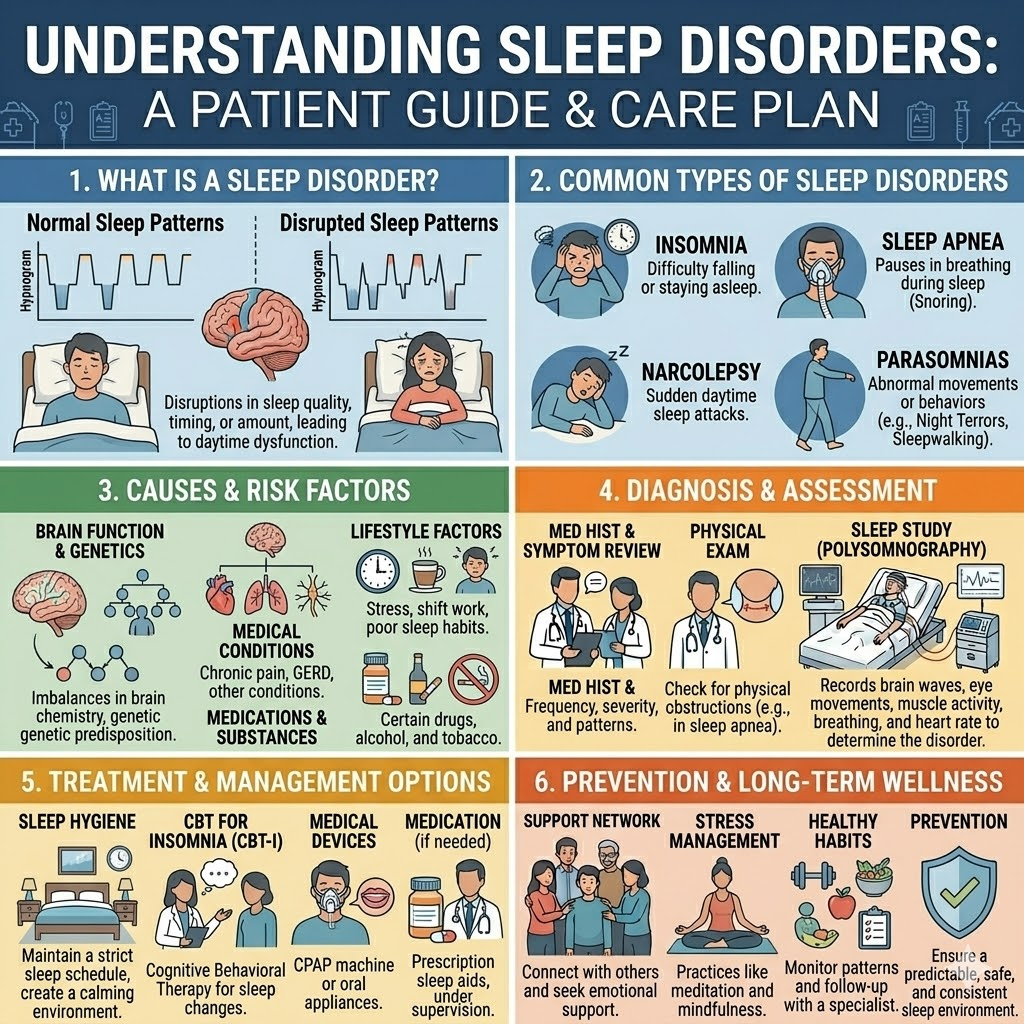
Sleep disorders are medical conditions that disrupt your sleep patterns, preventing you from getting enough restful sleep. This can lead to excessive daytime sleepiness, unusual breathing during sleep, or difficulty falling or staying asleep. Untreated sleep disorders can significantly impair your overall health, safety (e.g., driving), and quality of life, increasing risks for other serious health issues. Fortunately, effective treatments are available to help restore healthy sleep.
Understanding the Condition
Common Symptoms
Excessive Daytime Sleepiness: Feeling unusually tired or falling asleep unintentionally during the day, even during activities like driving, working, or talking.
Sleep Initiation & Maintenance Difficulties: Consistently struggling to fall asleep, frequent awakenings during the night with trouble returning to sleep, or waking up much earlier than desired.
Breathing Irregularities During Sleep: Noticed patterns of loud snoring, snorting, gasping, choking, or pauses in breathing during sleep.
Uncomfortable Urge to Move Limbs: Experiencing an uncomfortable, often 'creepy-crawly' or tingling sensation in legs or arms, creating an irresistible urge to move them when trying to sleep.
Excessive Sleep Movements: Frequent or disruptive body movements during sleep, such as restless leg or arm movements, or habitual teeth grinding (bruxism).
Unusual Sleep Behaviors: Engaging in activities while asleep that are typically performed while awake, including sleepwalking, sleep-eating, or bed-wetting.
Consultation Guide
Which Specialist to Meet
If you consistently struggle with sleep, don't feel rested upon waking, or experience excessive daytime sleepiness, start by consulting your primary care doctor. They may refer you to a sleep specialist (a physician with expertise in sleep medicine), a neurologist (for nerve- or brain-related sleep issues), or a pulmonologist (for breathing-related sleep disorders).
Preparations Before Your Visit
Before your visit, keep a detailed sleep diary for one to two weeks, noting your sleep and wake times, perceived sleep quality, any awakenings, daytime alertness levels, and intake of caffeine or alcohol. List all your symptoms, recent life changes, and any medications or supplements you are currently taking. Prepare a list of questions for your doctor.
Book a doctor visit near me
A patient-kept record documenting daily sleep patterns, habits, and symptoms, providing crucial subjective information for diagnosis and treatment planning.
Adhere to Prescribed Treatment Plans: Consistently follow your doctor's recommendations for devices, medications, or therapies to manage symptoms and prevent complications.
Diagnostic Procedures
Sleep Disorders: Understanding, Diagnosis, and Treatment
Understanding the Condition
Polysomnography (Sleep Study)
An overnight test conducted in a sleep lab that records brain activity (EEG), eye movements, muscle activity, heart rate, breathing patterns, and blood oxygen levels to diagnose conditions like sleep apnea or narcolepsy.
What to Expect
You'll spend the night in a specialized sleep center. Technicians will attach small, painless sensors to your scalp, face, chest, and limbs using adhesive or paste. These sensors connect to a computer that records your physiological data throughout the night. You'll be monitored by staff, and while the sensors may feel unusual, most people are able to sleep sufficiently for diagnostic purposes.
Multiple Sleep Latency Test (MSLT)
Often performed the day after a polysomnography, this test measures how quickly you fall asleep during the day to assess the severity of daytime sleepiness, particularly for conditions like narcolepsy.
What to Expect
You will be given several (typically four or five) opportunities to nap for 20 minutes each, spaced two hours apart, in a quiet, dark room. Sensors similar to those from the overnight study will monitor your brain activity to determine when you fall asleep and if you enter REM sleep. You'll be asked to try and stay awake between nap periods.
Maintenance of Wakefulness Test (MWT)
This test measures your ability to stay awake and alert for a defined period in a quiet environment, often used to evaluate treatment effectiveness or fitness for certain occupations.
What to Expect
Similar to the MSLT, you'll sit in a quiet, dimly lit room for several trials throughout the day. Instead of napping, you'll be instructed to try and stay awake for a specific period (e.g., 40 minutes). Sensors will again monitor your brain activity to detect any onset of sleep.
A small, watch-like device worn on the wrist that continuously records movement and activity patterns over several days or weeks, providing insights into sleep-wake cycles and overall sleep quantity.
What to Expect
You'll wear a small, unobtrusive device on your wrist, much like a watch, for an extended period (typically one to two weeks) while at home. You go about your normal daily activities, and the device passively collects data on your movement, which helps estimate your sleep and wake times without requiring a lab visit.
What to Expect
Treatment Options
Sleep disorders are medical conditions that disrupt your sleep patterns, preventing you from getting enough restful sleep. This can lead to excessive daytime sleepiness, unusual breathing during sleep, or difficulty falling or staying asleep. Untreated sleep disorders can significantly impair your overall health, safety (e.g., driving), and quality of life, increasing risks for other serious health issues. Fortunately, effective treatments are available to help restore healthy sleep.
You will be asked to meticulously record details about your sleep for one to two weeks. This includes bedtime, wake-up time, how long it took to fall asleep, any nighttime awakenings, perceived sleep quality, daytime alertness levels, and any consumption of caffeine, alcohol, or medications.
Medications
Sleep-Promoting Medications: Prescription medications to help initiate or maintain sleep, used for short-term insomnia or specific sleep disorders. (Duration: Short-term use or as prescribed by a doctor; duration varies depending on specific medication and condition.)
Wakefulness-Promoting Medications: Prescription medications designed to reduce excessive daytime sleepiness associated with conditions like narcolepsy or severe sleep apnea. (Duration: Daily, as prescribed by a doctor, often long-term for chronic conditions.)
Medications for Restless Legs Syndrome: Specific medications to reduce the uncomfortable sensations and urges to move limbs associated with restless legs syndrome. (Duration: Daily, as prescribed by a doctor, often long-term for chronic management.)
Surgical Procedures
Airway Surgery for Sleep Apnea: Various surgical options to remove or reposition tissue in the throat or jaw to widen the airway and reduce obstructions, considered when other treatments are ineffective. (Duration: One-time procedure with a recovery period; effectiveness varies by individual and procedure type.)
Schedule Regular Medical Check-ups: Maintain follow-up appointments with your doctor or sleep specialist to monitor your condition, assess treatment effectiveness, and address new concerns.
Address Underlying Health Issues: Work with your healthcare team to manage any medical or mental health conditions that can contribute to sleep problems, such as heart disease, diabetes, depression, or anxiety.
Avoid Unsupervised Self-Medication: Do not use over-the-counter sleep aids or recreational drugs without medical guidance, as they can worsen sleep problems or interact with other medications.
Educate Yourself and Your Family: Understand your specific sleep disorder and share information with family to foster support for your treatment and lifestyle adjustments.
Prevention & Long-Term Wellbeing
Lifestyle and Behavioral Therapies
Sleep Hygiene Improvements: Establishing a consistent sleep schedule, creating a relaxing bedtime routine, ensuring a dark, quiet, and cool sleep environment, and avoiding large meals, caffeine, or alcohol before bed. (Duration: Ongoing; immediate effects may be seen, but consistent practice is key for long-term benefit.)
Cognitive Behavioral Therapy for Insomnia (CBT-I): A structured program to identify and modify thoughts and behaviors that interfere with sleep, replacing them with habits that promote healthy sleep. (Duration: Typically 6-8 weekly sessions, with lasting benefits and self-management skills.)
Light Therapy: Exposure to specific types of artificial bright light to help reset the body's internal clock, often used for circadian rhythm disorders like jet lag or shift work sleep disorder. (Duration: Daily for several weeks initially, then as needed for maintenance.)
Continuous Positive Airway Pressure (CPAP): A device that delivers a constant stream of air through a mask worn during sleep, keeping the airway open and preventing breathing pauses, primarily for obstructive sleep apnea. (Duration: Nightly use, long-term; immediate improvement in breathing and sleep quality.)
Oral Appliances: Custom-fitted mouthpieces worn during sleep to reposition the jaw and tongue, helping to keep the airway open. Used for mild to moderate sleep apnea or snoring. (Duration: Nightly use, long-term; effects are noticeable quickly.)
Prevention and Healthy Sleep Habits
Maintain a Consistent Sleep Schedule: Go to bed and wake up at the same time every day, including weekends, to regulate your body's natural sleep-wake cycle.
Create a Relaxing Bedtime Routine: Engage in calming activities like reading, taking a warm bath, or listening to quiet music for an hour before bed.
Optimize Your Sleep Environment: Ensure your bedroom is dark, quiet, cool, and comfortable. Remove distractions like electronic devices.
Mindful Diet and Hydration: Avoid heavy meals, excessive liquids, caffeine, and alcohol, especially several hours before bedtime.
Regular Physical Activity: Incorporate daily exercise, but finish strenuous workouts at least a few hours before you plan to sleep.
Manage Stress Effectively: Practice stress-reduction techniques such as meditation, yoga, or deep breathing to calm your mind before sleep.
Long-Term Monitoring and Management
Tags & Topics
Notice an error or need an update?
Help us keep medical information accurate. Report incorrect info or suggest an edit.


