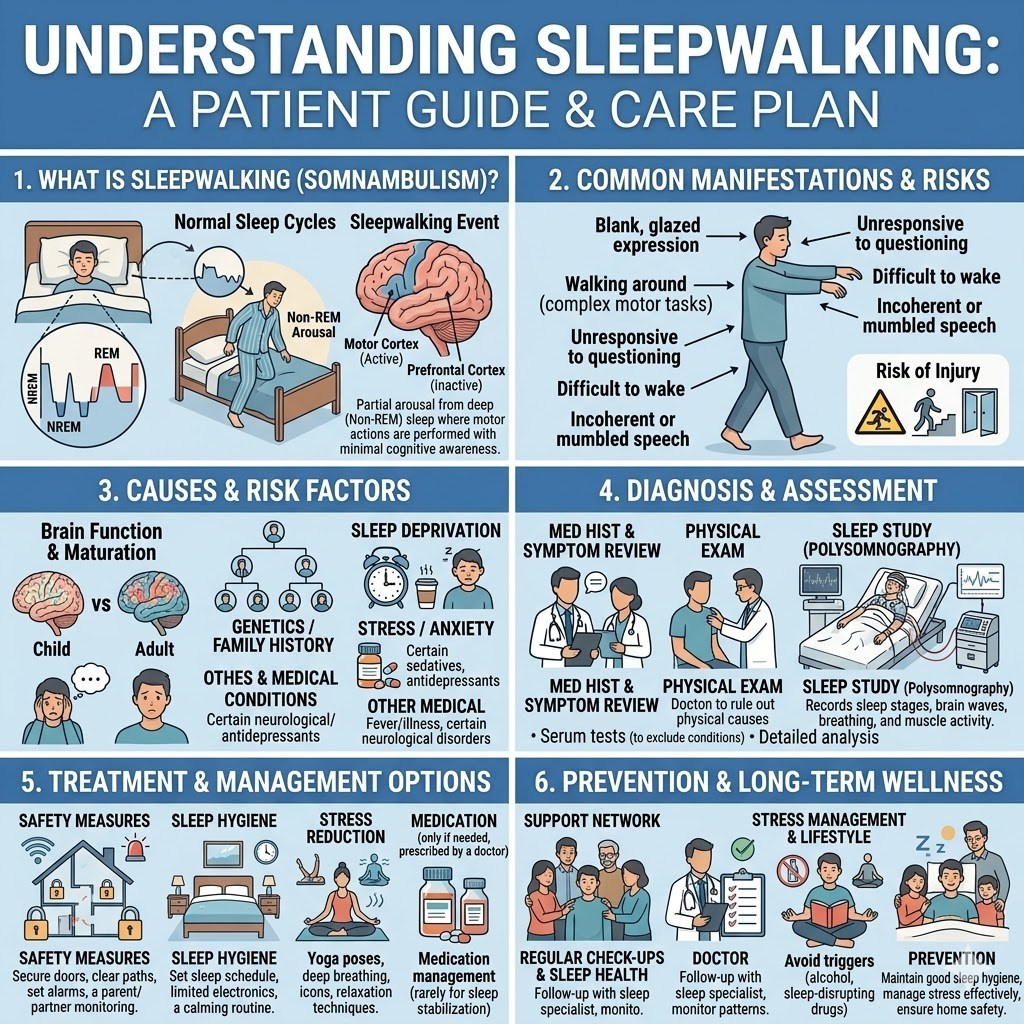
Sleepwalking, medically known as somnambulism, is a condition where individuals get out of bed and perform activities while still in a state of deep sleep. It is more prevalent in children, who often outgrow it by their teenage years. Occasional sleepwalking is usually not a cause for concern and doesn't require specific treatment. However, frequent episodes or sleepwalking that starts in adulthood may indicate an underlying sleep disorder or other medical conditions. For anyone in the household who sleepwalks, it is crucial to implement safety measures to prevent potential injuries.
Understanding the Condition
Understanding Sleepwalking (Somnambulism)
Understanding the Condition
Common Symptoms
Moving While Asleep: Getting out of bed and walking around, or simply sitting up in bed with open eyes, without being truly awake.
Blank Stare: Having a glazed, glassy-eyed expression, often appearing unresponsive to others.
Difficulty Communicating: Not responding to attempts to talk to them, or speaking in a way that doesn't make sense.
Hard to Wake: Being difficult to rouse from sleep, even during an episode.
Post-Awakening Confusion: Feeling confused or disoriented for a short period after being woken up from a sleepwalking episode.
No Memory: Having no recollection of the sleepwalking event in the morning.
Daytime Tiredness: Experiencing problems functioning during the day due to disturbed sleep at night.
Associated Sleep Terrors: Sometimes occurring alongside sleep terrors, which involve screaming, thrashing, and extreme fear during sleep.
Consultation Guide
Which Specialist to Meet
Address New or Worsening Symptoms: If sleepwalking episodes become more frequent, severe, or are accompanied by new symptoms, seek immediate medical advice.
Consultation Guide
Sleepwalking, medically known as somnambulism, is a condition where individuals get out of bed and perform activities while still in a state of deep sleep. It is more prevalent in children, who often outgrow it by their teenage years. Occasional sleepwalking is usually not a cause for concern and doesn't require specific treatment. However, frequent episodes or sleepwalking that starts in adulthood may indicate an underlying sleep disorder or other medical conditions. For anyone in the household who sleepwalks, it is crucial to implement safety measures to prevent potential injuries.
Prescription Medications: In some cases, especially when sleepwalking is frequent, severe, or causes safety concerns, a doctor may prescribe certain medications (e.g., specific sedatives or anti-anxiety drugs) to help reduce the episodes. These are generally used when other strategies haven't been successful. (Duration: Typically short-term or as needed, under strict medical supervision.)
Procedures Addressing Underlying Conditions
Educate Household Members: Inform family members or housemates about sleepwalking and how to safely guide an individual back to bed without waking them abruptly, which can cause confusion or agitation.
Diagnostic Procedures
Start by consulting your primary care doctor. Depending on the findings, they may refer you to a sleep specialist, such as a neurologist or pulmonologist with expertise in sleep medicine, to evaluate your sleep patterns and diagnose any underlying conditions. For children, a pediatrician may refer to a pediatric sleep specialist.
Preparations Before Your Visit
Polysomnography (Sleep Study)
A polysomnography, commonly known as a sleep study, is a comprehensive test used to diagnose various sleep disorders. It records several body functions during sleep, including brain waves, the oxygen level in your blood, heart rate, breathing patterns, and eye and leg movements. This test helps identify if and when your sleep patterns are disrupted and why, particularly in cases where sleepwalking is frequent or concerns other health issues.
What to Expect
A sleep study is usually conducted overnight at a specialized sleep center or a hospital's sleep disorders unit. You will arrive in the evening and be prepared by a technician. Small sensors (electrodes) will be painlessly attached to your scalp, face, chest, and limbs. These sensors are connected by wires to a computer that records data while you sleep. You'll sleep in a private room, and the technician will monitor you from an adjacent room. The sensors track your brain activity (EEG) to identify sleep stages, breathing (airflow, effort), heart rhythm, and muscle activity. Sometimes, a home sleep apnea test may be used first to screen for obstructive sleep apnea, which involves fewer sensors and can be done in your own bed. Regardless of the setting, the goal is to observe your natural sleep to gather crucial diagnostic information.
Treatment Options
Before your appointment, keep a detailed sleep diary for one to two weeks, noting your sleep and wake times, any observed sleepwalking incidents, and how you feel during the day. Prepare a list of all medications you are currently taking, any other medical conditions you have, and your family's medical history, especially regarding sleep disorders. Be ready to describe specific sleepwalking events, including what happened and how long they lasted. Also, list any questions you have for the doctor.
Book a doctor visit near me
Medications
Treatment for Sleep-Disordered Breathing: If an underlying condition like obstructive sleep apnea is causing sleepwalking, treatments such as continuous positive airway pressure (CPAP) therapy, oral appliances, or in rare cases, surgery, may be recommended to improve breathing during sleep. (Duration: CPAP: Ongoing nightly; Oral appliances: Ongoing nightly; Surgery: Single procedure with recovery time.)
Regular Medical Follow-ups: Maintain regular appointments with your doctor or sleep specialist to monitor the frequency and severity of sleepwalking episodes and adjust any treatment plans as needed.
Maintain a Sleep Journal: Continue to log sleep patterns, potential triggers, and any observed episodes, which can provide valuable information for ongoing management and treatment adjustments.
Prevention & Long-Term Wellbeing
Home Remedies and Lifestyle Adjustments
Prioritize Sleep: Ensure you get enough sleep consistently. Sleep deprivation is a common trigger for sleepwalking. (Duration: Ongoing)
Maintain a Regular Sleep Schedule: Go to bed and wake up at the same time each day, even on weekends, to regulate your body's natural sleep-wake cycle. (Duration: Ongoing)
Create a Safe Sleep Environment: Lock windows and doors, remove clutter from pathways, secure stairways with gates, and put away dangerous objects to prevent injury during an episode. (Duration: Ongoing)
Avoid Triggers: Limit or avoid alcohol, caffeine, and heavy meals, especially close to bedtime, as these can disrupt sleep. (Duration: Ongoing)
Scheduled Awakenings: For children, this involves gently waking them 15-30 minutes before they typically sleepwalk, keeping them awake for a few minutes, and then letting them fall back asleep. This can disrupt the cycle. (Duration: Daily for several weeks, then adjusted as needed.)
Stress Management: Techniques such as meditation, deep breathing exercises, or yoga can help reduce stress and anxiety, which are known triggers for sleepwalking. (Duration: Ongoing, as part of daily routine.)
Prevention
Prioritize Consistent, Quality Sleep: Make sleep a priority by adhering to a strict sleep schedule, even on weekends, and ensuring 7-9 hours of sleep for adults, and more for children and adolescents.
Optimize Your Sleep Environment: Keep your bedroom dark, quiet, cool, and comfortable. Avoid screens (phones, tablets, TVs) for at least an hour before bedtime.
Manage Stress and Anxiety: Incorporate relaxation techniques into your daily routine, such as mindfulness, deep breathing, or light exercise, to reduce stress that can trigger sleepwalking.
Avoid Sleep-Disrupting Substances: Refrain from consuming alcohol, caffeine, and nicotine, especially in the hours leading up to bedtime, as these can interfere with deep sleep stages.
Ensure Home Safety: Secure your home environment by locking doors and windows, placing gates at stairwells, and removing any potential hazards or sharp objects from pathways to prevent injuries during episodes.
Long-Term Monitoring and Support
Tags & Topics
Notice an error or need an update?
Help us keep medical information accurate. Report incorrect info or suggest an edit.


