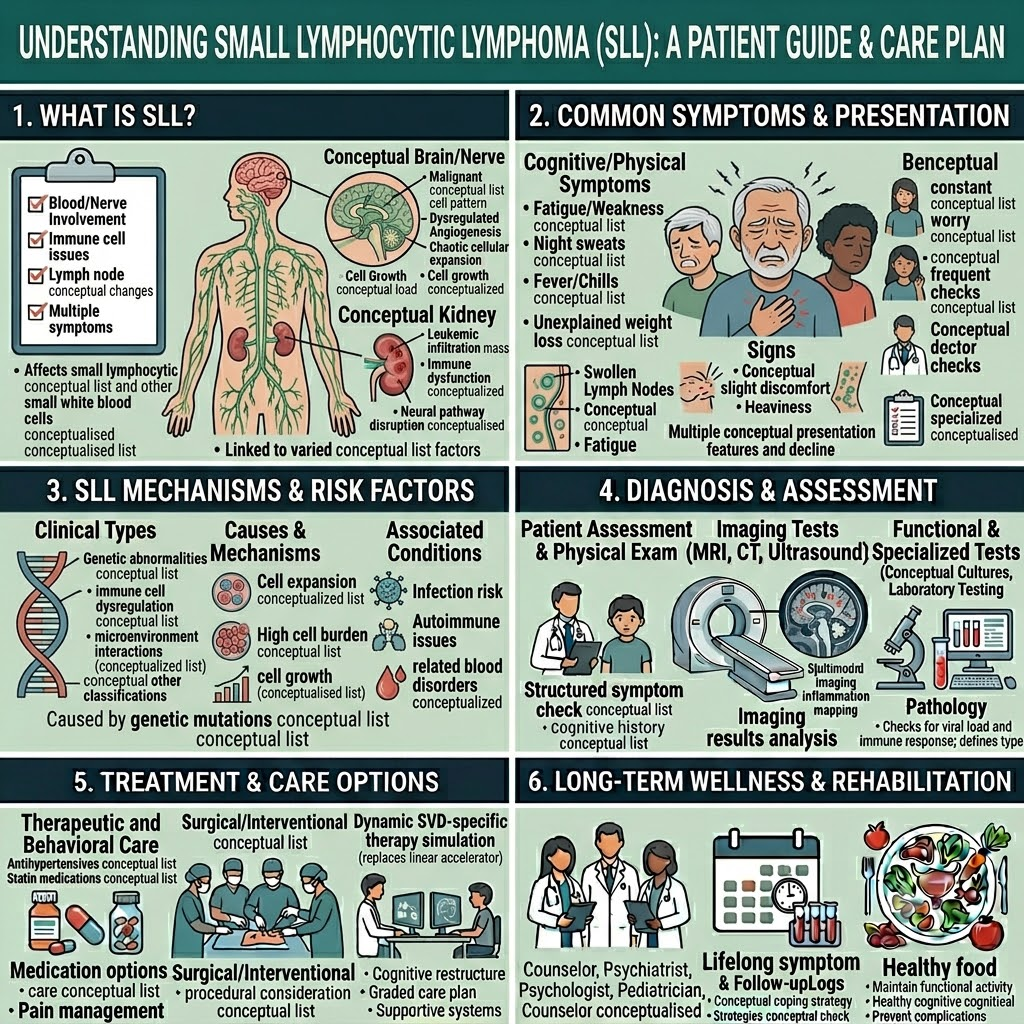
Small Lymphocytic Lymphoma (SLL) is a slow-growing cancer that affects the lymphatic system, a vital part of your body's immune defense against germs. It's classified as a type of non-Hodgkin lymphoma. SLL is closely related to chronic lymphocytic leukemia (CLL); however, in SLL, the cancer cells are primarily found in the lymph nodes, while in CLL, they are more often in the blood and bone marrow. SLL can impact lymph nodes, the spleen, blood, bone marrow, and other body parts. While often not curable, treatments can effectively control the disease for extended periods, leading to a generally favorable outlook for many patients.
Understanding the Condition
Small Lymphocytic Lymphoma (SLL): A Comprehensive Guide
Understanding the Condition
Common Symptoms
Swollen Lymph Nodes: These might feel like painless lumps under the skin, most commonly in the neck, armpit, or groin.
Drenching Night Sweats: Profuse sweating during the night, often soaking clothes or bedding.
Unexplained Weight Loss: Losing weight without intentionally trying to do so.
Loss of Appetite: A noticeable decrease in the desire to eat.
Upper Left Abdominal Pain: Discomfort or pain in the upper left side of the belly, which can be a sign of an enlarged spleen.
Consultation Guide
Which Specialist to Meet
If you experience concerning symptoms, you should consult with a general practitioner initially. They may refer you to a specialist such as a hematologist (a doctor specializing in blood disorders) or an oncologist (a doctor specializing in cancer treatment).
Preparations Before Your Visit
Before your appointment, gather your medical history, including any past illnesses, current medications, and allergies. Make a list of all your symptoms, noting when they started and how often they occur. Write down any questions you have for your doctor to ensure all your concerns are addressed during the visit.
Book a doctor visit near me
Watch and Wait Approach: For slow-growing cancers like SLL, some individuals may not require immediate treatment. Instead, your doctor will closely monitor your condition for any signs of progression. (Duration: Ongoing, until treatment becomes necessary based on symptoms or disease progression.)
Targeted Therapy: Drugs designed to specifically attack cancer cells by targeting unique features that help them grow and survive, while minimizing harm to healthy cells. (Duration: Varies widely, often taken for months or even years, depending on the specific therapy and response.)
Diagnostic Procedures
Complete Blood Count (CBC)
A routine blood test that measures the different types of cells in your blood, including red blood cells, white blood cells, and platelets. It can indicate unusual increases or decreases in cell counts, which may suggest an underlying condition.
What to Expect
A healthcare professional will draw a small sample of blood, typically from a vein in your arm. The process is quick, usually taking only a few minutes, and involves a brief pinch as the needle is inserted. No specific preparation, like fasting, is usually required unless other tests are ordered simultaneously.
Bone Marrow Aspiration and Biopsy
These procedures collect and examine bone marrow, the soft tissue inside certain bones where blood cells are produced. Aspiration removes a liquid sample, while a biopsy takes a small piece of solid bone tissue and marrow.
What to Expect
You will usually lie on your stomach or side. After numbing the skin and bone, a thin needle is inserted into the back of your hip bone (pelvis) to withdraw a liquid sample (aspiration). You might feel a strong pressure or a brief, sharp pain as the marrow is removed. Then, a slightly larger needle takes a small piece of solid bone and marrow (biopsy). The area may be sore for a few days. The entire procedure typically takes 15-30 minutes.
CT Scan (Computed Tomography Scan)
An imaging technique that uses X-rays and computer processing to create detailed cross-sectional images (slices) of bones, blood vessels, and soft tissues inside the body. These images provide more detail than standard X-rays.
What to Expect
You will lie on a motorized table that slides into a large, doughnut-shaped machine. The machine rotates around you, taking images from various angles. You may be given a contrast dye, either orally or through an injection, to make certain body parts clearer. You must remain still during the scan, which typically lasts 10-30 minutes.
PET Scan (Positron Emission Tomography Scan)
An imaging test that helps reveal the metabolic or biochemical function of tissues and organs. It often detects disease activity before it appears on other imaging tests by showing areas of high metabolic activity, which can indicate cancer.
What to Expect
A small amount of a radioactive tracer is injected into your arm, and you'll typically wait about an hour for it to circulate in your body. Then, you will lie on a narrow table that slides into a doughnut-shaped scanner. You must remain very still for about 30 minutes while the scanner takes images. The PET scan is often combined with a CT scan (PET-CT) for more precise imaging.
Clinical Trials: Research studies that test new treatments, procedures, or combinations of therapies. These offer access to cutting-edge approaches not yet widely available. (Duration: Highly variable, depending on the specific trial protocol, which can range from weeks to several years.)
Monitoring for Disease Progression: Regular check-ups and diagnostic tests are crucial to monitor for any changes in the disease, including a rare progression to a more aggressive form of cancer, like diffuse large B-cell lymphoma (Richter syndrome), or an increased risk of other cancers (e.g., skin, lung, digestive tract).
Addressing Immune System Attacks: A small number of SLL patients may experience their immune system mistakenly attacking healthy blood cells, such as red blood cells (autoimmune hemolytic anemia) or platelets (autoimmune thrombocytopenia). Your doctor will monitor for these and provide appropriate management.
Regular Follow-ups: Adhere to your doctor's recommended schedule for appointments and tests. This ensures continuous monitoring of your disease, allows for timely adjustments to treatment, and helps manage any side effects or new complications promptly.
Treatment Options
Small Lymphocytic Lymphoma (SLL) is a slow-growing cancer that affects the lymphatic system, a vital part of your body's immune defense against germs. It's classified as a type of non-Hodgkin lymphoma. SLL is closely related to chronic lymphocytic leukemia (CLL); however, in SLL, the cancer cells are primarily found in the lymph nodes, while in CLL, they are more often in the blood and bone marrow. SLL can impact lymph nodes, the spleen, blood, bone marrow, and other body parts. While often not curable, treatments can effectively control the disease for extended periods, leading to a generally favorable outlook for many patients.
Chemotherapy: Powerful drugs that kill fast-growing cells, primarily cancer cells. It can be given orally or intravenously. (Duration: Typically administered in cycles over several months, with breaks in between treatments.)
Immunotherapy: Treatments that harness and boost your body's own immune system to recognize and fight cancer cells. (Duration: Varies, often given in cycles over several months to years, or until disease progression or unacceptable toxicity.)
Radiation Therapy: Uses high-energy beams, often X-rays, to destroy cancer cells and shrink tumors. It can be external (beams aimed from outside the body) or internal (small implants placed near the cancer). (Duration: Typically delivered in daily sessions over several weeks, depending on the type and location of the cancer.)
Prevention & Long-Term Wellbeing
Bone Marrow Transplant (Stem Cell Transplant): A procedure to replace unhealthy bone marrow with healthy blood-forming stem cells. These cells can come from your own body (autologous) or a donor (allogeneic). (Duration: Involves intensive preparation (chemotherapy) over several days, the transplant itself, and then several weeks to months of recovery and close monitoring.)
CAR-T Cell Therapy: A type of immunotherapy where a patient's own immune cells (T-cells) are collected, genetically modified in a lab to better recognize and attack cancer cells, and then infused back into the patient. (Duration: The process of collecting, modifying, and re-infusing cells takes several weeks. The infusion itself is a single event, but monitoring and recovery can extend for months.)
Managing Complications
Preventing Infections: SLL can weaken your immune system, making you more susceptible to infections. Practice good hygiene, avoid sick individuals, and discuss immunizations or immunoglobulin infusions with your doctor to bolster your body's defenses.
Lifestyle and Support
Maintaining a Healthy Lifestyle: Adopt a balanced diet, engage in light exercise as tolerated, and ensure adequate sleep to support your overall health and energy levels, which can help manage fatigue associated with cancer.
Stress Management: Coping with SLL can be emotionally challenging. Incorporate stress-reducing activities like mindfulness, meditation, or joining support groups to help manage the psychological impact of your condition.
Tags & Topics
Notice an error or need an update?
Help us keep medical information accurate. Report incorrect info or suggest an edit.


