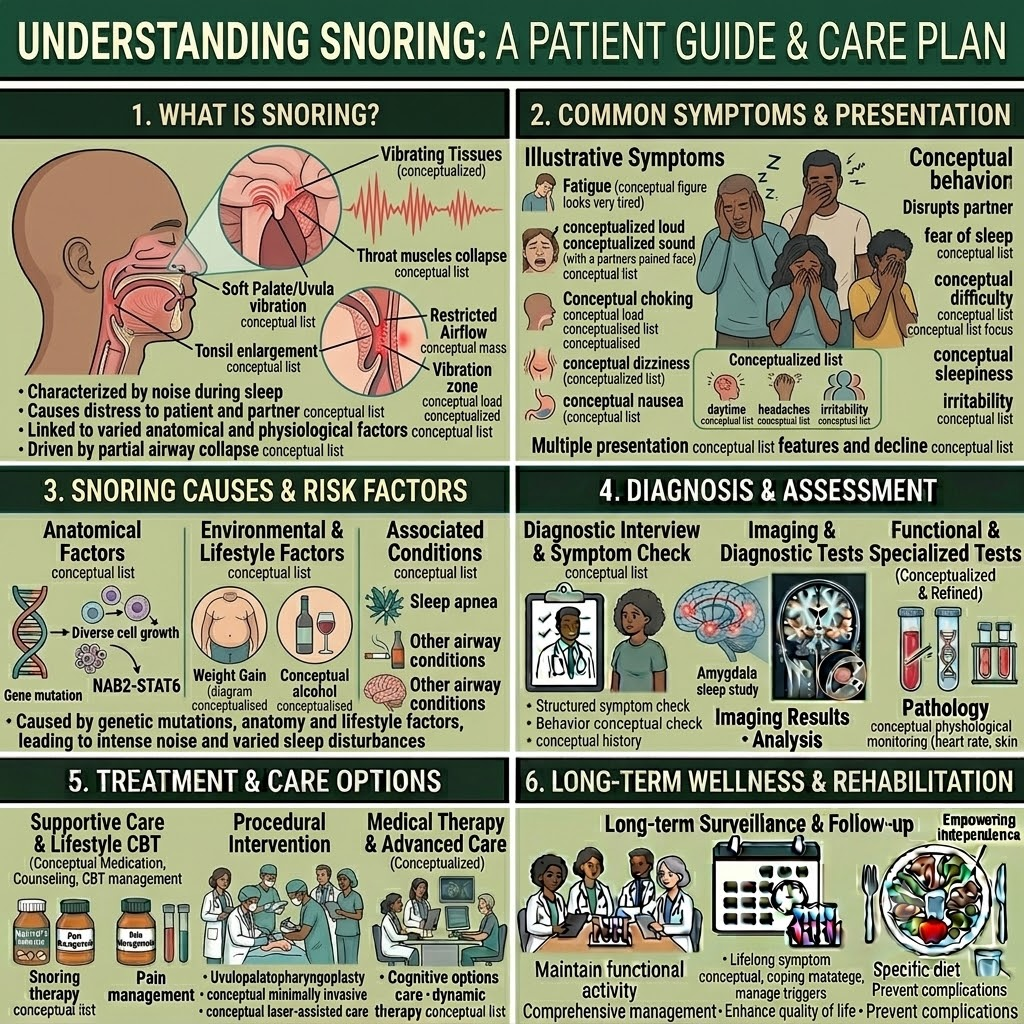
Snoring is a common sound made during sleep, characterized by a harsh or hoarse noise. It happens when air moves past relaxed tissues in your throat, causing them to vibrate. While occasional snoring is normal, persistent snoring can signal a serious underlying health problem, such as obstructive sleep apnea. It can also significantly disturb a bed partner's sleep. Simple lifestyle adjustments, specific medical devices, and sometimes surgery can help reduce or stop disruptive snoring, though not all treatments are suitable for everyone.
Understanding the Condition
Understanding Snoring and Its Health Implications
Understanding the Condition
Common Symptoms
Witnessed Breathing Pauses: Someone observing you momentarily stop breathing during sleep.
Excessive Daytime Sleepiness: Feeling very tired and sleepy during the day, even after a full night's rest.
Difficulty Concentrating: Struggling to focus or maintain attention on tasks.
Morning Headaches: Waking up with a headache regularly.
Sore Throat Upon Awakening: Experiencing a dry or sore throat immediately after waking.
Restless Sleep: Frequent tossing and turning, or generally not feeling rested after sleep.
Gasping or Choking at Night: Waking up suddenly feeling like you're gasping for air or choking.
High Blood Pressure: Developing or worsening high blood pressure.
Chest Pain at Night: Experiencing chest discomfort while sleeping.
Disruptive Snoring: Snoring that is loud enough to consistently disturb your bed partner's sleep.
In Children: Poor attention span, behavioral issues, or struggling with school performance.
Consultation Guide
Which Specialist to Meet
Begin by consulting your primary care doctor. They can assess your symptoms and medical history. Depending on their findings, they may refer you to a sleep specialist, who focuses on sleep disorders, or an Ear, Nose, and Throat (ENT) specialist (otolaryngologist), who can evaluate your airway anatomy.
Preparations Before Your Visit
Before your appointment, it's helpful to keep a sleep diary for a week or two, noting when you sleep, wake up, and any related symptoms. List all current medications and provide a complete medical history. If possible, ask your bed partner to observe and document your snoring patterns and any breathing pauses they notice.
Book a doctor visit near me
Regular Medical Check-ups: If you experience persistent snoring or symptoms of sleep apnea, regular follow-up with your doctor or sleep specialist is crucial for monitoring and adjusting treatment.
Monitor for Symptom Changes: Be aware of any changes in your snoring intensity, frequency of breathing pauses, or daytime sleepiness, and report them to your healthcare provider.
Consultation Guide
A sleep study is the most comprehensive test for sleep disorders, including obstructive sleep apnea. It monitors brain waves, blood oxygen, heart rate, breathing, and eye/leg movements while you sleep, revealing disruptions and their causes.
Maintain a Healthy Weight: Obesity is a significant risk factor; managing your weight through diet and exercise can greatly reduce snoring.
Limit Alcohol and Sedatives: Avoid alcohol and medications that cause drowsiness, especially before bedtime, as they relax throat muscles.
Establish a Regular Sleep Schedule: Go to bed and wake up at consistent times to promote sufficient and restful sleep.
Optimize Sleep Position: Primarily sleep on your side rather than your back to prevent gravity from narrowing your airway. Consider using special pillows or devices to maintain this position.
Keep Nasal Passages Clear: Use saline rinses, nasal strips, or decongestants (as advised by a doctor) to manage nasal congestion caused by allergies or colds.
Diagnostic Procedures
An X-ray is a quick, painless imaging test that uses radiation to create pictures of internal body structures, especially bones. It can help identify structural issues in the head and neck relevant to snoring.
What to Expect
You'll be positioned by a technician to stand, sit, or lie down and asked to remain still for a few seconds while the images are taken. The process is quick, usually taking only a few minutes.
CT Scan (Computed Tomography Scan)
A CT scan uses multiple X-ray images from different angles, processed by a computer to create detailed cross-sectional views ("slices") of bones, blood vessels, and soft tissues. This provides a comprehensive view of your head, neck, and airway anatomy, identifying potential blockages or abnormalities linked to snoring or sleep apnea.
What to Expect
You will lie on a motorized table that slides into a large, donut-shaped scanner. You must remain still. You might hear humming. A contrast dye may be used to enhance visibility. The scan is painless and takes 10 to 30 minutes.
Polysomnography (Sleep Study)
What to Expect
You typically spend a night at a sleep center. Small sensors are attached to your scalp, face, chest, and limbs with adhesive and connected to monitoring equipment. The goal is to sleep as normally as possible. Home versions are also available.
Treatment Options
Snoring is a common sound made during sleep, characterized by a harsh or hoarse noise. It happens when air moves past relaxed tissues in your throat, causing them to vibrate. While occasional snoring is normal, persistent snoring can signal a serious underlying health problem, such as obstructive sleep apnea. It can also significantly disturb a bed partner's sleep. Simple lifestyle adjustments, specific medical devices, and sometimes surgery can help reduce or stop disruptive snoring, though not all treatments are suitable for everyone.
Maxillomandibular Advancement (MMA): Extensive surgery to move both jaws forward, significantly enlarging the airway. (Duration: Permanent effect)
Nasal Surgery: Procedures like septoplasty (deviated septum correction) or turbinate reduction improve nasal airflow. (Duration: Permanent effect)
Prevention & Long-Term Wellbeing
Lifestyle Changes and Home Remedies
Weight Loss: Reduce body weight to decrease throat tissue narrowing. (Duration: Ongoing)
Avoid Alcohol Before Bed: Limit alcohol close to bedtime to prevent excessive throat muscle relaxation. (Duration: As needed)
Sleep on Your Side: Helps keep the airway open by countering gravity's effect. (Duration: Nightly)
Clear Nasal Passages: Treat allergies or congestion to improve nasal airflow. (Duration: As needed)
Address Sleep Deprivation: Ensure adequate sleep to prevent excessive muscle relaxation. (Duration: Ongoing)
Medical Devices and Therapies
Oral Appliances: Custom mouthpieces worn nightly to advance the jaw/tongue, keeping the airway open. (Duration: Worn nightly)
Continuous Positive Airway Pressure (CPAP): A machine worn nightly that delivers air pressure via a mask to prevent airway collapse. (Duration: Worn nightly)
Uvulopalatopharyngoplasty (UPPP): Removes excess throat tissue to widen the airway. (Duration: Permanent effect)
Palatal Implants: Small rods surgically inserted to stiffen the soft palate, reducing vibration. (Duration: Permanent effect)
Radiofrequency Tissue Ablation: Uses energy to shrink and stiffen soft palate, tongue, or uvula tissues. (Duration: Permanent effect, may need multiple sessions)
Genioglossus Advancement: Moves part of the jaw bone forward to reposition and stabilize the tongue. (Duration: Permanent effect)
Prevention and Long-Term Management
Tags & Topics
Notice an error or need an update?
Help us keep medical information accurate. Report incorrect info or suggest an edit.


