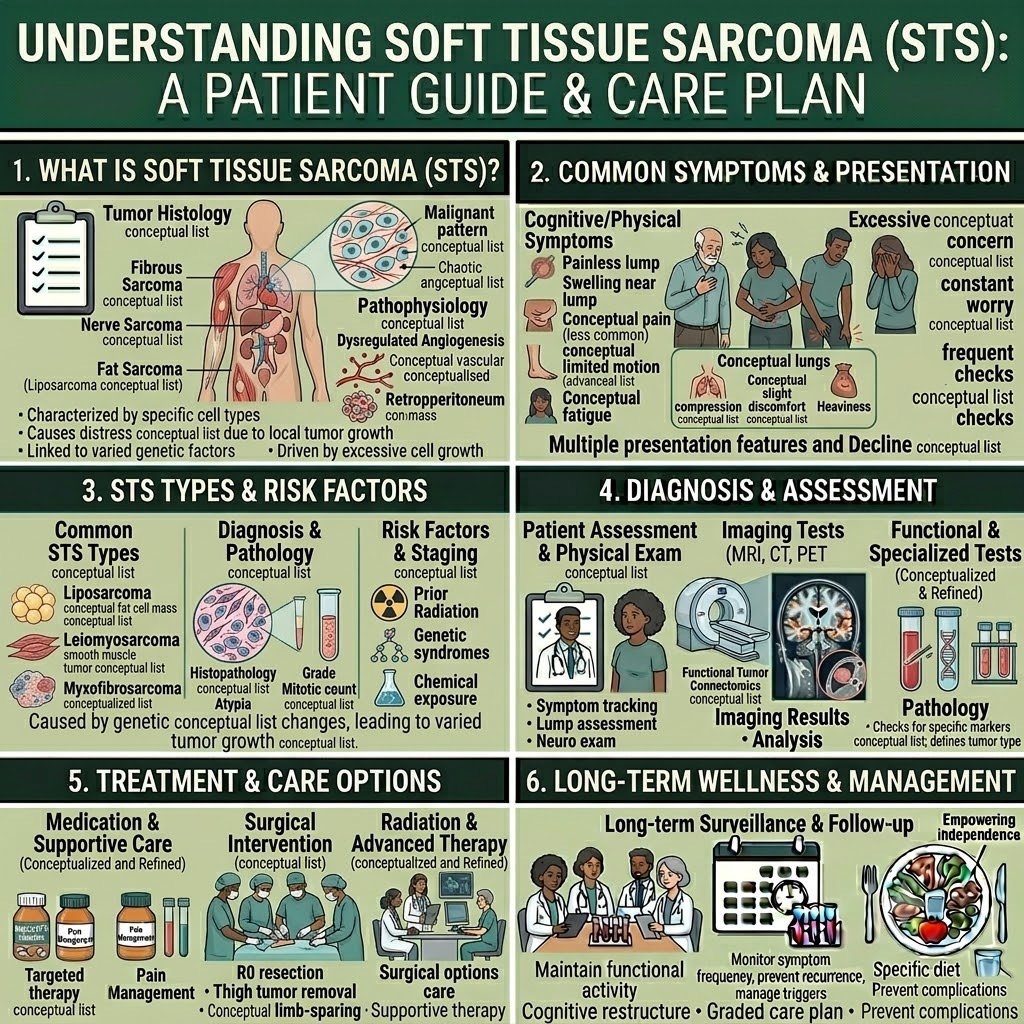
Soft tissue sarcoma is a rare type of cancer that develops from cells within the body's soft tissues. These tissues include muscles, fat, blood vessels, nerves, tendons, and the linings of joints, all of which connect, support, and surround other body structures. This cancer can arise anywhere but is most frequently found in the arms, legs, and abdomen. With over 50 known types, some primarily affect children, while others mostly affect adults. Diagnosing soft tissue sarcoma can be challenging as its growths may be mistaken for other conditions. Treatment typically involves surgery, often combined with radiation therapy or chemotherapy, with the specific approach depending on the cancer's size, type, location, and growth rate.
Understanding the Condition
Understanding Soft Tissue Sarcoma: A Guide for Non-Medical Persons
Understanding the Condition
Common Symptoms
Noticeable Lump or Swelling: As the tumor grows, it may create a visible or palpable lump beneath the skin or a general swelling in the affected area, often without initial pain.
Initially, you might see your primary care provider or a general practitioner who can then refer you to specialists. For suspected soft tissue sarcoma, you would typically consult an oncologist (a cancer specialist), an orthopedic oncologist (if the tumor affects bones or surrounding soft tissues), or a surgeon specializing in sarcoma. They will evaluate your symptoms and guide you through the diagnostic process.
Preparations Before Your Visit
Before your appointment, prepare to discuss your symptoms, including when they started, how they've changed, and any pain you've experienced. Make a list of all current medications, including over-the-counter drugs and supplements. Be ready to share your personal and family medical history. Consider writing down any questions you have for the doctor to ensure all your concerns are addressed.
Book a doctor visit near me
Consultation Guide
Pain: If the growing tumor presses on nearby nerves, muscles, or other structures, it can cause localized pain or discomfort.
Consultation Guide
Which Specialist to Meet
Diagnostic Procedures
Soft tissue sarcoma is a rare type of cancer that develops from cells within the body's soft tissues. These tissues include muscles, fat, blood vessels, nerves, tendons, and the linings of joints, all of which connect, support, and surround other body structures. This cancer can arise anywhere but is most frequently found in the arms, legs, and abdomen. With over 50 known types, some primarily affect children, while others mostly affect adults. Diagnosing soft tissue sarcoma can be challenging as its growths may be mistaken for other conditions. Treatment typically involves surgery, often combined with radiation therapy or chemotherapy, with the specific approach depending on the cancer's size, type, location, and growth rate.
An X-ray is a quick, non-invasive imaging test that uses a small amount of radiation to create pictures of the inside of your body. It is particularly good at visualizing dense structures like bones, which appear white. Soft tissues, muscles, and fat appear in shades of gray. While it doesn't show soft tissue tumors in great detail, it can sometimes reveal abnormal growths or changes in bone that might be related.
What to Expect
You will be asked to remove any metal objects or jewelry that might interfere with the image. You will lie or stand in various positions, and a technician will position the X-ray machine. You might need to hold your breath or stay very still for a few seconds during the image capture. The procedure is painless and usually takes only a few minutes.
An ultrasound uses high-frequency sound waves to create live images of structures inside your body, including soft tissues, organs, and blood vessels. It can help determine the size, shape, and consistency of a lump, distinguishing between solid tumors and fluid-filled cysts. It's often used as an initial imaging test or to guide a biopsy.
What to Expect
You will lie on an examination table. A gel will be applied to the skin over the area to be examined; this gel helps the sound waves travel. A technician will then press a small handheld device called a transducer against your skin and move it around the area. You might feel slight pressure from the transducer, but the procedure is generally painless. Depending on the area being scanned, you might be asked to fast or drink water beforehand. The scan usually takes 15 to 30 minutes.
CT Scan (Computed Tomography)
A CT scan uses a series of X-ray images taken from different angles around your body. A computer then processes these images to create detailed cross-sectional pictures (slices) of your bones, blood vessels, and soft tissues. This provides more detailed information than a standard X-ray and can help pinpoint the exact location, size, and extent of a tumor.
What to Expect
You will lie on a motorized table that slides into a large, donut-shaped machine. You must remain very still during the scan. In some cases, a contrast dye might be injected into a vein to make certain structures more visible; you might feel a warm flush or a metallic taste in your mouth if this happens. The scan itself is painless but can be noisy. It typically takes 10 to 30 minutes.
A needle biopsy is a crucial procedure to diagnose soft tissue sarcoma. It involves removing a small sample of cells or tissue from the suspicious lump using a special needle. This sample is then sent to a laboratory where a pathologist examines it under a microscope to determine if cancer cells are present and, if so, the specific type of sarcoma.
What to Expect
You will lie on an examination table. The doctor will clean the skin and inject a local anesthetic to numb the area, so you should feel minimal pain during the procedure, though you might feel pressure. An imaging technique like ultrasound or CT scan is often used to guide the needle precisely into the lump. A thin or slightly thicker needle is inserted to collect the tissue sample. After the sample is taken, pressure will be applied to the site to prevent bruising. The procedure can take 15 to 60 minutes, and you can usually go home the same day.
PET Scan (Positron Emission Tomography)
A PET scan is an imaging test that helps reveal how well your tissues and organs are functioning. It uses a small amount of a radioactive sugar tracer, which is injected into your body. Cancer cells tend to use more sugar than healthy cells, so they absorb more of the tracer and appear as bright spots on the scan. This can help identify cancer, determine if it has spread, and assess how well treatment is working.
What to Expect
First, a radioactive tracer will be injected into a vein, usually in your arm. You will then rest quietly for about an hour while your body absorbs the tracer. After this, you will lie on a narrow table that slides into a large, donut-shaped scanner. You must remain very still during the scan, which typically takes about 30 minutes. You will be encouraged to drink plenty of fluids afterward to help flush the tracer from your body.
Emotional and Psychological Support: A cancer diagnosis and its treatment can be emotionally challenging. Seeking support from family, friends, support groups, or a mental health professional can help manage stress, anxiety, and depression.
Treatment Options
Surgical Procedures
Surgery: This is often the primary treatment for soft tissue sarcoma. The goal is to remove the tumor completely, along with a margin of healthy tissue around it to ensure no cancer cells are left behind. For large tumors in limbs, limb-sparing surgery may be possible, involving removal of the tumor while preserving the limb's function. In cases where cancer has spread, surgery may also be used to remove distant tumors. (Duration: A single procedure, with recovery time varying from several weeks to a few months depending on the size and location of the tumor and the extent of the surgery.)
Therapies
Radiation Therapy: This treatment uses high-energy beams to kill cancer cells and shrink tumors. It can be delivered externally (from a machine outside the body, aimed at the tumor) or internally (by placing a small radioactive source directly in or near the tumor, known as brachytherapy). Radiation therapy might be used before surgery to shrink a tumor, after surgery to eliminate any remaining cancer cells, or as the main treatment if surgery isn't an option. (Duration: Typically administered 5 days a week over several weeks, often 4 to 8 weeks, with each daily session lasting only a few minutes.)
Chemotherapy: Chemotherapy involves powerful drugs, usually given intravenously (into a vein) or orally (by mouth), that target and kill fast-growing cancer cells throughout the body. It can be used to shrink large tumors before surgery, destroy microscopic cancer cells after surgery, or control cancer that has spread to other parts of the body. (Duration: Administered in cycles, such as weekly or every 2 to 3 weeks, over a period of several months, with breaks between cycles to allow the body to recover.)
Targeted Drug Therapy: These medications specifically target weaknesses within cancer cells. Unlike traditional chemotherapy, they are designed to primarily affect cancer cells while minimizing harm to healthy cells, potentially leading to fewer side effects. This approach is used for certain types of soft tissue sarcomas that have specific genetic mutations or characteristics. (Duration: Can be taken for several months or even years, as long as the treatment is effective and tolerable.)
Immunotherapy: Immunotherapy uses medications to boost your body's natural immune system to recognize and fight cancer cells more effectively. It helps the immune system to identify and attack the cancer, which it might otherwise overlook. (Duration: Administered in cycles over several months or longer, depending on the patient's response and tolerance to the treatment.)
Regular Follow-Up Care: After treatment, consistent follow-up appointments with your oncology team are crucial. This includes physical exams and imaging scans (like MRI, CT, or PET) to monitor for any signs of recurrence or new cancer development. The frequency will decrease over time but remains important for many years.
Rehabilitation and Physical Therapy: Depending on the location and extent of your surgery or radiation therapy, physical or occupational therapy can help you regain strength, flexibility, and function, improving your quality of life.
Healthy Lifestyle: Maintaining a balanced diet, engaging in regular physical activity (as advised by your healthcare team), and avoiding tobacco and excessive alcohol can support overall health and recovery during and after treatment.
Prevention & Long-Term Wellbeing
Prevention and Risk Reduction
Awareness of Genetic Risk: If you have a family history of inherited conditions known to increase sarcoma risk (e.g., Li-Fraumeni syndrome), discuss this with your doctor to understand potential screening or monitoring strategies.
Minimize Chemical Exposure: While the link isn't fully understood, some studies suggest certain chemical exposures (like herbicides, arsenic, dioxin) might increase risk. Taking precautions to minimize exposure to such substances when possible is advisable.
Long-Term Monitoring and Support
Tags & Topics
Notice an error or need an update?
Help us keep medical information accurate. Report incorrect info or suggest an edit.


