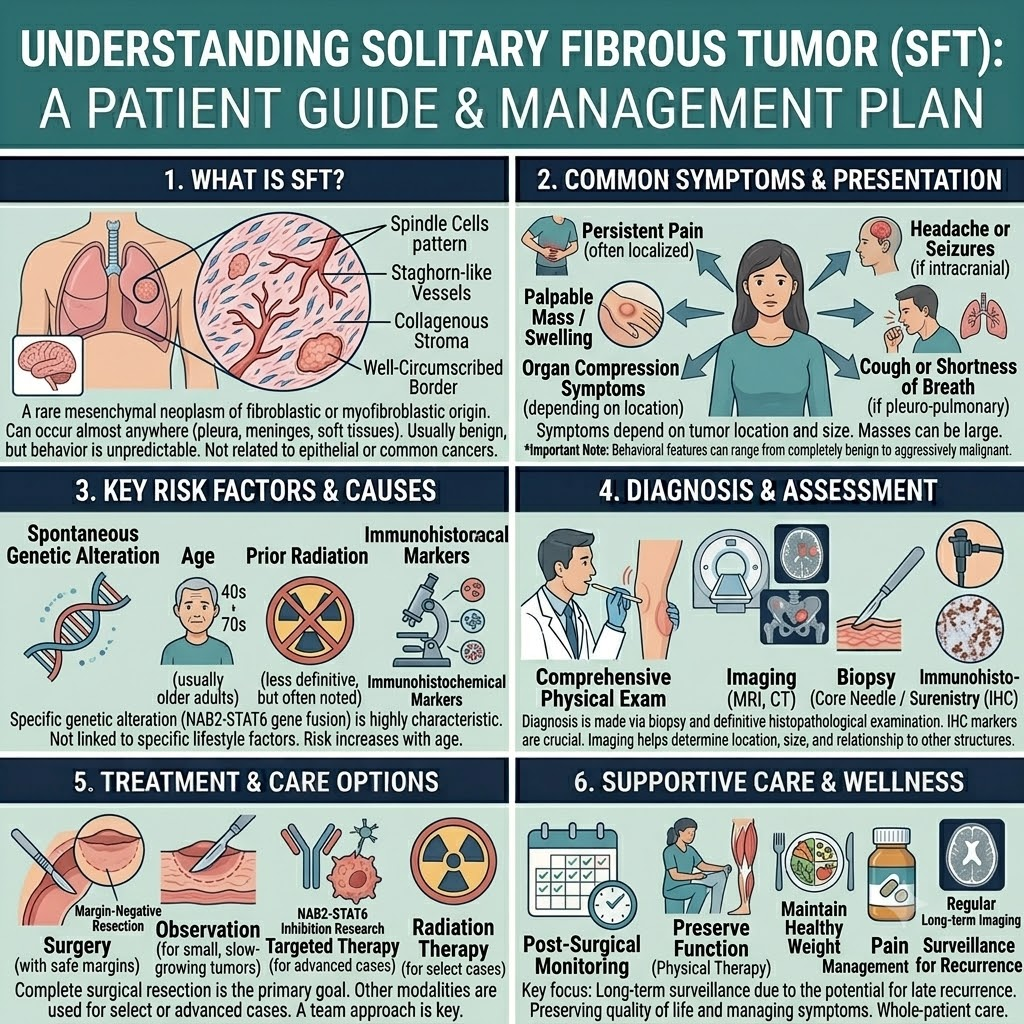
Solitary fibrous tumors are rare growths of cells that can develop in almost any part of the body. These tumors originate from cells within the body's supporting tissues, known as connective tissues. They are most commonly found in older adults and tend to grow slowly, often not causing noticeable symptoms until they become quite large. While they frequently occur in the lining around the lungs (called the pleura), they can also appear in areas like the head, neck, abdomen, breast, kidney, prostate, and spinal cord. Treatment typically involves surgery to remove the tumor. Sometimes, however, the tumor may return after surgery or spread to other body parts. Healthcare professionals classify solitary fibrous tumors into low, intermediate, or high-risk categories, considering factors like a person's age, tumor size, and how the cells appear under a microscope, to assess the likelihood of recurrence or spread.
Understanding the Condition
Understanding Solitary Fibrous Tumors: A Patient's Guide
Understanding the Condition
Solitary fibrous tumors are rare growths of cells that can develop in almost any part of the body. These tumors originate from cells within the body's supporting tissues, known as connective tissues. They are most commonly found in older adults and tend to grow slowly, often not causing noticeable symptoms until they become quite large. While they frequently occur in the lining around the lungs (called the pleura), they can also appear in areas like the head, neck, abdomen, breast, kidney, prostate, and spinal cord. Treatment typically involves surgery to remove the tumor. Sometimes, however, the tumor may return after surgery or spread to other body parts. Healthcare professionals classify solitary fibrous tumors into low, intermediate, or high-risk categories, considering factors like a person's age, tumor size, and how the cells appear under a microscope, to assess the likelihood of recurrence or spread.
Common Symptoms
General Symptoms (can vary by location): Slow-growing tumors may not cause symptoms for some time. When they do, symptoms depend on where the tumor is located. Tumors in other body areas might cause painless lumps or masses that can be felt.
Symptoms in or Around the Lungs: If a solitary fibrous tumor is located in or near the lungs, symptoms may include a persistent cough, shortness of breath, and chest pain or discomfort.
Symptoms in the Abdomen: When a tumor is in the abdomen, it might lead to abdominal pain, a feeling of fullness even after eating a small amount, constipation, nausea, and vomiting.
Symptoms in the Head and Neck: Tumors in the head or neck can cause difficulty swallowing, changes in the voice (hoarseness), and swelling or drooping of parts of the face.
Consultation Guide
Which Specialist to Meet
Initially, you should consult with your primary care doctor about any new or concerning symptoms. If a solitary fibrous tumor is suspected, your doctor will likely refer you to specialists such as an oncologist (a doctor specializing in cancer), a surgeon with expertise in tumor removal, or a pulmonologist (lung specialist) if the tumor is in the chest.
Preparations Before Your Visit
Before your appointment, gather your medical history, including any past illnesses, surgeries, and current medications. Make a list of all your symptoms, noting when they started, how often they occur, and their severity. Prepare a list of questions you want to ask your doctor. For the visit, wear comfortable, loose-fitting clothing.
Book a doctor visit near me
Symptom Awareness: It's important to be vigilant and aware of your body. Report any new or worsening symptoms, unusual lumps, or unexpected changes in your health to your doctor immediately. Early detection of potential recurrence is key for effective management.
Diagnostic Procedures
CT Scan (Computerized Tomography Scan)
A CT scan is an imaging test that uses X-rays and computer processing to create detailed cross-sectional images, often called 'slices,' of the bones, blood vessels, and soft tissues inside your body. It provides much more detail than standard X-rays and is used to diagnose injuries or diseases and to plan medical treatments.
What to Expect
You will lie on a narrow table that slides into a large, doughnut-shaped machine. You may be asked to hold your breath for brief periods. Sometimes, a contrast dye is given through an injection or orally to highlight certain areas and provide clearer images. The procedure is generally painless and takes a short amount of time.
A needle biopsy is a procedure where a long, thin needle is used to remove a small sample of cells or tissue from a suspicious area in the body. This sample is then sent to a laboratory to be examined under a microscope, primarily to check for signs of disease, such as cancer. Common types include fine-needle aspiration and core needle biopsy.
What to Expect
The area where the biopsy will be taken is numbed with a local anesthetic. The doctor, often guided by imaging techniques like ultrasound or CT, will insert the needle through the skin and into the target area to collect the tissue sample. You might feel some pressure or a brief sting, but significant pain is uncommon. Afterward, there might be slight bruising or soreness.
PET Scan (Positron Emission Tomography Scan)
A PET scan is an imaging test that helps reveal the metabolic or biochemical function of your body's tissues and organs. It uses a small amount of a radioactive drug, called a tracer, to highlight areas with higher levels of metabolic activity, which can indicate disease. PET scans can often detect abnormal activity earlier than other imaging tests.
What to Expect
A radioactive tracer is injected into a vein, usually in your arm or hand. You will then wait for about an hour for the tracer to travel throughout your body and collect in the tissues. After this waiting period, you will lie on a narrow table that slides into a large scanner. The scan itself typically takes about 30 minutes. PET scans are often combined with CT or MRI scans (PET-CT or PET-MRI) for more precise imaging.
An X-ray is a quick and painless imaging test that uses a small amount of radiation to create pictures of the structures inside your body, especially bones. Dense materials like bone appear white, air in the lungs appears black, and soft tissues like fat and muscle appear in shades of gray.
What to Expect
You will be asked to position yourself on an examination table or stand in front of an X-ray plate. A technician will position the X-ray machine. You must remain still during the brief moments the X-ray is taken. You might wear a lead apron to protect other parts of your body from radiation. For some X-rays, a contrast material may be given to improve the visibility of certain organs.
Ultrasound (Sonography)
An ultrasound uses high-frequency sound waves to create real-time images of the structures inside your body. It is a safe procedure that uses low-power sound waves and has no known risks. However, sound waves do not travel well through air or bone, making it less effective for imaging lungs or areas hidden by bone.
What to Expect
You will typically lie on an examination table. A clear gel is applied to your skin over the area to be examined. A small handheld device called a transducer is then moved over the gelled area. The transducer sends out sound waves and records the echoes, which are then converted into images. Most ultrasounds are external, but some may involve placing a small device inside the body. The procedure is generally painless, though you might feel some pressure.
Regular Follow-Up Appointments: After initial treatment, consistent follow-up appointments with your healthcare team are crucial. These will include physical examinations and imaging tests (such as CT scans, PET scans, or X-rays) to monitor for any signs that the tumor might have returned or developed in a new location.
Treatment Options
Surgical Procedures
Tumor Removal Surgery: The most common and often preferred treatment for solitary fibrous tumors involves surgically removing the entire tumor. The primary goal is to achieve complete removal of the growth. (Duration: The duration of the surgical procedure varies based on the tumor's size, location, and complexity. Hospital stay typically ranges from a few days to a week, with full recovery taking several weeks to months, depending on the extent of the surgery.)
Chemotherapy: Chemotherapy uses strong medications designed to kill rapidly growing cells, such as those found in tumors. It may be considered if the tumor has spread to other parts of the body, or if it cannot be fully removed by surgery. (Duration: Chemotherapy is typically administered in cycles over several weeks or months, with periods of rest in between to allow the body to recover. The exact regimen and duration depend on the individual's specific situation and tumor response.)
Radiation Therapy: Radiation therapy uses high-energy beams, such as X-rays or protons, to damage and destroy tumor cells while aiming to minimize harm to surrounding healthy tissues. It can be used as a primary treatment if surgery is not feasible, or in combination with surgery (before or after) to reduce the risk of recurrence. (Duration: Radiation therapy is often given in daily sessions over several weeks, but the total number of treatments and the schedule can vary significantly based on the tumor's characteristics and the treatment goals.)
Maintain a Healthy Lifestyle: Adopting and maintaining a balanced diet rich in fruits, vegetables, and whole grains, combined with regular physical activity, can support overall health and well-being during and after treatment. Avoiding smoking and limiting alcohol consumption are also beneficial.
Prevention & Long-Term Wellbeing
Long-Term Monitoring
General Health and Lifestyle
Emotional Support and Stress Management: Coping with a medical condition can be emotionally challenging. Seeking support from family, friends, patient support groups, or mental health professionals can help manage stress, anxiety, and the emotional impact of the condition. Prioritizing mental well-being is an integral part of recovery and long-term health.
Tags & Topics
Notice an error or need an update?
Help us keep medical information accurate. Report incorrect info or suggest an edit.


