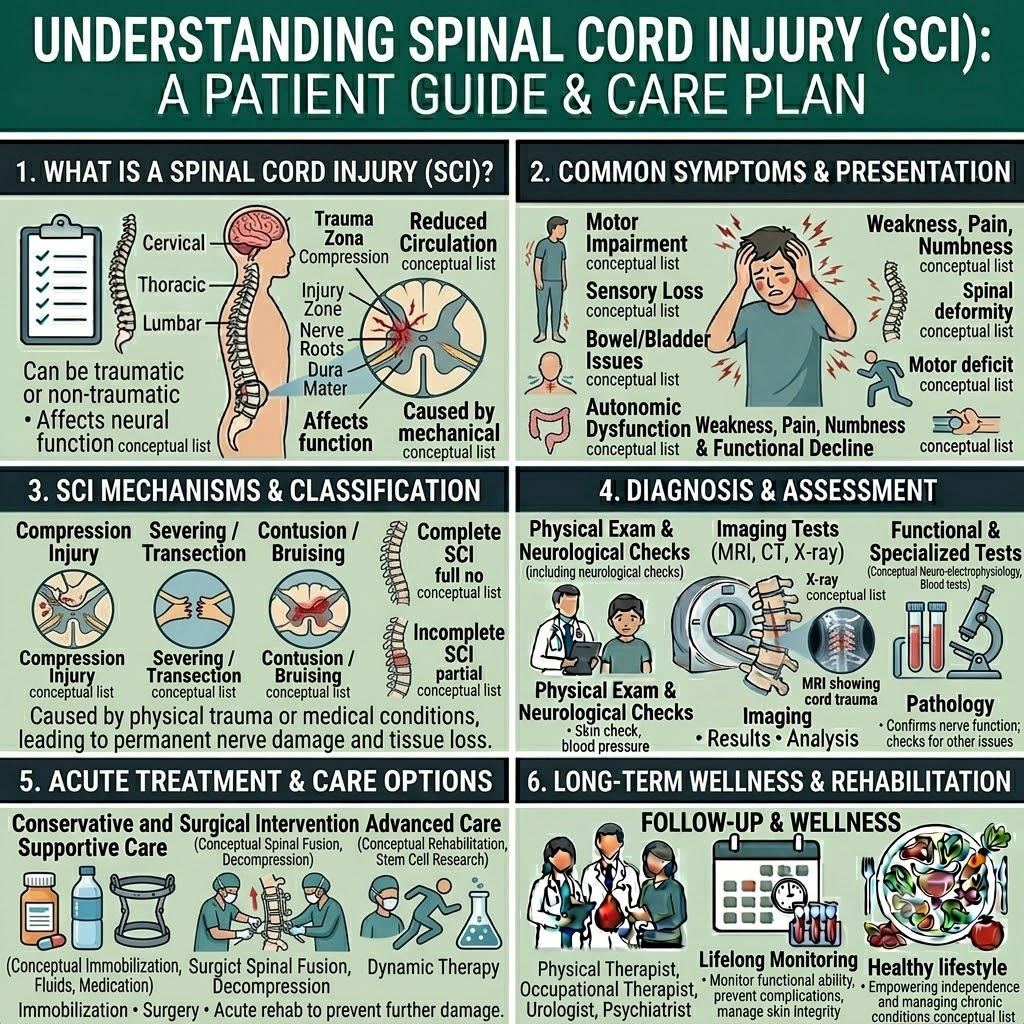
A spinal cord injury involves damage to any part of the spinal cord or the nerves at its lower end, known as the cauda equina. The spinal cord relays signals between the brain and body, controlling movement, sensation, and vital functions. Injuries often cause lasting changes in strength, feeling, and other body functions below the injury site, alongside potential mental, emotional, and social impacts. While research aims for future repairs, current treatments and rehabilitation help many individuals lead productive, independent lives.
Understanding the Condition
Understanding the Condition
Common Symptoms
Injury Classification and Paralysis: The ability to control movement and sensation depends on the injury's location and severity. The lowest undamaged spinal cord segment is the neurological level. Injury 'completeness' defines the extent of loss:- **Complete:** Total loss of feeling and movement control below the injury.- **Incomplete:** Some feeling or movement control remains below the injury, with varying degrees.Loss of control is paralysis:- **Tetraplegia (Quadriplegia):** Affects arms, hands, trunk, legs, and pelvic organs.- **Paraplegia:** Affects all or part of the trunk, legs, and pelvic organs, but not the arms.
Loss of Movement: Inability to move affected body parts.
Altered Sensation: Changes in the ability to feel heat, cold, or touch.
Loss of Bowel or Bladder Control: Difficulty managing urination and bowel movements.
Exaggerated Reflexes or Spasms: Uncontrolled muscle tightening or sudden movements.
Changes in Sexual Function: Alterations in sexual sensitivity, function, and fertility.
Nerve Pain: Intense stinging, burning, or aching pain from damaged nerve fibers.
Breathing Difficulties: Trouble breathing, coughing, or clearing lung secretions, particularly with neck or upper chest injuries.
Consultation Guide
Which Specialist to Meet
Before your visit, be prepared to discuss your symptoms in detail, any recent injuries, and your full medical history. Write down any questions you have. It is helpful to bring a family member or friend for support and to assist in recalling information. Be ready for physical and neurological examinations.
Book a doctor visit near me
The doctor will ask about your symptoms and medical history. They will then perform tests checking your mental status, vision, hearing, balance, coordination, muscle strength, reflexes, and sensation using simple tools like a reflex hammer or a pin. The exam can take minutes to over an hour.
Spasticity Management: Treatments aim to reduce muscle stiffness and spasms through physical therapy, stretching, bracing, and sometimes oral medications or injections. (Duration: Ongoing, adjusted as symptoms and needs change.)
Circulatory Health Monitoring: Be aware of symptoms of low blood pressure, swelling, and potential blood clots. Learn how to manage high blood pressure spikes (autonomic dysreflexia) if they occur.
Respiratory Health: Work with your healthcare team to manage breathing difficulties, practice deep breathing exercises, and prevent lung infections like pneumonia, especially for high-level injuries.
Bone Density Maintenance: Discuss strategies with your doctor to monitor and maintain bone health below the injury level to reduce fracture risk.
Muscle Tone Management: Address muscle tightening (spasticity) or limpness (flaccidity) through physical therapy and other interventions to improve comfort and function.
Mental and Emotional Support: Seek counseling or support groups to cope with potential depression, anxiety, and social changes that can follow a spinal cord injury.
Consultation Guide
A spinal cord injury involves damage to any part of the spinal cord or the nerves at its lower end, known as the cauda equina. The spinal cord relays signals between the brain and body, controlling movement, sensation, and vital functions. Injuries often cause lasting changes in strength, feeling, and other body functions below the injury site, alongside potential mental, emotional, and social impacts. While research aims for future repairs, current treatments and rehabilitation help many individuals lead productive, independent lives.
A neurological exam assesses the function of your brain, spinal cord, nerves, and muscles. It helps doctors identify nervous system conditions and their causes.
Diagnostic Procedures
Neurological Examination
What to Expect
An X-ray is a quick, painless imaging test that uses radiation to create pictures of internal body structures, especially bones. It can detect fractures, dislocations, or other bone damage affecting the spine.
What to Expect
You will be asked to lie on a table or stand against a surface. A technician will position your body and you may need to hold still or briefly hold your breath while the images are taken. The procedure is typically very fast.
CT Scan (Computerized Tomography)
A CT scan uses multiple X-ray beams and computer processing to create detailed cross-sectional images (slices) of bones, blood vessels, and soft tissues. It provides more comprehensive views than standard X-rays, aiding in identifying spinal cord damage, bone fragments, bleeding, or swelling.
What to Expect
You will lie on a motorized table that slides into a large, donut-shaped scanner. You must remain very still during the scan, which may last several minutes. You might hear whirring noises. Sometimes, a contrast dye may be injected into a vein to enhance the images.
Treatment Options
You will likely meet a team including neurologists (brain and nerve specialists), neurosurgeons (spinal surgery specialists), rehabilitation physicians, physical therapists, occupational therapists, urologists, and pain management experts.
Preparations Before Your Visit
Therapies
Medications and Management Techniques
Neurogenic Bladder Management: Strategies including scheduled urination, complete bladder emptying techniques, intermittent catheterization, fluid management, and sometimes medications to prevent infections and manage control. (Duration: Lifelong management.)
Pain Management: Addresses muscle, joint, and nerve pain through various therapies, including physical therapy, heat/cold, and appropriate medications. (Duration: Ongoing, tailored to the type and severity of pain.)
Sexuality and Fertility Management: Counseling and medical interventions to address changes in sexual function and fertility, often involving specialists. (Duration: As needed, with ongoing support and adjustments.)
Prevention & Long-Term Wellbeing
Spinal Cord Injury Rehabilitation: A comprehensive program involving physical, occupational, and sometimes speech therapists to optimize recovery, regain function, and adapt to daily life. (Duration: Ongoing, typically for months to years, depending on recovery and adaptation needs.)
Functional Electrical Stimulation (FES): Uses low-level electrical impulses applied to specific muscles to promote contraction, improve strength, control, and reduce spasms. (Duration: Regular sessions, often long-term as part of a home program.)
Upper Extremity Functional Restoration: Therapies focused on improving function in shoulders, arms, wrists, and hands through techniques like nerve reeducation, muscle strengthening, and task-specific training. (Duration: Ongoing, adapted to individual progress and goals.)
Procedures and Devices
Diaphragm Pacing: A surgical procedure to implant a battery-powered system that electrically stimulates the diaphragm muscle and nerves to aid breathing, potentially reducing reliance on a mechanical ventilator. (Duration: Permanent implant, with ongoing device management.)
Assistive Technology (AT): Use of advanced wheelchairs, adaptive equipment, smartphones, and robotics to improve physical function, communication, and independence in daily living. (Duration: Long-term use, adapted as needs change.)
Neurogenic Bowel Management: Involves a high-fiber diet, adequate fluid intake, regular bowel programs, suppositories, and sometimes digital stimulation or specialized procedures to maintain bowel regularity. (Duration: Lifelong management.)
Fitness and Wellness Programs: Dietitian support for nutrition and weight management, and tailored exercise programs with physical and occupational therapists to combat muscle thinning, weight gain, and reduce risks of cardiovascular disease and diabetes. (Duration: Lifelong commitment to healthy habits.)
Prevention Strategies
Drive Safely: Always wear a seat belt. Ensure children use appropriate safety seats and ride in the back seat. Avoid distracted driving.
Check Water Depth Before Diving: Never dive into shallow water, aboveground pools, or water of unknown depth. Ensure at least 9 feet of depth for diving.
Prevent Falls: Use step stools with grab bars, install handrails on stairways, and use nonslip mats in bathrooms. For young children, use safety gates and window guards.
Take Precautions When Playing Sports: Always wear recommended safety gear. Avoid leading with the head in sports, such as headfirst sliding in baseball or tackling with the helmet top in football. Use spotters for new moves in gymnastics.
Avoid Impaired Driving: Never drive under the influence of alcohol or drugs, and do not ride with an impaired driver.
Long-Term Living and Support
Bladder and Bowel Care: Implement regular routines and techniques (e.g., catheterization, high-fiber diet) to manage function and prevent complications like infections or stones.
Skin Care and Pressure Sore Prevention: Regularly change positions, perform thorough skin checks, and maintain good hygiene to prevent pressure injuries, especially in areas with reduced sensation.
Tags & Topics
Notice an error or need an update?
Help us keep medical information accurate. Report incorrect info or suggest an edit.


