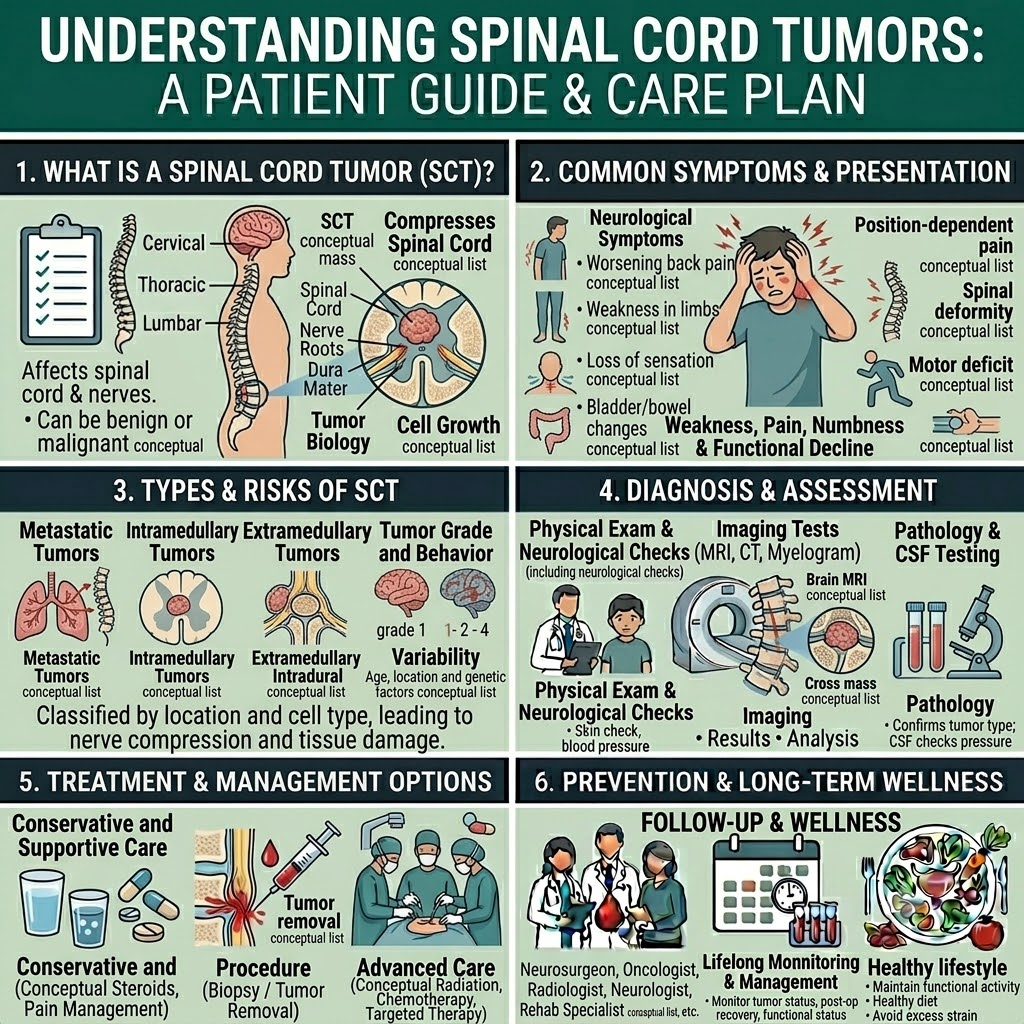
A spinal cord tumor is an abnormal growth of cells that forms either within or around the spinal cord. The spinal cord is a vital bundle of nerves extending from the brain down the back, acting as a communication highway between your brain and the rest of your body, protected by the bony spine. While most spinal cord tumors are non-cancerous (benign), some can be cancerous (malignant). These tumors are often categorized by their location: intramedullary tumors grow within the spinal cord itself, while extramedullary tumors develop in the tissues surrounding the spinal cord, such as its protective covering or nerve roots. Tumors can occur anywhere along the spine, most commonly in the upper back. They can cause pain and affect body functions by pressing on nerves. Treatment options usually include surgery, radiation, or chemotherapy, depending on the tumor's type and location.
Understanding the Condition
Spinal Cord Tumors: A Guide for Non-Medical Individuals
Understanding the Condition
Common Symptoms
Spine-Related Pain: Pain in the back or neck near the tumor's location. Pain that feels worse during the night. Pain that radiates or shoots from the back to nearby areas. Pain that steadily worsens over time.
Nerve Compression Symptoms: Changes in sensation, such as reduced feeling of pain, heat, or cold in a specific body area. Problems with bladder or bowel control. Muscle weakness in a limb or other part of the body. Difficulty walking, which may lead to falls.
Consultation Guide
Which Specialist to Meet
List all symptoms with onset and changes. Bring full medical history, current medications. Note family history of similar conditions. Prepare questions for the doctor.
Book a doctor visit near me
Doctor reviews symptoms, medical history, then tests reflexes, muscle strength, balance, sensation, and mental status. Non-invasive, painless, 15-60 minutes.
Magnetic Resonance Imaging (MRI)
Uses magnets and radio waves for detailed soft tissue images (spinal cord, nerves), crucial for tumor detection.
Consultation Guide
A spinal cord tumor is an abnormal growth of cells that forms either within or around the spinal cord. The spinal cord is a vital bundle of nerves extending from the brain down the back, acting as a communication highway between your brain and the rest of your body, protected by the bony spine. While most spinal cord tumors are non-cancerous (benign), some can be cancerous (malignant). These tumors are often categorized by their location: intramedullary tumors grow within the spinal cord itself, while extramedullary tumors develop in the tissues surrounding the spinal cord, such as its protective covering or nerve roots. Tumors can occur anywhere along the spine, most commonly in the upper back. They can cause pain and affect body functions by pressing on nerves. Treatment options usually include surgery, radiation, or chemotherapy, depending on the tumor's type and location.
Diagnostic Procedures
Neurological Examination
A physical exam assessing nervous system function (brain, spinal cord, nerves, muscles) to identify issues.
What to Expect
What to Expect
Lie on a table in a tube-shaped machine. Loud noises (earplugs provided). Must stay still. Contrast dye may be used. Painless, 30-60 minutes.
Computed Tomography (CT) Scan
X-rays and computer create cross-sectional "slices" of bones, vessels, soft tissues. Useful for bone assessment or when MRI is not an option.
What to Expect
Lie on a table moving through a donut-shaped scanner. Contrast dye might be used. Quick (minutes), generally painless.
A thin needle extracts a tissue sample from a suspicious area for lab analysis to identify tumor type (cancerous/non-cancerous).
What to Expect
Local anesthetic numbs the site. Doctor guides needle with imaging (e.g., ultrasound, CT). May feel pressure. Bandage applied post-procedure. Possible soreness.
Treatment Options
You may consult with a neurologist (nerve disorders), a neurosurgeon (spine surgery), an oncologist (cancer specialist, if malignant), a radiation oncologist (radiation treatments), a pain management specialist, and rehabilitation therapists (physical, occupational).
Preparations Before Your Visit
Surgical Procedures
Spinal Cord Tumor Removal Surgery: A neurosurgeon aims to remove as much of the tumor as safely possible while preserving nerve function. The specific approach depends on the tumor's location and size. (Duration: Hospital stay days to weeks; full recovery and rehabilitation weeks to months.)
Conventional Radiation Therapy: High-energy beams (e.g., X-rays) precisely target and kill tumor cells, often used alone or after surgery. (Duration: Typically daily sessions, 5 days a week, for 3-6 weeks.)
Proton Therapy: Uses positively charged particles for more precise radiation delivery, potentially minimizing damage to healthy tissues. (Duration: Schedules vary, often similar to conventional radiation over several weeks.)
Stereotactic Radiosurgery (SRS/SBRT): Highly focused radiation delivers a high dose to the tumor in few sessions, without traditional incisions. For spine, called SBRT. (Duration: Completed in 1 to 5 sessions.)
Medication-Based Treatments
Chemotherapy: Powerful drugs (oral or IV) designed to kill fast-growing cancerous tumor cells, mainly for malignant tumors. (Duration: Involves cycles over several months or longer, depending on tumor and drugs.)
Genetic Counseling & Screening: Spinal cord tumors can't be prevented. For those with genetic conditions (Neurofibromatosis 1/2, Von Hippel-Lindau), genetic counseling and regular MRI screenings are vital for early detection, improving treatment effectiveness.
Post-Treatment Monitoring
Consistent Follow-Up & Imaging: Regular medical appointments and periodic MRI scans are crucial after treatment to monitor recovery, manage side effects, and check for any tumor recurrence or new growth.
Rehabilitation & Support
Physical & Occupational Therapy: Essential for regaining strength, improving mobility, and adapting to functional changes from the tumor or treatment.
Pain Management: Strategies like medication or nerve blocks can help manage chronic pain and enhance quality of life.
Emotional & Psychological Support: Counseling or support groups offer valuable coping mechanisms and community for emotional well-being.
Prevention & Long-Term Wellbeing
Genetic Risk & Early Detection
Tags & Topics
Notice an error or need an update?
Help us keep medical information accurate. Report incorrect info or suggest an edit.


