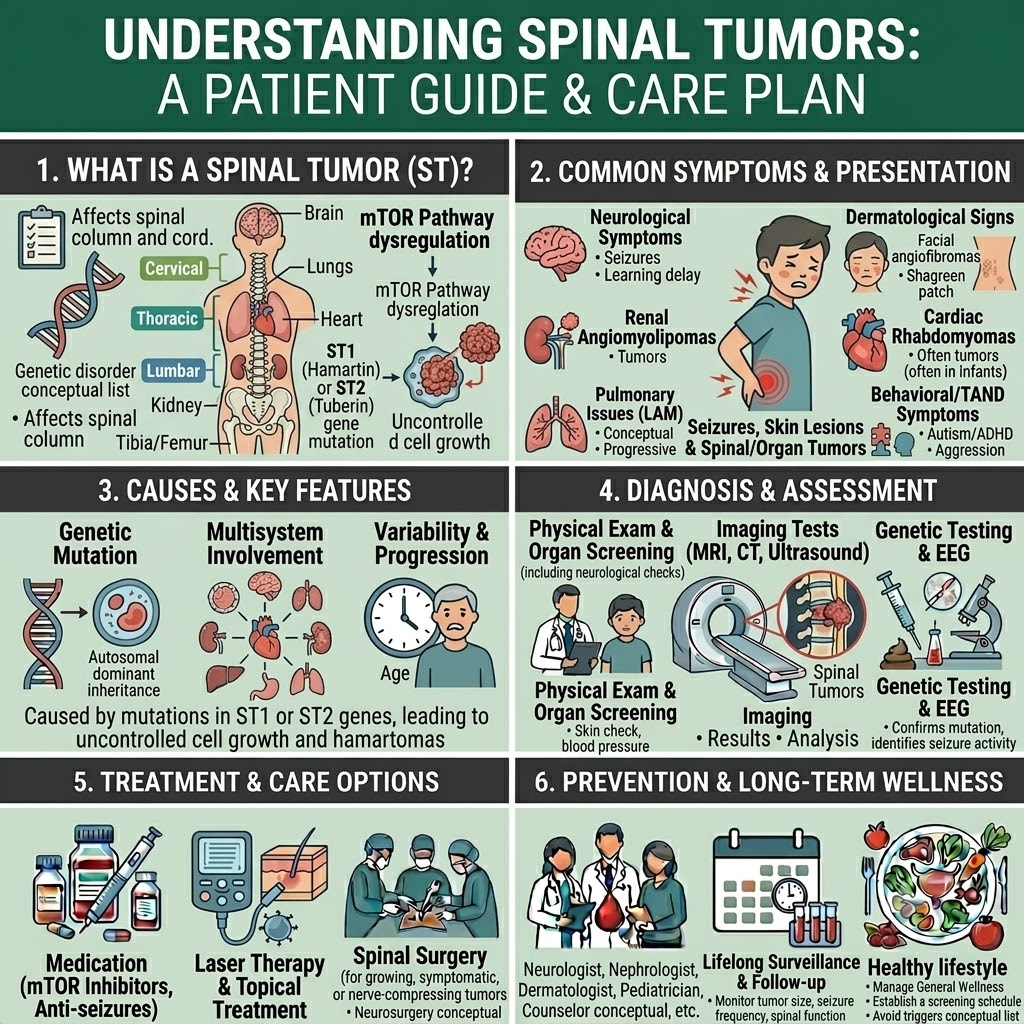
A spinal tumor is an abnormal growth of cells within or around the spine, involving the backbone, spinal cord, and nerves. These tumors are uncommon. Some are non-cancerous (benign) and grow slowly; others are cancerous (malignant) and can spread. "Spinal tumor" covers both, while "spinal cancer" usually means a malignant tumor originating in or spreading to the spine. Most spinal cancers (95%) are metastatic, spreading from other body parts. Tumors can occur anywhere, most often in the middle or lower back. They can press on the spinal cord or nerves, causing pain, weakness, numbness, or balance problems. Early diagnosis and treatment are key to preserving mobility and nerve function.
Understanding the Condition
Understanding Spinal Tumors
Understanding the Condition
Common Symptoms
Persistent Back or Neck Pain: Often dull, sharp, or burning; doesn't improve with rest. Worsens at night or when lying down.
Radiating Pain: Spreads from spine to arms, legs, chest, or hips.
Numbness or Tingling: "Pins and needles" in limbs.
Muscle Weakness/Walking Difficulty: Trouble moving limbs or maintaining balance.
Changes in Sensation: Reduced ability to feel pain, heat, or cold.
Muscle Spasms: Involuntary muscle tightening.
Loss of Bladder/Bowel Control: In severe cases, difficulty controlling urination or bowel movements.
Consultation Guide
Which Specialist to Meet
You should first consult your primary care doctor. They may refer you to specialists such as a neurologist (a doctor specializing in the nervous system), a neurosurgeon or orthopedic surgeon (surgeons specializing in the spine or bones), or an oncologist (a cancer specialist).
Preparations Before Your Visit
Before your visit, list your symptoms (including when they started and how they've progressed), medications, medical history, and any family history of cancer. Be ready to discuss your pain, sensation changes, and daily impact.
Book a doctor visit near me
Monitoring (Watchful Waiting): For small, slow-growing, non-cancerous tumors that are not causing symptoms, doctors may recommend regular check-ups with MRI scans to monitor the tumor's size and any changes. (Duration: Ongoing, with periodic scans (e.g., every 6-12 months) as determined by your doctor.)
Medications: Various drugs may be used to manage symptoms like pain or to reduce swelling around the tumor. For cancerous tumors, specific medicines like chemotherapy or biological therapies target cancer cells. (Duration: Varies widely, from short-term for symptom relief to several months or years for cancer treatment, depending on the specific medication and tumor type.)
Procedures & Therapies
Regular Follow-Up Care: If you have a history of cancer, consistent follow-up appointments and screenings are crucial to detect any new or spreading tumors early, before they cause severe symptoms.
Symptom Management: Collaborate with your doctor to manage any ongoing pain, weakness, or other symptoms. This may involve physical therapy, occupational therapy, or pain management specialists to improve quality of life and function.
Consultation Guide
You will position yourself against an X-ray plate, and a machine will direct a beam of radiation through your body. You'll need to stay still briefly. The procedure is typically very fast and causes no discomfort.
CT Scan (Computerized Tomography Scan)
Uses multiple X-ray images from different angles to create detailed cross-sectional pictures (slices) of your bones, blood vessels, and soft tissues, offering more detail than a standard X-ray.
Vertebroplasty/Kyphoplasty: Procedures used to treat painful spinal fractures, often caused by tumors or osteoporosis. Bone cement is injected into a cracked or broken spinal bone (vertebra) to stabilize it and relieve pain. In kyphoplasty, a balloon is first used to create space before cement injection. (Duration: A single procedure, with pain relief often experienced quickly.)
Diagnostic Procedures
A spinal tumor is an abnormal growth of cells within or around the spine, involving the backbone, spinal cord, and nerves. These tumors are uncommon. Some are non-cancerous (benign) and grow slowly; others are cancerous (malignant) and can spread. "Spinal tumor" covers both, while "spinal cancer" usually means a malignant tumor originating in or spreading to the spine. Most spinal cancers (95%) are metastatic, spreading from other body parts. Tumors can occur anywhere, most often in the middle or lower back. They can press on the spinal cord or nerves, causing pain, weakness, numbness, or balance problems. Early diagnosis and treatment are key to preserving mobility and nerve function.
Neurological Examination
A comprehensive check of your nervous system (brain, spinal cord, nerves, muscles) to identify potential problems.
What to Expect
The doctor assesses reflexes, muscle strength, balance, coordination, sensation, and mental status. This might involve simple tasks like walking or touching your nose. The exam can take minutes to over an hour.
A quick, painless imaging test using radiation to create pictures of your bones and other structures. Dense materials like bone appear white.
What to Expect
What to Expect
You will lie on a motorized table that slides into a large, donut-shaped machine. The scanner rotates around you, taking images. You may hear buzzing or clicking noises and be asked to hold your breath briefly. A contrast dye might be given, causing a warm sensation or metallic taste. The scan usually takes 10-30 minutes.
MRI (Magnetic Resonance Imaging)
Uses a powerful magnetic field and radio waves to create highly detailed images of the spinal cord, nerves, and surrounding structures. It is excellent for detecting spinal cord compression.
What to Expect
You will lie on a movable table that slides into a long, narrow tube-like machine. The machine creates loud knocking or thumping sounds (earplugs or headphones may be offered). It's important to remain very still during the scan, which can last from 30 minutes to an hour or longer. A contrast dye may be injected into a vein.
If imaging suggests a tumor, a small tissue sample is removed from the growth and examined under a microscope to determine if it is cancerous and its specific type.
What to Expect
A biopsy can involve a needle inserted through the skin (image-guided) or a small surgical procedure. You will receive local anesthesia to numb the area, or general anesthesia to put you to sleep. Expect some soreness or bruising at the biopsy site afterward.
Support Systems: Engage with support groups or mental health professionals to cope with the emotional and psychological challenges of a spinal tumor diagnosis and treatment.
Treatment Options
Monitoring & Medication
Surgery: The goal of surgery is to remove as much of the tumor as safely possible while preserving spinal cord and nerve function. Spinal stabilization may be performed if the tumor has weakened spinal bones. (Duration: A single surgical procedure, with recovery typically lasting weeks to months.)
Radiation Therapy: Uses high-energy beams to kill cancer cells or shrink tumors. This includes External Beam Radiation (beams from outside the body), Proton Therapy (precise external radiation using protons to potentially reduce damage to healthy tissue), and Stereotactic Body Radiotherapy (SBRT), a highly focused, high-dose radiation in fewer sessions (1-5), minimizing healthy tissue impact. When used in the brain, it's called stereotactic radiosurgery (SRS). (Duration: Typically given over several weeks (e.g., 5 days a week for 3-6 weeks) for conventional radiation, or 1-5 sessions for SBRT, depending on the tumor and type of radiation.)
Chemotherapy: Drug treatment using powerful chemicals to kill fast-growing cancer cells throughout the body. It can be given orally or through an IV. (Duration: Administered in cycles, typically lasting several months to a year or more, depending on the cancer type and how the body responds.)
Biological Therapy (Immunotherapy): Treatments that harness the body's own immune system to fight cancer. These therapies help the immune system recognize and attack cancer cells that it might otherwise ignore. (Duration: Varies widely, often given in cycles over several months or longer.)
Prevention & Long-Term Wellbeing
Prevention
Overall Cancer Risk Reduction: While most spinal tumors cannot be prevented, you can lower your general cancer risk by avoiding tobacco, eating a healthy diet rich in fruits and vegetables, exercising regularly, maintaining a healthy weight, and limiting alcohol.
Managing Health Conditions: Work closely with your healthcare team to manage any existing long-term health conditions.
Genetic Counseling: Consider genetic counseling if you have a family history of rare genetic conditions like neurofibromatosis type 2 (NF2) or Von Hippel-Lindau disease.
Long-Term Monitoring & Support
Tags & Topics
Notice an error or need an update?
Help us keep medical information accurate. Report incorrect info or suggest an edit.


