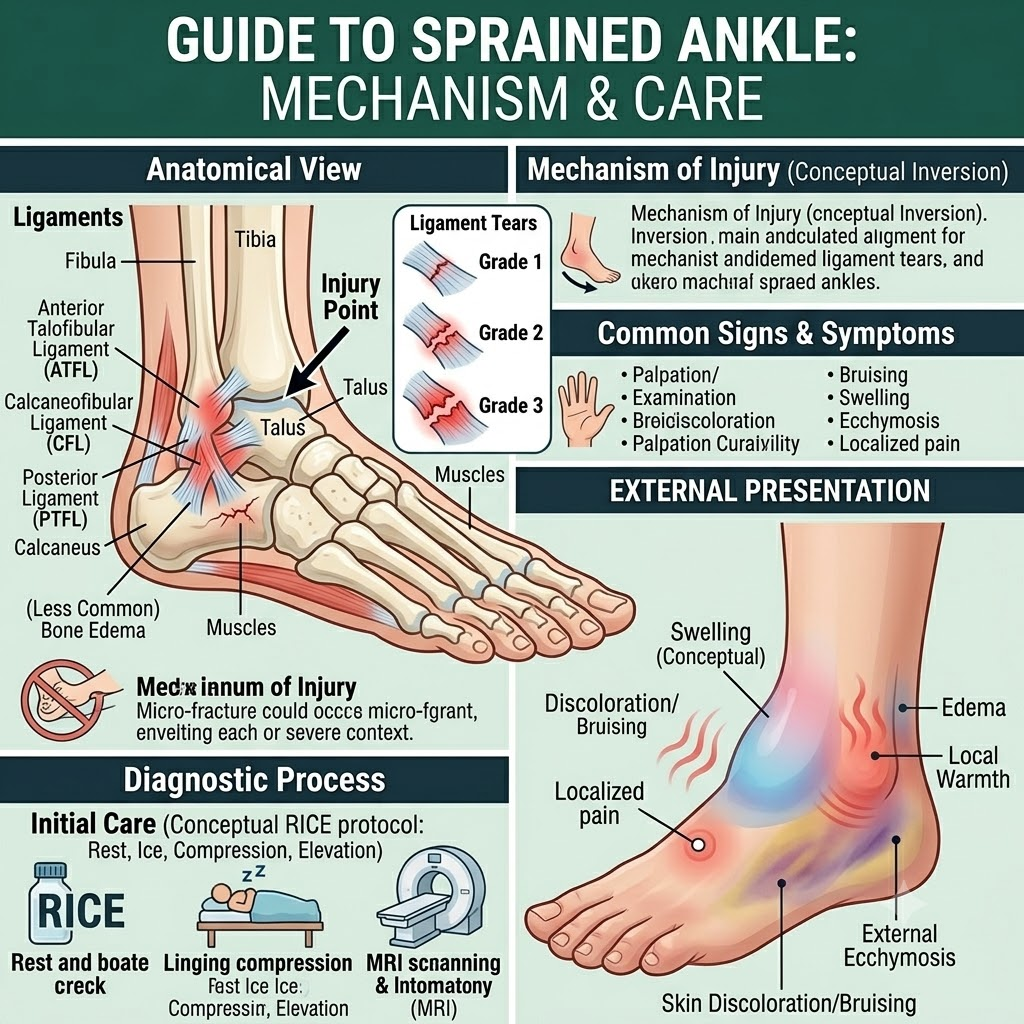
A sprained ankle is an injury that occurs when you roll, twist, or turn your ankle in an awkward way. This can stretch or tear the strong bands of tissue, called ligaments, that hold your ankle bones together. Ligaments help stabilize joints and prevent excessive movement. A sprain happens when these ligaments are forced beyond their normal range of motion. Most sprained ankles involve injuries to the ligaments on the outer side of the ankle. Treatment depends on the injury's severity, ranging from self-care to medical evaluation and interventions.
Understanding the Condition
Understanding and Managing a Sprained Ankle
Understanding the Condition
Common Symptoms
Pain: Especially when putting weight on the affected foot or walking.
Tenderness: When you touch the ankle area.
Swelling: The ankle may appear puffy or larger than usual.
Bruising: Discoloration around the ankle, which may appear later.
Restricted Movement: Difficulty moving the ankle through its full range of motion.
Instability: A feeling that the ankle might give way when standing or walking.
Popping Sensation or Sound: Experienced at the exact moment of the injury.
Consultation Guide
Which Specialist to Meet
Before your visit, be prepared to describe exactly how the injury happened, including the specific motion of your ankle, when it occurred, and all the symptoms you are experiencing. Also, mention any previous ankle injuries you may have had.
Book a doctor visit near me
An X-ray is a quick, painless imaging test that uses a small amount of radiation to create pictures of the bones inside your body. It is often the first test used to determine if you have a broken bone, which can have similar symptoms to a severe sprain.
Address Chronic Symptoms: If you experience persistent ankle pain, swelling, or instability even after treatment, seek further medical evaluation. Untreated chronic issues can lead to complications like ankle joint arthritis.
Diagnostic Procedures
What to Expect
You will be asked to remove any jewelry or metal objects from the area being scanned and may need to wear a hospital gown. You’ll lie or sit on an X-ray table, and a technician will position your ankle to capture images from different angles. You will need to remain still for a few seconds while the X-ray is taken. The entire procedure is usually very fast, taking only a few minutes.
CT Scan (Computed Tomography)
A CT scan uses specialized X-ray equipment combined with computer processing to create detailed cross-sectional images, or 'slices,' of your bones, blood vessels, and soft tissues. This provides more in-depth information than a standard X-ray, which can be useful if your doctor needs a closer look at the extent of an injury, such as subtle fractures or the condition of surrounding soft tissues.
What to Expect
You will lie on a motorized table that slides into a large, donut-shaped machine. You might hear humming or clicking noises during the scan. It’s important to remain very still, and you may be asked to hold your breath briefly at certain times. The scan itself typically takes between 5 to 20 minutes. In some cases, a contrast dye may be administered intravenously or orally to highlight specific areas or structures more clearly.
A bone scan is a nuclear imaging test that involves injecting a small amount of a radioactive tracer into your bloodstream. This tracer is absorbed by your bones, with higher absorption in areas where bone cells are more active due to healing, injury, or disease. A special camera then detects the radiation to create images, identifying 'hot spots' that could indicate the source of unexplained bone pain, an infection, or injuries not easily visible on other scans.
What to Expect
First, a small amount of radioactive tracer is injected into a vein, typically in your arm. You will then wait for 2 to 3 hours for the tracer to be absorbed into your bones; you might be encouraged to drink water during this time to help clear any unabsorbed tracer. After the waiting period, you'll lie on a table while a camera moves slowly over your body, taking pictures of your bones. This scanning process can take 30 minutes to an hour, and you will need to lie still.
Treatment Options
A sprained ankle is an injury that occurs when you roll, twist, or turn your ankle in an awkward way. This can stretch or tear the strong bands of tissue, called ligaments, that hold your ankle bones together. Ligaments help stabilize joints and prevent excessive movement. A sprain happens when these ligaments are forced beyond their normal range of motion. Most sprained ankles involve injuries to the ligaments on the outer side of the ankle. Treatment depends on the injury's severity, ranging from self-care to medical evaluation and interventions.
You should first consult your primary care doctor. Depending on the severity of your sprain, they may refer you to an orthopedic specialist (a doctor specializing in bones and joints) or a physical therapist for further evaluation and treatment.
Preparations Before Your Visit
RICE Method (Rest, Ice, Compression, Elevation): Rest involves keeping weight off the injured ankle. Apply ice packs for 15-20 minutes every 2-3 hours. Use an elastic bandage to gently compress the ankle and reduce swelling. Elevate your ankle above heart level as much as possible. (Duration: Typically for the first 24-72 hours after injury, but rest and elevation may continue longer as needed.)
Medications
Non-Prescription Pain Relievers: Over-the-counter medications can help manage pain and reduce inflammation. (Duration: As needed for pain and swelling, usually for a few days to weeks.)
Rehabilitation Exercises: A supervised program of exercises designed to restore strength, flexibility, range of motion, and balance to the ankle. This includes specific stretches, strengthening exercises, and balance training to help the ankle heal properly and prevent re-injury. (Duration: Several weeks to a few months, depending on the severity of the injury and individual progress.)
Ligament Repair: For severe sprains where ligaments are extensively torn or do not heal with non-surgical treatments, surgery may be recommended to directly repair or reconstruct the damaged ligaments. (Duration: Recovery from surgical repair can take several months, involving a comprehensive rehabilitation program.)
Adhere to Treatment Plan: Follow your doctor's recommendations and complete any prescribed physical therapy to ensure your ankle heals fully and reduces the risk of re-injury or chronic problems.
Gradual Return to Activity: Do not rush back into strenuous activities before your ankle has completely recovered. A premature return can lead to re-injury, chronic pain, or long-term ankle instability.
Prevention & Long-Term Wellbeing
Crutches, Ankle Braces, or Walking Boots: Crutches can help keep weight off the ankle for initial healing. An ankle brace or a walking boot provides support and protection, stabilizing the joint during the recovery process. (Duration: Crutches may be used for a few days. Braces or boots can be worn for several weeks, as advised by your doctor, depending on injury severity.)
Prevention
Warm-Up and Stretching: Always perform a proper warm-up and stretch your muscles, especially before engaging in exercise or sports activities.
Care on Uneven Surfaces: Be mindful and cautious when walking, running, or working on uneven ground or unstable surfaces.
Ankle Support: If you have a history of ankle sprains or weak ankles, consider using an ankle support brace or athletic tape during physical activities.
Proper Footwear: Wear shoes that fit correctly, provide adequate support, and are appropriate for the specific activity you are doing. Minimize wearing high-heeled shoes, which increase ankle instability.
Maintain Physical Fitness: Keep good muscle strength and flexibility throughout your body, especially in and around your ankles, through regular exercise.
Balance Training: Incorporate balance exercises into your routine to improve proprioception and ankle stability, reducing the risk of sprains.
Long-Term Wellbeing
Tags & Topics
Notice an error or need an update?
Help us keep medical information accurate. Report incorrect info or suggest an edit.


