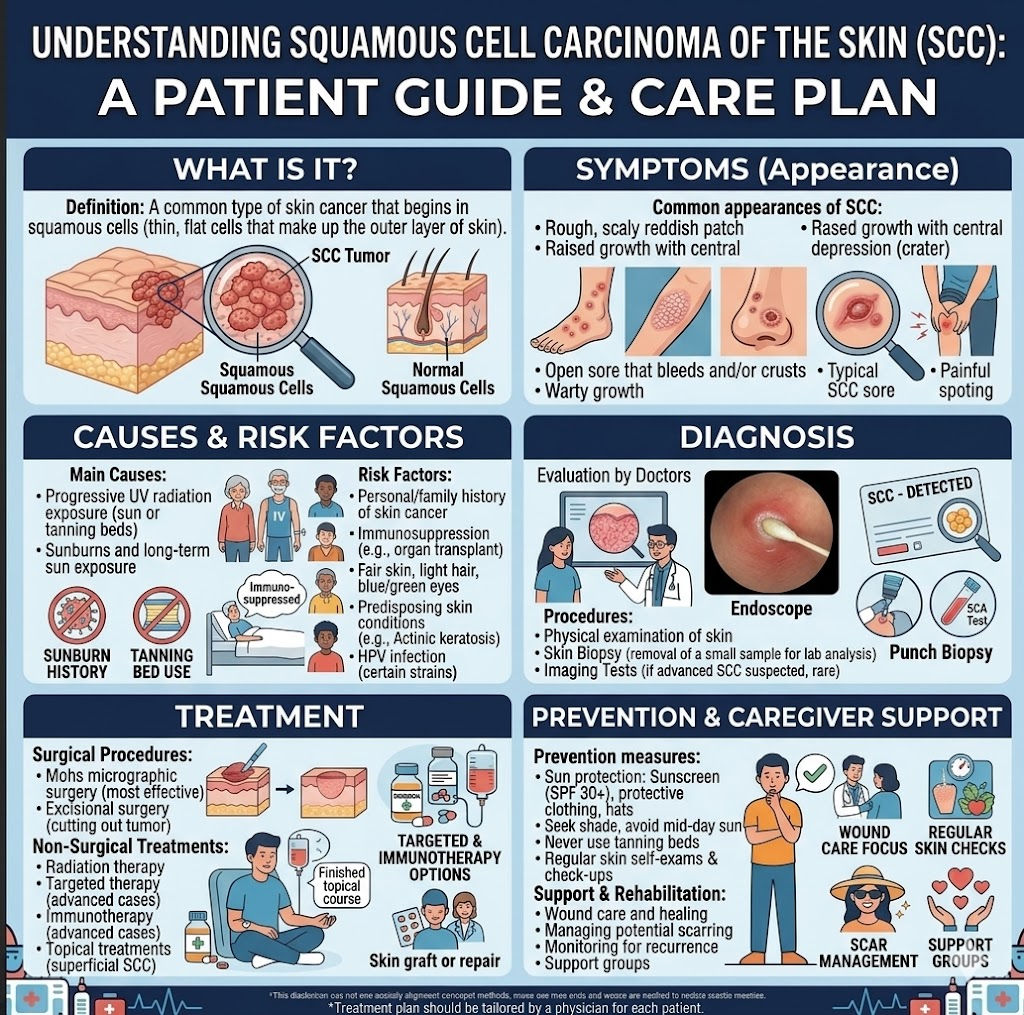
Squamous cell carcinoma (SCC) of the skin is a common type of skin cancer that begins in the squamous cells, which form the middle and outer layers of your skin. While typically not life-threatening, untreated SCC can grow significantly or spread to other body parts, leading to serious complications. Most cases are caused by excessive ultraviolet (UV) radiation from sunlight or tanning devices. Protecting your skin from UV light is key to reducing your risk. SCC can appear anywhere on the skin, often on sun-exposed areas for those with lighter skin. In people with Black or brown skin, it's more common in less sun-exposed areas like the genitals.
Understanding the Condition
Squamous Cell Carcinoma of the Skin: Understanding and Managing a Common Skin Cancer
Understanding the Condition
Common Symptoms
A firm bump (nodule): This growth can be skin-colored or appear pink, red, black, or brown, depending on your natural skin tone. It often occurs on sun-exposed skin, but in people with Black or brown skin, it can appear in less sun-exposed areas like the genitals.
A flat sore with a scaly crust: This lesion might be persistent and resistant to healing, often appearing on areas like the scalp, ears, lips, or hands.
A new or changing sore on an old scar or wound: A raised or non-healing area appearing within a pre-existing scar, burn, or chronic wound.
A rough, scaly patch on the lip: This can evolve into an open, non-healing sore.
A persistent sore or rough patch inside the mouth: Any unusual change in the oral cavity that doesn't heal.
A raised patch or wart-like sore in the anal or genital area: These can be mistaken for other conditions and may occur in areas not typically exposed to the sun.
Consultation Guide
Which Specialist to Meet
You should initially consult your primary care physician for any concerning skin changes, who may then refer you to a dermatologist (a skin specialist). In some cases, an oncologist (cancer specialist) may be involved, especially if the cancer is advanced.
Preparations Before Your Visit
Consultation Guide
Squamous cell carcinoma (SCC) of the skin is a common type of skin cancer that begins in the squamous cells, which form the middle and outer layers of your skin. While typically not life-threatening, untreated SCC can grow significantly or spread to other body parts, leading to serious complications. Most cases are caused by excessive ultraviolet (UV) radiation from sunlight or tanning devices. Protecting your skin from UV light is key to reducing your risk. SCC can appear anywhere on the skin, often on sun-exposed areas for those with lighter skin. In people with Black or brown skin, it's more common in less sun-exposed areas like the genitals.
Understand Your Risk Factors: Be aware if you have increased risk due to easily sunburned skin (low melanin), excessive past sun exposure, a history of blistering sunburns, precancerous lesions (like actinic keratosis), previous skin cancer, a weakened immune system, certain genetic disorders, HPV infection, or chronic skin wounds/scars.
Diagnostic Procedures
A procedure to remove a small sample of skin or cells for laboratory analysis to diagnose or rule out skin conditions, including cancer. The type of biopsy depends on the lesion's nature and location.
What to Expect
During a skin biopsy, the area of concern will first be numbed with a local anesthetic, so you will feel little to no pain. The doctor will then remove a small tissue sample. This might involve scraping the surface (shave biopsy), taking a small circular plug (punch biopsy), or cutting out the entire lesion (excisional biopsy). After the sample is taken, any bleeding will be controlled, and the site may be closed with stitches or covered with a bandage. You may feel some pressure during the procedure. The sample is then sent to a lab for microscopic examination.
A surgeon uses a sharp razor or scalpel to scrape off the outermost layers of the skin. It typically targets lesions that are raised or on the skin's surface.
What to Expect
After local anesthesia numbs the area, the doctor will carefully shave off the top part of the lesion. You'll feel little to no pain, possibly just a scraping sensation. Bleeding is usually minimal and controlled with pressure or a special ointment. Stitches are rarely needed, and the wound often heals with a small scab.
A small, circular cutting tool is used to remove a deeper, cylindrical sample of skin, including the epidermis (outer layer), dermis (middle layer), and sometimes the subcutaneous tissue (fat layer).
What to Expect
The skin area will be numbed with local anesthetic. The doctor will rotate the punch tool into the skin to extract a core of tissue. You might feel some pressure, but no sharp pain. Depending on the size of the removed sample, one or two stitches may be used to close the wound, which will then be covered with a bandage.
A surgeon uses a scalpel to remove the entire abnormal skin area along with a small margin of surrounding healthy skin. This is often performed when the lesion is larger or suspected to be deeper.
What to Expect
After local anesthesia numbs the area, the doctor will precisely cut out the lesion. You may feel a pulling sensation during the procedure, but no pain. The wound is then closed with stitches, often in layers, and covered with a dressing. You will likely have a small scar at the site.
Treatment Options
Before your appointment, prepare a list of questions, gather your medical history (including past skin conditions or cancers), note any medications you are taking, and consider taking photos of the skin lesion's progression over time.
Book a doctor visit near me
Surgical Procedures
Surgical Excision: The cancer is cut out with a margin of healthy tissue around it to ensure all cancerous cells are removed. This is a common and effective treatment for many SCCs. (Duration: Usually a single outpatient procedure.)
Mohs Surgery: A precise surgical technique where thin layers of cancerous tissue are removed and examined immediately under a microscope until no cancer cells remain. This method maximizes cancer removal while preserving healthy tissue, ideal for critical areas like the face, or for recurrent or aggressive cancers. (Duration: Typically completed in a single outpatient visit, potentially lasting several hours depending on the extent of the cancer.)
Therapies
Radiation Therapy: Uses high-energy beams to destroy cancer cells and shrink tumors. It's often used for SCCs that are difficult to operate on, very large, have spread, or for patients who cannot undergo surgery. (Duration: Administered over multiple sessions, often daily for several weeks.)
Photodynamic Therapy: Involves applying a special light-sensitive medicine to the skin, which is absorbed by cancer cells. Later, a specific type of light activates the medicine to kill the cancerous and precancerous cells. It is typically used for superficial SCCs or precancerous lesions. (Duration: Typically involves medicine application followed by a light treatment session hours or days later; may require multiple sessions.)
Biological Therapy (Immunotherapy): These treatments use the body's own immune system to fight cancer. They work by boosting the immune response or helping immune cells recognize and target cancer cells. It's usually reserved for advanced or aggressive SCCs that have spread or haven't responded to other treatments. (Duration: Administered through injections or infusions, often over weeks or months, depending on the specific therapy and patient response.)
Chemotherapy: Uses powerful drugs to kill fast-growing cells, including cancer cells. Topical chemotherapy is used for superficial SCCs, while systemic (body-wide) chemotherapy may be used for very advanced or metastatic cases where the cancer has spread to other parts of the body. (Duration: Topical chemotherapy is applied for weeks. Systemic chemotherapy is given in cycles, often over several months, depending on the drug regimen.)
Prevention & Long-Term Wellbeing
Prevention
Limit Sun Exposure: Avoid direct sunlight during peak hours (roughly 10 a.m. to 3 p.m.), even on cloudy days or in winter. Plan outdoor activities for other times of the day and seek shade whenever possible.
Use Sunscreen Consistently: Apply a broad-spectrum sunscreen with an SPF of at least 30 year-round. Apply generously to all exposed skin and reapply every two hours, or more often if swimming or sweating.
Wear Protective Clothing: Opt for dark, tightly woven fabrics that cover your arms and legs. Wear a wide-brimmed hat to protect your face, ears, and neck, and sunglasses that block both UVA and UVB rays.
Avoid Tanning Beds: Tanning beds emit harmful UV radiation that significantly increases the risk of skin cancer, including squamous cell carcinoma.
Long-Term Monitoring & Risk Management
Regular Self-Skin Exams: Frequently check your skin for any new growths or changes in existing moles, freckles, bumps, or birthmarks. Use mirrors to examine hard-to-see areas like your scalp, back, and genitals.
Professional Skin Checks: Schedule regular check-ups with a dermatologist, especially if you have a history of skin cancer, numerous moles, significant sun exposure, or a weakened immune system.
Tags & Topics
Notice an error or need an update?
Help us keep medical information accurate. Report incorrect info or suggest an edit.


