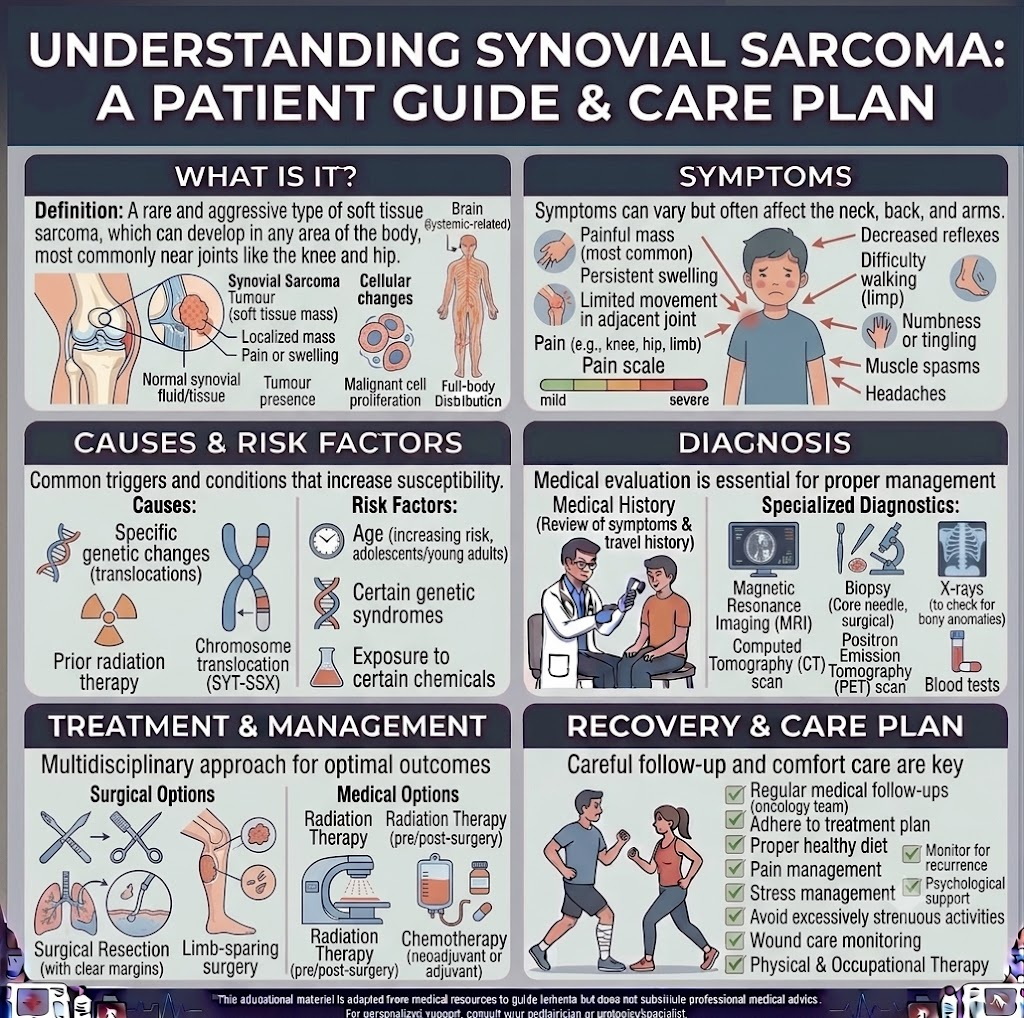
Synovial sarcoma is a rare, aggressive cancer affecting soft tissues like muscles, tendons, ligaments, and fat. Despite its name, it rarely starts in joint lining. It often develops near large joints, commonly the knee, but can appear anywhere. This cancer typically affects older children and young adults, often presenting as a noticeable lump, especially in arms or legs. It forms when cells' DNA changes, causing uncontrolled growth and tumor formation. These cells can invade healthy tissue and spread.
Understanding the Condition
Synovial Sarcoma: Understanding a Rare Soft Tissue Cancer
Understanding the Condition
Synovial sarcoma is a rare, aggressive cancer affecting soft tissues like muscles, tendons, ligaments, and fat. Despite its name, it rarely starts in joint lining. It often develops near large joints, commonly the knee, but can appear anywhere. This cancer typically affects older children and young adults, often presenting as a noticeable lump, especially in arms or legs. It forms when cells' DNA changes, causing uncontrolled growth and tumor formation. These cells can invade healthy tissue and spread.
Common Symptoms
Growing Lump: A new lump or swelling under the skin that slowly gets larger. Often painless initially, it may become painful. Commonly found near the knee or ankle, but can occur anywhere.
Head or Neck Symptoms: If located in the head or neck, symptoms can include breathing difficulties, trouble swallowing, or changes in voice.
Consultation Guide
Which Specialist to Meet
Start with your primary care doctor, who may refer you to an **orthopedic oncologist** (surgeon specializing in soft tissue cancers), a **medical oncologist** (cancer doctor for chemotherapy), or a **radiation oncologist**.
Preparations Before Your Visit
Before your visit, list all symptoms, medical conditions, medications, and questions. Bring any prior test results and consider having a family member or friend accompany you for support and note-taking.
Book a doctor visit near me
Consultation Guide
Joint Stiffness: If the tumor is near a joint, it might cause difficulty or pain with movement.
No Known Prevention: There is no known way to prevent synovial sarcoma, as its exact cause is not fully understood and it's not linked to avoidable lifestyle factors.
Diagnostic Procedures
The doctor will examine the lump or affected area, assessing its size, texture, and any tenderness.
What to Expect
The doctor will gently feel the area and nearby lymph nodes. It's a quick, non-invasive assessment.
Imaging Tests (X-ray, MRI, CT Scan)
These create detailed images to determine tumor size, exact location, and potential spread.
What to Expect
You'll lie on a table. X-rays are quick. MRI uses magnets, is noisy, and takes 30-60 mins; a contrast dye may be injected. CT scans use X-rays, are quicker (10-30 mins), and may also involve contrast dye.
A crucial test where a small tissue sample is removed from the tumor and examined by a pathologist to confirm cancer and its specific type.
What to Expect
For a **Core Needle Biopsy**, the area is numbed, and a hollow needle extracts samples, often guided by ultrasound or CT. For an **Incisional Biopsy**, a surgeon makes a small cut under local or general anesthesia. Expect some soreness or bruising. Results take several days to a week.
Helps detect if cancer has spread. A small amount of radioactive sugar is injected, which cancer cells absorb more readily.
What to Expect
After an injection, you'll wait about an hour, then lie in a scanner for 30-45 minutes. Avoid strenuous activity beforehand.
Regular Follow-Up Appointments: Crucial for monitoring recurrence or metastasis, including physical exams and repeat imaging tests.
Imaging Surveillance: Periodic MRI, CT, or PET scans to watch the treated area and check for new growths or spread, especially to the lungs.
Treatment Options
Surgical Procedures
Tumor Resection (Surgery): The primary treatment, involving removal of the tumor along with a margin of healthy tissue to ensure complete removal. Amputation is rarely considered in modern practice. (Duration: Surgery takes hours; recovery ranges from weeks to several months.)
Radiation Therapy: Uses high-energy beams to kill cancer cells, often used before surgery to shrink tumors or after surgery to destroy residual cells. (Duration: Typically given daily, five days a week, for several weeks (e.g., 5-7 weeks).)
Chemotherapy: Powerful anti-cancer medicines, usually given intravenously, to kill cancer cells throughout the body, especially for larger or spreading tumors. (Duration: Administered in cycles, lasting several months (e.g., 3-6 months or longer).)
Targeted Therapy: Focuses on specific vulnerabilities within cancer cells, targeting molecules involved in growth and spread, with less harm to healthy cells. (Duration: Can be taken daily for many months or even years, if effective and well-tolerated.)
Pain Management: Managing pain from cancer or treatment side effects through medication, physical therapy, or other strategies.
Physical and Occupational Therapy: Rehabilitation is vital after surgery to regain strength, mobility, and function; occupational therapy helps with daily activities.
Psychological and Emotional Support: Seeking support from counselors, support groups, family, or friends to cope with stress, anxiety, and depression.
Healthy Lifestyle: Maintain a balanced diet, gentle exercise (doctor-approved), and adequate rest to support overall health during and after treatment.
Prevention & Long-Term Wellbeing
Prevention
Supportive Care and Lifestyle
Tags & Topics
Notice an error or need an update?
Help us keep medical information accurate. Report incorrect info or suggest an edit.


