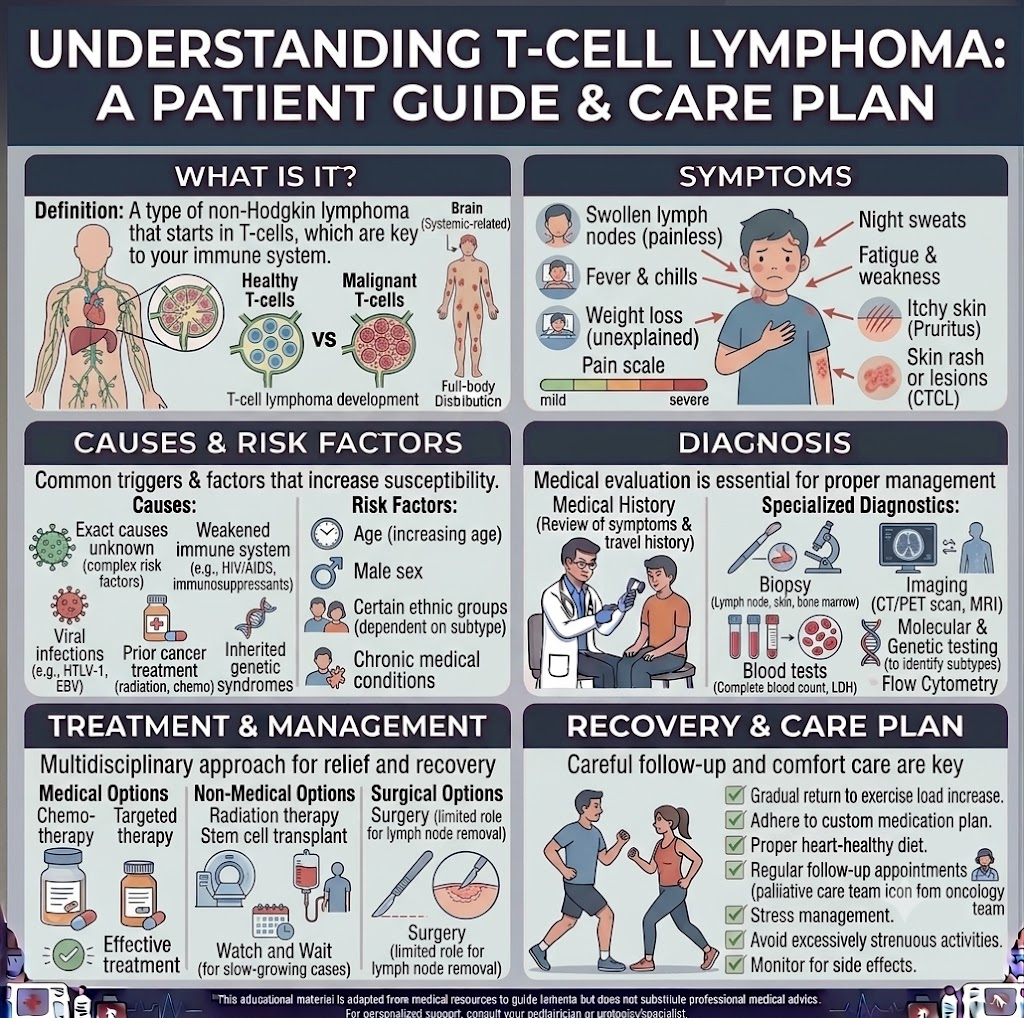
T-cell lymphomas are a type of cancer that affects the lymphatic system, a key part of your body's immune system. This system includes lymph nodes (where immune cells gather), organs, and vessels that help fight infections. These cancers originate in specific germ-fighting white blood cells called T cells (T lymphocytes). As a type of non-Hodgkin lymphoma, T-cell lymphomas can impact lymph nodes, blood, bone marrow, and other body tissues like the skin, liver, or intestines, depending on the specific subtype.
Understanding the Condition
Understanding T-Cell Lymphoma: A Comprehensive Guide
Understanding the Condition
Common Symptoms
Swollen Lymph Nodes: Noticeable swelling in areas like the neck, armpit, or groin.
Drenching Night Sweats: Excessive sweating during sleep, often soaking through clothing.
If you experience concerning symptoms, consult your primary care physician. They may refer you to a hematologist (blood disorder specialist) or an oncologist (cancer specialist). Depending on the lymphoma type and affected body areas, a dermatologist (skin), or gastroenterologist (digestive system) might also be involved.
Preparations Before Your Visit
Before your visit, list all your symptoms, including when they started and their severity. Gather your medical history, current medications, and any past diagnoses. Prepare questions for your doctor. Consider bringing a family member or friend for support and to help recall information.
Book a doctor visit near me
"Watch and Wait" Approach: Close monitoring without immediate active treatment for slow-growing, asymptomatic lymphomas. Treatment begins if the disease progresses or symptoms worsen. (Duration: Ongoing, with regular check-ups over months or years.)
Symptom and Side Effect Management: Collaborate with your healthcare team to effectively address and manage ongoing symptoms or treatment side effects to improve your quality of life.
Diagnostic Procedures
T-cell lymphomas are a type of cancer that affects the lymphatic system, a key part of your body's immune system. This system includes lymph nodes (where immune cells gather), organs, and vessels that help fight infections. These cancers originate in specific germ-fighting white blood cells called T cells (T lymphocytes). As a type of non-Hodgkin lymphoma, T-cell lymphomas can impact lymph nodes, blood, bone marrow, and other body tissues like the skin, liver, or intestines, depending on the specific subtype.
Bone Marrow Biopsy and Aspiration
These procedures collect samples of bone marrow (the spongy tissue inside larger bones where blood cells are made) to check for healthy cell production and diagnose blood and marrow diseases, including lymphomas. Aspiration takes a liquid sample, while a biopsy takes a small piece of solid tissue.
What to Expect
You will typically lie on your side or stomach. After numbing an area, usually at the back of your hip bone, a thin needle is inserted to withdraw a liquid sample (aspiration). Then, a slightly larger needle removes a small piece of solid bone marrow tissue (biopsy). You may feel pressure or a brief, sharp pain. The site will be bandaged afterward.
CT Scan (Computed Tomography Scan)
A CT scan uses specialized X-ray equipment and computer processing to create detailed cross-sectional images ('slices') of bones, blood vessels, and soft tissues inside the body. It provides more detail than standard X-rays and is used to diagnose diseases, injuries, and to guide treatment planning.
What to Expect
You will lie on a motorized table that slides into a large, donut-shaped scanner. You will need to remain still and may be asked to hold your breath briefly. In some cases, a contrast dye may be injected into a vein to highlight specific areas. The scan usually takes 10 to 30 minutes.
Lumbar Puncture (Spinal Tap)
This procedure involves inserting a thin needle into the lower back to collect a sample of cerebrospinal fluid (CSF), which is the fluid that surrounds and protects the brain and spinal cord. It helps diagnose serious infections, certain neurological conditions, or cancers affecting the brain or spinal cord.
What to Expect
You will usually lie on your side with your knees drawn up to your chest, or sit leaning forward. After numbing the skin, a needle is carefully inserted between two vertebrae in your lower back to collect the CSF sample. You may feel pressure or a brief sting. Afterward, you might be asked to lie flat for some time to help prevent headaches.
PET Scan (Positron Emission Tomography Scan)
A PET scan is an imaging test that reveals how your body's tissues and organs are functioning metabolically. A small amount of a radioactive 'tracer' is injected, which accumulates in areas with higher metabolic activity, such as cancer cells. PET scans are often combined with CT or MRI scans (PET-CT or PET-MRI) for clearer, more comprehensive images.
What to Expect
A radioactive tracer will be injected into a vein, and you will wait for about an hour for it to circulate. Then, you will lie on a narrow table that moves into a large, donut-shaped scanner. You must remain very still during the scan, which typically lasts about 30 minutes. Cancer cells often appear as bright spots due to their increased metabolic rate.
Upper Endoscopy (Esophagogastroduodenoscopy)
An upper endoscopy is a procedure to visually examine the lining of the upper digestive system, which includes the esophagus, stomach, and the first part of the small intestine (duodenum). A long, flexible tube with a camera (endoscope) is used, allowing doctors to identify and sometimes treat issues in these areas.
What to Expect
Clinical Trials: Research studies testing new treatments or diagnostic methods. Offers access to experimental therapies not yet widely available. (Duration: Varies significantly based on the trial protocol, from months to years.)
Emotional and Psychological Support: Seek support from family, friends, support groups, or mental health professionals to manage stress, anxiety, and depression associated with a cancer diagnosis.
Treatment Options
You will likely receive medication to help you relax or sleep during the procedure, and your throat may be numbed. The endoscope is gently guided down your throat. You might feel some pressure, but typically no pain. Air may be gently inflated to improve visibility. Tissue samples (biopsies) can be taken if needed. The procedure usually takes 15-30 minutes, followed by a recovery period from sedation.
Medications
Chemotherapy: Uses powerful drugs to kill fast-growing cancer cells systemically. Administered intravenously or orally, often in combinations. (Duration: Cycles over several months, depending on the regimen and response.)
Targeted Therapy: Medications specifically targeting unique weaknesses or signals in cancer cells, minimizing harm to healthy cells. (Duration: Ongoing for months or years, or a defined period.)
Immunotherapy: Boosts the body's own immune system to identify and attack cancer cells. Involves various substances or techniques. (Duration: Cycles over several months or longer.)
Procedures / Therapies
Radiation Therapy: High-energy beams (X-rays, protons) directed to precisely destroy cancer cells or shrink tumors. Delivered externally (machine outside body) or internally (radioactive source near cancer). (Duration: Daily sessions over several weeks for external; single or few sessions for internal.)
Surgical Procedures
Regular Follow-up Care: Essential for monitoring health, assessing treatment, detecting recurrence, and managing long-term side effects through scheduled doctor visits and scans.
Infection Prevention and Management: Practice good hygiene, get recommended vaccinations, and promptly report infection signs, especially with a weakened immune system due to lymphoma or treatment.
Prevention & Long-Term Wellbeing
Unexplained Weight Loss: Losing weight without making changes to diet or exercise.
Loss of Appetite: A decreased desire to eat, leading to reduced food intake.
- Consultation Guide
Which Specialist to Meet
Bone Marrow Transplant (Stem Cell Transplant): Replaces diseased bone marrow with healthy blood-forming stem cells after high-dose chemotherapy or radiation. Stem cells can be from the patient (autologous) or a donor (allogeneic). (Duration: Preparation (days to weeks), infusion (hours), and a recovery period (weeks to months).)
Long-Term Monitoring & Support
Healthy Lifestyle Practices: Maintain a balanced diet, engage in regular physical activity as tolerated, ensure adequate rest, and avoid smoking/excessive alcohol for overall well-being.
Tags & Topics
Notice an error or need an update?
Help us keep medical information accurate. Report incorrect info or suggest an edit.


