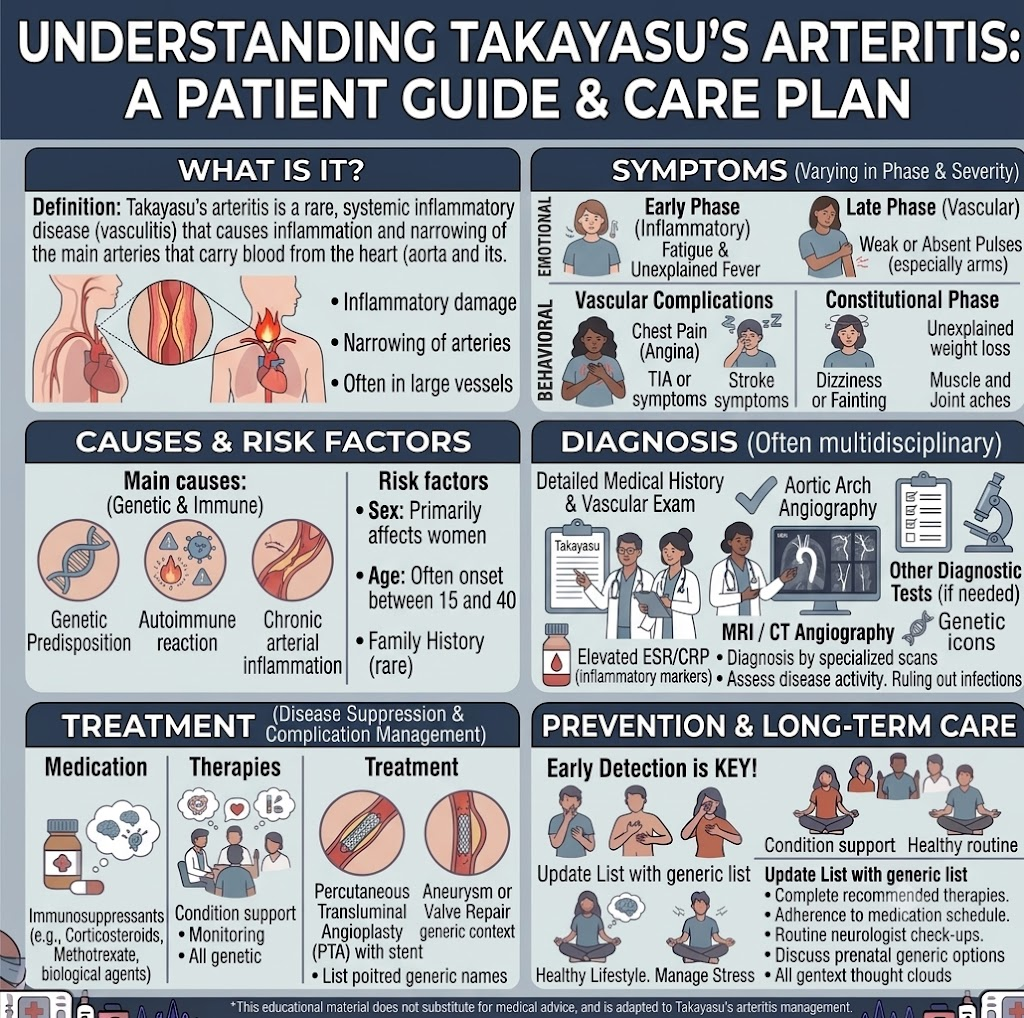
Takayasu's arteritis is a rare inflammatory disease that primarily damages the body's largest blood vessel, the aorta, and its main branches. This condition belongs to a family of diseases called vasculitis, which cause blood vessel swelling. Over time, the chronic inflammation can lead to narrowed, blocked, or stretched and weakened arteries (aneurysms). This restriction of blood flow to key organs and limbs can cause chest pain, high blood pressure, and in severe cases, heart failure or a stroke.
Understanding the Condition
Understanding Takayasu's Arteritis
Understanding the Condition
Common Symptoms
Early-Stage Inflammatory Symptoms: Many people initially experience generalized symptoms of inflammation, including extreme fatigue, unexplained weight loss, mild muscle or joint aches, and a low-grade fever.
Late-Stage Arterial Narrowing Symptoms: As the blood vessels narrow and blood flow drops, symptoms become more localized. These can include pain or weakness in your arms or legs during activity (claudication), coldness or numbness in the limbs, a weak or absent pulse, dizziness, fainting, headaches, chest pain, and high blood pressure.
Emergency Warning Signs: Seek immediate emergency care if you experience severe shortness of breath, sudden chest or arm pain, or signs of a stroke, such as weakness on one side of your face or body, arm numbness, or difficulty speaking.
Consultation Guide
Which Specialist to Meet
You should consult a rheumatologist, who specializes in autoimmune and inflammatory diseases. Depending on your symptoms, you may also need to see a cardiologist (heart specialist) or a vascular surgeon (blood vessel specialist).
Preparations Before Your Visit
Before your appointment, write down all symptoms you are experiencing (even those that seem unrelated), your complete medical and family history, and a list of all current medications. Be prepared to discuss when your symptoms started and if anything makes them better or worse. You may need to fast (not eat or drink) if blood tests or imaging are scheduled for the same day.
Book a doctor visit near me
Routine Medical Checkups: Since symptoms of Takayasu's arteritis can come and go, regular visits with your specialist—including routine blood work and imaging—are essential to detect hidden flare-ups early.
Consultation Guide
Takayasu's arteritis is a rare inflammatory disease that primarily damages the body's largest blood vessel, the aorta, and its main branches. This condition belongs to a family of diseases called vasculitis, which cause blood vessel swelling. Over time, the chronic inflammation can lead to narrowed, blocked, or stretched and weakened arteries (aneurysms). This restriction of blood flow to key organs and limbs can cause chest pain, high blood pressure, and in severe cases, heart failure or a stroke.
A nurse or technician will insert a small needle into a vein in your arm to draw a tube of blood. This is a very quick procedure that may cause a mild pinch.
Coronary or Vascular Angiogram
This is an invasive imaging procedure that uses X-rays and a special dye to look inside your blood vessels to identify blockages or narrowings.
You will lie on an X-ray table and receive local numbing medication. A doctor will insert a thin, flexible tube called a catheter into a blood vessel in your groin, wrist, or neck and guide it to your heart. Contrast dye is injected through the tube, which may cause a temporary warm flushing sensation, while X-ray images are captured.
CT Coronary Angiogram
A non-invasive alternative to standard angiography that uses a advanced computer and X-rays to create detailed 3D pictures of your arteries.
Immune System Suppressants: If anti-inflammatory drugs alone aren't enough or cause too many side effects, these medications help calm your immune system to prevent it from attacking the arteries. (Duration: Often taken long-term, sometimes for several years, to keep the disease in remission.)
Surgical and Minimally Invasive Procedures
Vaccinations: Because treatments often suppress your immune system, staying up-to-date on routine vaccines (like flu and pneumonia shots) is critical to protect yourself from infections.
Diagnostic Procedures
Blood Tests (CRP and ESR)
These tests measure the level of C-reactive protein (CRP) and your erythrocyte sedimentation rate (ESR or 'sed rate') in your blood, both of which rise when there is active inflammation in your body.
What to Expect
What to Expect
What to Expect
An intravenous (IV) line will be placed in your arm to deliver contrast dye. You will lie flat on a motorized table that slides into a doughnut-shaped scanning machine. You will need to lie very still and briefly hold your breath when instructed.
Positron Emission Tomography (PET) Scan
An imaging test that uses a small amount of radioactive material to highlight active, chemical-level inflammation in tissue walls that might not show up on standard scans.
What to Expect
You will receive an injection of a radioactive tracer through an IV. After resting for about an hour to let the tracer circulate, you will lie on a narrow table that slides into the PET scanner. The scan takes about 30 minutes, during which you must remain completely still.
A painless diagnostic test that uses high-frequency sound waves to evaluate blood flow and map the thickness of your arterial walls.
What to Expect
A cool, water-soluble gel is applied to your skin, and the technician gently presses a handheld wand (transducer) against the area being examined. You will feel some mild pressure but no pain.
A quick, standard imaging test to check the size of your heart and the health of your lungs.
What to Expect
You will stand or lie against a flat surface while holding your breath for a few seconds as the X-ray machine shoots beams through your chest. This is entirely painless and takes only a few minutes.
Treatment Options
Medications
Anti-Inflammatory Medications: These drugs are used to quickly control the swelling in your blood vessels and prevent further damage. (Duration: Typically started at a high dose and slowly reduced (tapered) over several months to years, depending on your response.)
Bypass Surgery: A surgical procedure where a healthy blood vessel taken from another part of your body is grafted to redirect blood flow around a severely blocked artery. (Duration: A major surgery requiring several days of hospitalization and a recovery period of several weeks to months.)
Prevention & Long-Term Wellbeing
Angioplasty and Stenting: A procedure where a balloon-tipped catheter is used to widen a narrowed artery, and a tiny metal mesh tube (stent) is left in place to hold it open. (Duration: A one-time procedure taking 1 to 2 hours, requiring a brief hospital observation and a few days of recovery.)
Long-Term Monitoring & Lifestyle Management
Adopt a Heart-Healthy Lifestyle: Eating a balanced diet low in sodium, managing stress, and getting regular, moderate exercise helps keep your blood pressure controlled and reduces strain on your cardiovascular system.
Avoid Tobacco Products: Smoking severely damages blood vessels, accelerates the hardening of your arteries, and can worsen inflammation. Quitting smoking is a vital step in protecting your vascular health.
Tags & Topics
Notice an error or need an update?
Help us keep medical information accurate. Report incorrect info or suggest an edit.


