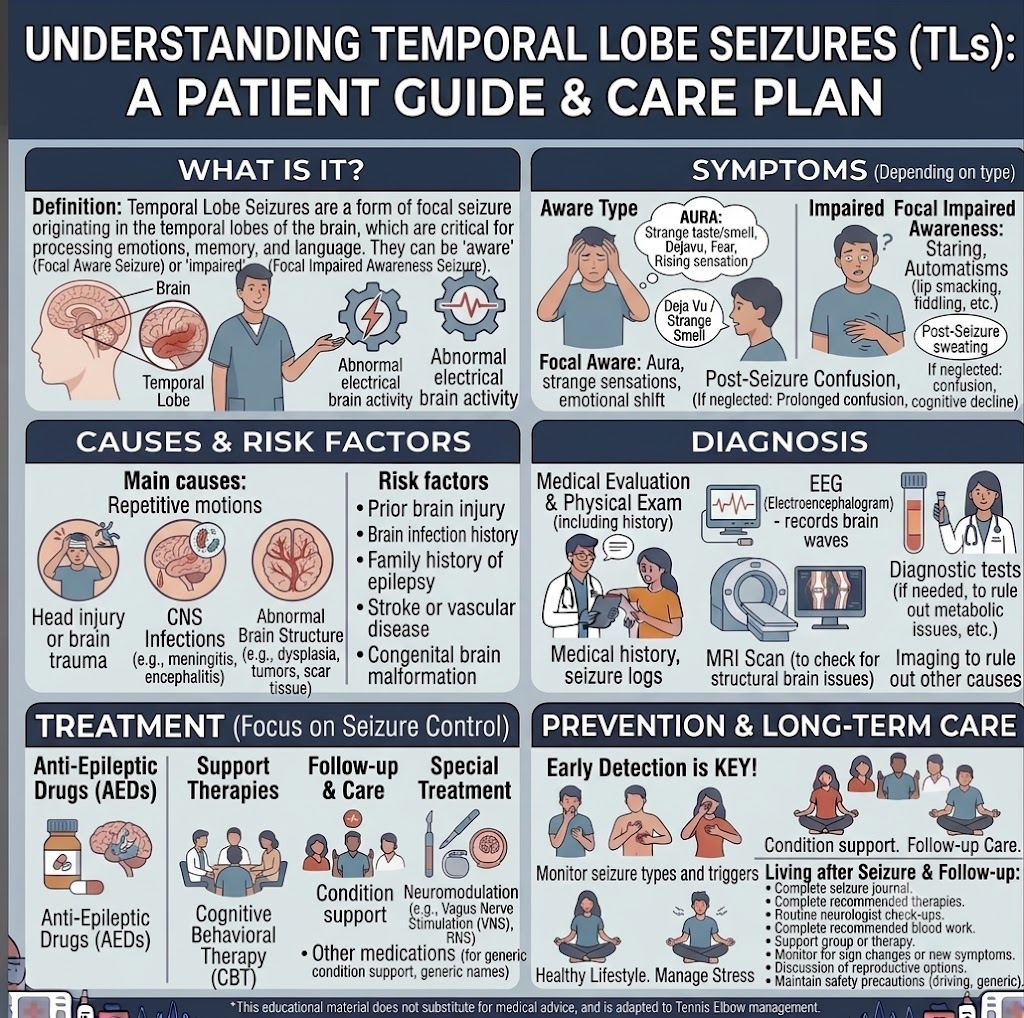
Temporal lobe seizures are a type of brain event that starts in the temporal lobes, areas crucial for emotions, memory, and processing senses like smell and hearing. These seizures can cause unusual feelings, changes in awareness, and repetitive movements. They are often called focal seizures with impaired awareness because they originate in a specific brain area and can affect a person's ability to respond to their surroundings. While the exact cause is often unknown, these seizures are treatable, primarily with medication, and sometimes with surgery for those who don't respond to medicine.
Understanding the Condition
Temporal Lobe Seizures: Understanding Brain Activity and Symptoms
Understanding the Condition
Common Symptoms
Aura (Warning Signs): An 'aura' is an unusual feeling or sensation that some people experience just before a temporal lobe seizure. It acts as a warning sign and is considered the first part of the seizure, even if full awareness is maintained. Not everyone with temporal lobe seizures experiences auras, and not all who do remember them. Examples include sudden feelings of fear or joy, a sense of 'deja vu' (feeling like something has happened before), a strange smell or taste (known as phantosmia if smelling things not present), or a rising sensation in the stomach similar to being on a roller coaster.
Changes in Awareness and Responsiveness: During a temporal lobe seizure, which typically lasts between 30 seconds and 2 minutes, individuals may appear awake but are often not fully aware of their surroundings or unable to respond to others. They might stare blankly.
Repetitive Movements: Common physical symptoms include involuntary, repeated motions such as lip smacking, chewing or swallowing repeatedly, and picking or fumbling movements with the fingers or hands.
Consultation Guide
Which Specialist to Meet
For symptoms suggesting temporal lobe seizures, it's best to consult a neurologist, a doctor specializing in brain and nervous system disorders. In some cases, an epileptologist, a neurologist with additional expertise in epilepsy, may be recommended.
Preparations Before Your Visit
Before your visit, compile a detailed medical history, including any past head injuries, infections, or family history of seizures. Keep a record of your symptoms: when they occur, how long they last, what they feel like, and any triggers you've noticed. Bring a list of all medications you currently take and prepare a list of questions for your doctor.
Book a doctor visit near me
Regular Medical Follow-ups: Regular appointments with a neurologist are essential to monitor your condition, adjust medications if needed, and discuss any new symptoms or concerns. This also helps monitor for long-term complications like memory issues.
Consultation Guide
Temporal lobe seizures are a type of brain event that starts in the temporal lobes, areas crucial for emotions, memory, and processing senses like smell and hearing. These seizures can cause unusual feelings, changes in awareness, and repetitive movements. They are often called focal seizures with impaired awareness because they originate in a specific brain area and can affect a person's ability to respond to their surroundings. While the exact cause is often unknown, these seizures are treatable, primarily with medication, and sometimes with surgery for those who don't respond to medicine.
Manage Underlying Risk Factors: While many causes are unknown, managing known risk factors like preventing head injuries, promptly treating infections such as meningitis or encephalitis, and addressing alcohol overuse can contribute to overall brain health and potentially reduce seizure risk.
Diagnostic Procedures
Neurological Examination
A neurological exam assesses the functioning of your nervous system, including your brain, spinal cord, nerves, and muscles. It helps your healthcare team identify potential nervous system conditions.
What to Expect
The doctor will ask about your medical history and perform tests to check your physical and mental status. This may include evaluating your reflexes, coordination, balance, muscle strength, sensation, vision, hearing, and memory. The exam can range from a few minutes to over an hour.
Electroencephalogram (EEG)
An EEG measures the electrical activity of your brain. Brain cells communicate through electrical impulses, and an EEG records these signals as wavy lines, which can reveal abnormal patterns associated with seizures.
What to Expect
Small metal discs called electrodes will be attached to your scalp. These electrodes detect your brain's electrical activity. The test is painless and involves sitting or lying still while the recording takes place. You may be asked to do specific tasks like hyperventilating or looking at flashing lights, or a prolonged recording might be done during sleep.
Brain Magnetic Resonance Imaging (MRI)
A brain MRI is a diagnostic test that uses a strong magnet and radio waves to create detailed images of your brain, and sometimes the neck and spine. It can identify structural abnormalities such as scars, tumors, or vascular problems.
What to Expect
You will lie on a movable table that slides into a large, tube-shaped machine. The machine makes loud knocking or thumping noises during the scan. You'll need to remain very still. The test is painless and does not use radiation, but some people may feel uncomfortable in the enclosed space. In some cases, a contrast dye might be injected to enhance image detail.
Single-Photon Emission Computed Tomography (SPECT) Scan
A SPECT scan is an imaging test that uses a small amount of radioactive substance and a special camera to create 3D pictures showing how well organs are working, particularly blood flow and activity in the brain.
What to Expect
A small amount of a radioactive tracer will be injected into a vein, usually in your arm. After a waiting period for the tracer to travel to your brain, you will lie on a table that moves through a special camera that rotates around your head. This camera detects the tracer's signals to create detailed 3D images of blood flow and activity in your brain. You will need to remain still during the scan.
Treatment Options
Medications
Anti-Seizure Medications: These oral medications work by altering brain chemistry to reduce the frequency and severity of seizures. The goal is to find the most effective medication at the lowest possible dose with minimal side effects. (Duration: Lifelong, or as long as seizures are present and managed by medication, with regular review by a specialist.)
Surgical Procedures
Resective Surgery: For individuals whose seizures don't respond to medication, surgery to remove the small area of the temporal lobe where seizures originate may be an option. This is usually considered when the seizure-causing area can be precisely identified and removed without causing significant damage to vital brain functions. (Duration: A single procedure, followed by a recovery period of several weeks to months. Long-term follow-up is necessary.)
Vagus Nerve Stimulation (VNS): This involves implanting a small device under the skin in the chest that sends regular, mild electrical pulses to the vagus nerve in the neck. These pulses travel to the brain and can help reduce seizure frequency. (Duration: A single surgical implantation procedure, with the device providing ongoing stimulation. Battery replacement may be needed every 7-10 years.)
Stereotactic Radiosurgery: A non-invasive procedure that uses highly focused radiation beams, guided by 3D imaging, to target and destroy the brain tissue causing seizures. It's not traditional surgery with an incision. (Duration: Typically completed in a single session for brain conditions, followed by a period where the treated tissue gradually changes.)
Medication Adherence: Taking prescribed anti-seizure medications consistently and exactly as directed is crucial for managing the condition and preventing seizures. Never stop medication without consulting your doctor.
Prevention & Long-Term Wellbeing
Prevention and Long-Term Management
Identify and Avoid Triggers: Keeping a seizure diary can help identify common triggers such as lack of sleep, stress, alcohol, or flashing lights. Avoiding these known triggers can help reduce seizure frequency.
Healthy Lifestyle: Maintaining a balanced diet, getting adequate sleep, managing stress, and regular physical activity can support overall brain health and potentially impact seizure control. Avoid excessive alcohol intake.
Safety Precautions: Implement safety measures to prevent injury during a seizure, such as avoiding swimming alone, taking showers instead of baths, and discussing driving restrictions with your doctor.
Tags & Topics
Notice an error or need an update?
Help us keep medical information accurate. Report incorrect info or suggest an edit.


