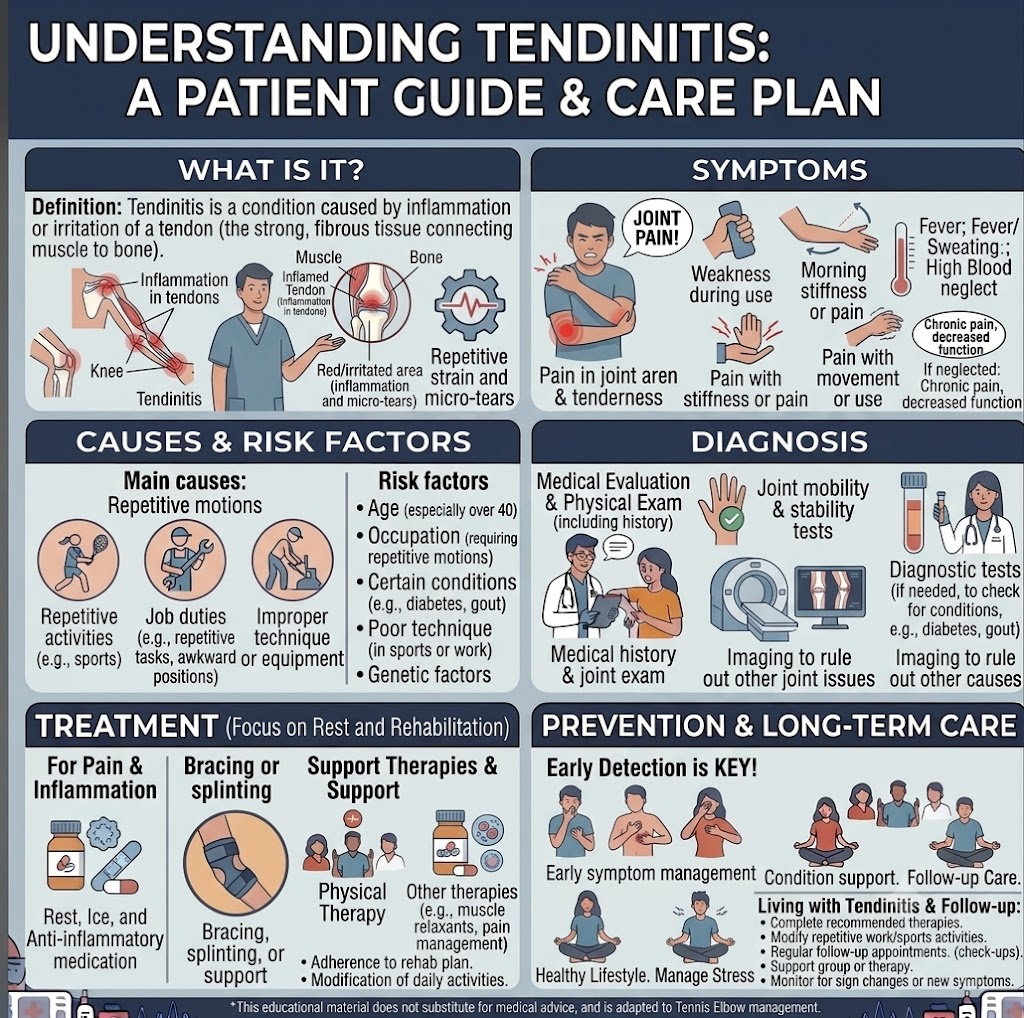
Tendinitis is a condition characterized by inflammation of a tendon, which is a strong, fibrous cord that connects muscle to bone. This inflammation typically causes pain and tenderness directly outside a joint. While tendinitis can affect any tendon in the body, it is most commonly found around the shoulders, elbows, wrists, knees, and heels. Most cases improve with conservative treatments like rest, physical therapy, and pain-relieving medications. However, if chronic, tendinitis can lead to the tendon breaking down or tearing, which might require surgery.
Understanding the Condition
Tendinitis: Understanding and Managing Tendon Pain
Understanding the Condition
Common Symptoms
Pain: Pain, often a dull ache, typically felt where the affected tendon connects to bone. It usually worsens with movement of the injured limb or joint.
Tenderness: The area around the affected tendon may feel tender to the touch.
Mild Swelling: Some slight swelling may be noticeable around the affected joint.
Consultation Guide
Which Specialist to Meet
Initially, you should consult your primary care provider. If symptoms persist or are severe, they may refer you to a specialist such as an orthopedist (a doctor specializing in bones, joints, and tendons), a sports medicine physician, or a physical therapist. These specialists can offer more targeted diagnosis and treatment plans.
Preparations Before Your Visit
Before your appointment, be prepared to discuss when your symptoms started, what activities worsen or improve them, your medical history, any medications you are currently taking, and details about your job, hobbies, and exercise routine. Wearing loose-fitting clothing to your appointment can also facilitate a physical examination of the affected area.
Book a doctor visit near me
An X-ray is a quick, painless imaging test that uses a small amount of radiation to create pictures of the inside of your body, primarily focusing on bones. While X-rays cannot directly show tendons, they can help rule out other conditions like fractures or arthritis that might be causing similar symptoms.
Activity Modification: Adjusting daily activities, work tasks, or sports techniques to reduce stress on the injured tendon. (Duration: Ongoing, until symptoms resolve and as a preventive measure.)
Pain Relievers: Over-the-counter pain medications can help reduce pain and inflammation. (Duration: Used as needed for symptom relief, typically short-term (days to a few weeks).)
Physical Therapy: A physical therapist can guide you through specific exercises to stretch and strengthen the affected muscle-tendon unit, improve range of motion, and correct movement patterns. (Duration: Several weeks to a few months, with consistent participation.)
Consultation Guide
Tendinitis is a condition characterized by inflammation of a tendon, which is a strong, fibrous cord that connects muscle to bone. This inflammation typically causes pain and tenderness directly outside a joint. While tendinitis can affect any tendon in the body, it is most commonly found around the shoulders, elbows, wrists, knees, and heels. Most cases improve with conservative treatments like rest, physical therapy, and pain-relieving medications. However, if chronic, tendinitis can lead to the tendon breaking down or tearing, which might require surgery.
Listen to Your Body: Pay attention to pain signals. If an activity causes pain, stop and rest. Pushing through pain can worsen tendon injuries.
Diagnostic Procedures
A doctor will physically examine the affected area to check for tenderness, swelling, and to assess your range of motion and strength.
What to Expect
During a physical examination, the doctor will gently press on the area around your tendon and joint to identify points of tenderness and swelling. They will also ask you to move the affected limb or joint in various directions to observe your range of motion and pain levels. This part of the examination typically takes only a few minutes and may involve some mild discomfort if the area is sensitive.
What to Expect
For an X-ray, you will typically be asked to remove any metal objects or jewelry and may need to change into a hospital gown. You will then be positioned on an X-ray table, and the technician will carefully position the X-ray machine over the part of your body being examined. You will be asked to remain very still, and sometimes to hold your breath for a few seconds, while the image is taken. The procedure is brief, usually lasting only a few minutes, and is generally painless.
MRI (Magnetic Resonance Imaging) or Ultrasound
These advanced imaging techniques can provide detailed images of soft tissues, including tendons, and may be used in cases where the diagnosis is unclear or a tendon tear is suspected.
What to Expect
For an MRI, you will lie on a movable table that slides into a large, tunnel-like machine. The machine uses powerful magnets and radio waves to create detailed images. It can be noisy, so earplugs or headphones are often provided. The scan can take 30 to 60 minutes, and you must remain very still. Some people might feel claustrophobic. An ultrasound uses sound waves to produce real-time images of soft tissues. During an ultrasound, a gel is applied to your skin over the affected area, and a small handheld device called a transducer is moved across it. This is typically quick (15-30 minutes) and painless, providing immediate results.
Treatment Options
Home Remedies and Self-Care
Rest: Avoid activities that aggravate the tendon. Resting the affected area is crucial to allow the inflammation to subside and the tendon to begin healing. (Duration: Typically, a few days to several weeks, depending on the severity.)
Ice or Heat Application: Applying ice packs to the affected area can help reduce pain and swelling, especially during the acute phase. Heat may be used later to relax muscles and improve blood flow. (Duration: 15-20 minutes, several times a day, as needed for pain relief.)
Medications
Corticosteroid Injections: Injections of anti-inflammatory medication directly into the area around the tendon can provide temporary pain relief and reduce inflammation. (Duration: Relief can last weeks to months, but repeated injections are generally not recommended due to potential tendon weakening.)
Surgical Procedures
Tendon Repair Surgery: If a tendon completely tears or if conservative treatments are ineffective after several months, surgery may be necessary to repair the damaged tendon or remove inflamed tissue. (Duration: Recovery can take several months, often followed by extensive physical therapy.)
Prevention & Long-Term Wellbeing
Prevention
Gradual Activity Increase: When starting a new exercise or increasing the intensity of an existing one, do so gradually. Allow your tendons time to adapt to the increased load.
Cross-Training: Incorporate a variety of exercises into your routine. Alternate high-impact activities (like running) with lower-impact options (like swimming or cycling) to prevent overuse of specific tendons.
Proper Technique and Equipment: Ensure you are using correct form and posture during physical activities and at work. Consider professional instruction for new sports or exercise equipment. Use appropriate and well-maintained gear, such as supportive shoes.
Regular Stretching and Strengthening: After warming up or exercise, gently stretch your muscles to improve flexibility and maintain full range of motion in your joints. Strengthen the muscles surrounding your tendons to help them better bear loads.
Ergonomic Workplace Setup: Adjust your chair, keyboard, and desk to ensure they are positioned correctly for your body height and tasks. This minimizes awkward positions and repetitive stress on your tendons during work.
Long-Term Monitoring and Management
Adequate Recovery: Allow sufficient rest and recovery time between intense workouts or after an injury. Don't rush back into activities too quickly.
Maintain Overall Health: A balanced diet and staying hydrated support tissue health. Managing chronic conditions and avoiding smoking can also positively impact tendon health.
Tags & Topics
Notice an error or need an update?
Help us keep medical information accurate. Report incorrect info or suggest an edit.


