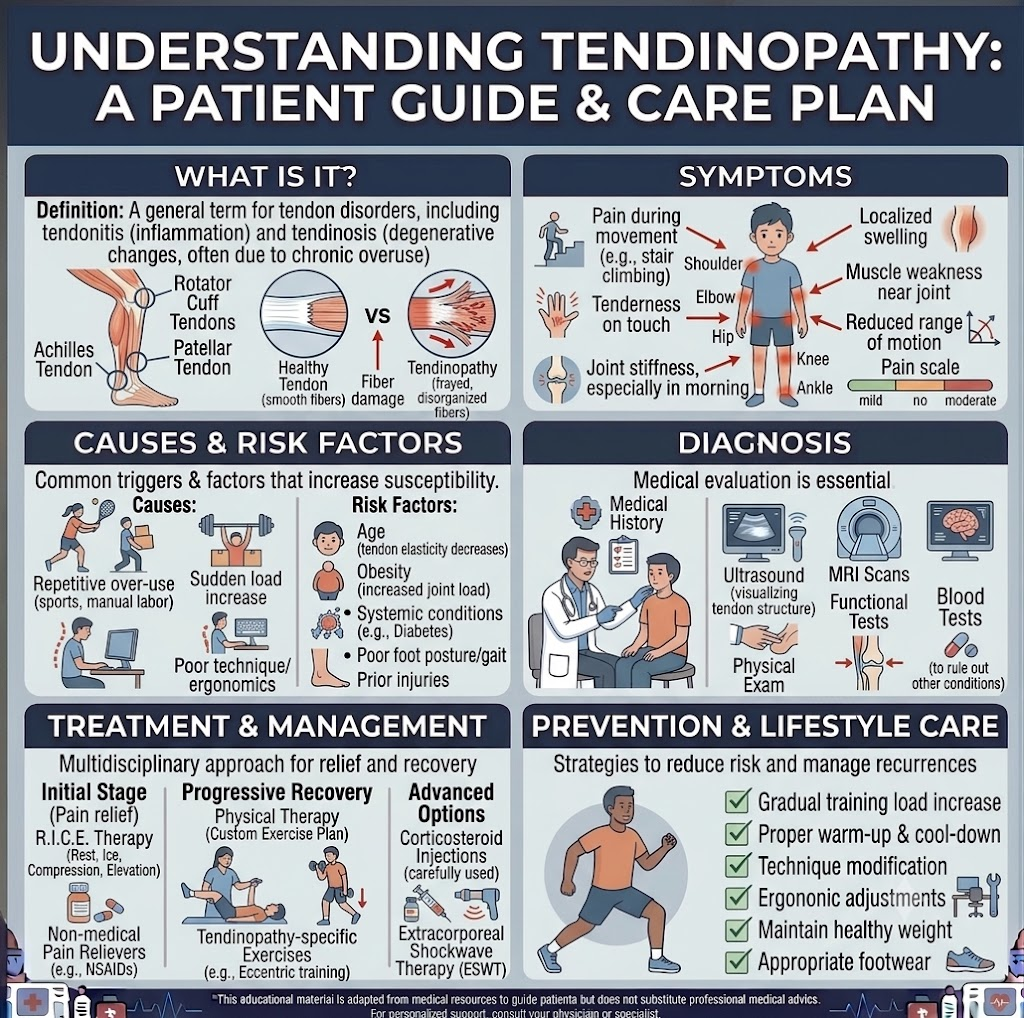
Tendinopathy is a general term for any condition affecting a tendon. Tendons are strong, cord-like tissues that connect your muscles to your bones, allowing you to move. Tendinopathy causes pain and tenderness and is very common. It usually happens when a tendon is used too much or performs the same movements repeatedly. Conditions under the umbrella of tendinopathy include:* **Tendinitis:** This means there's new or sudden irritation and swelling (inflammation) of a tendon. People often mistakenly use this term for all tendon problems.* **Tendinosis:** This is a gradual breakdown of the tendon tissue over time, without much swelling.* **Tenosynovitis:** This occurs when the thin layer of tissue surrounding a tendon, called the sheath, becomes inflamed.Tendon conditions can occur in any part of the body but are most common in the shoulders, elbows, wrists, hips, knees, and heels. Most cases can be managed with rest, physical therapy, and pain-relieving medication.
Understanding the Condition
Understanding Tendinopathy: A Guide for Non-Medical Persons
Understanding the Condition
Common Symptoms
Pain: Often described as a dull ache, especially when you move the affected limb or joint.
Stiffness or Weakness: Feeling rigid or weak in the area where the tendon is affected.
Tenderness: Pain when you touch or press on the affected area.
Mild Swelling: Slight puffiness or enlargement around the tendon.
Consultation Guide
Which Specialist to Meet
Initially, you should consult your primary care doctor. Depending on the severity and nature of your condition, they may refer you to an orthopedic specialist (a doctor specializing in bones, joints, and muscles), a sports medicine physician, or a physical therapist.
Preparations Before Your Visit
Before your appointment, make a list of your symptoms, including when they started, how severe they are, and what makes them better or worse. Note any recent injuries, changes in your activities, or new exercises. Also, bring a list of all medications and supplements you currently take, and be ready to discuss your daily activities, job, and hobbies.
Book a doctor visit near me
Consultation Guide
Tendinopathy is a general term for any condition affecting a tendon. Tendons are strong, cord-like tissues that connect your muscles to your bones, allowing you to move. Tendinopathy causes pain and tenderness and is very common. It usually happens when a tendon is used too much or performs the same movements repeatedly. Conditions under the umbrella of tendinopathy include:* **Tendinitis:** This means there's new or sudden irritation and swelling (inflammation) of a tendon. People often mistakenly use this term for all tendon problems.* **Tendinosis:** This is a gradual breakdown of the tendon tissue over time, without much swelling.* **Tenosynovitis:** This occurs when the thin layer of tissue surrounding a tendon, called the sheath, becomes inflamed.Tendon conditions can occur in any part of the body but are most common in the shoulders, elbows, wrists, hips, knees, and heels. Most cases can be managed with rest, physical therapy, and pain-relieving medication.
Rest: Avoiding activities that cause pain or stress on the tendon. (Duration: Typically several days to weeks, until pain subsides.)
Ice/Cold Packs: Applying cold to the affected area to reduce pain and swelling. (Duration: 15-20 minutes at a time, several times a day for the first few days.)
Heat: Applying warmth can help relax muscles and increase blood flow after the initial acute pain has settled. (Duration: 15-20 minutes.)
Listen to Your Body: Pay close attention to pain signals. If an activity causes discomfort, stop and rest, or modify the movement to prevent minor issues from becoming chronic.
Maintain a Healthy Weight: Keeping a healthy body weight reduces overall stress on weight-bearing tendons, such as those in the knees and ankles.
Stay Active with Modified Movements: Continue engaging in physical activity, choosing movements that do not aggravate your condition, to maintain overall fitness, flexibility, and tendon health.
Diagnostic Procedures
Your doctor will carefully examine the affected area to check for tenderness, swelling, range of motion, and strength.
What to Expect
The doctor will gently touch and press on the painful area, move your limb in different directions, and ask you to perform simple movements to assess your flexibility and strength.
This imaging test uses a small amount of radiation to create pictures of your bones. While X-rays don't show tendons well, they can help rule out other problems like fractures or arthritis, and in some cases, show calcium deposits in the tendon.
What to Expect
You will be asked to lie or sit still on a table while an X-ray machine takes images. The procedure is quick and generally painless.
An ultrasound uses sound waves to create real-time images of soft tissues, including tendons. It can help your doctor see tendon damage, inflammation, fluid around the tendon, or even small tears.
What to Expect
A gel will be applied to your skin over the affected area, and a small handheld device (transducer) will be gently moved across it. You may feel slight pressure, and the images will appear on a screen.
MRI (Magnetic Resonance Imaging)
An MRI uses strong magnets and radio waves to produce very detailed images of soft tissues, such as tendons, muscles, and ligaments. It provides a comprehensive view of any tendon damage, swelling, or tears.
What to Expect
You will lie on a movable table that slides into a large, tunnel-shaped machine. The procedure is painless, but the machine can be noisy, so you might be given headphones. It's important to remain very still throughout the scan, which can take 15 to 60 minutes.
Treatment Options
Medications
Oral Pain Relievers: Over-the-counter medications to help reduce pain and inflammation. (Duration: As needed, short-term use.)
Topical Pain Relievers: Creams or gels applied directly to the skin over the painful area for local relief. (Duration: As directed, short-term use.)
Therapies
Physical Therapy: Guided exercises to stretch and strengthen the affected tendon and surrounding muscles, improve movement, and correct improper body mechanics. (Duration: Several weeks to months, depending on severity.)
Occupational Therapy: Learning how to modify daily tasks or work activities to reduce strain on the tendon. (Duration: As needed, short-term or ongoing guidance.)
Procedures & Injections
Corticosteroid Injections: An anti-inflammatory medication injected directly into the area around the tendon to reduce pain and swelling. Used cautiously as repeated injections can weaken tendons. (Duration: Temporary relief, effects last weeks to months; not a long-term solution.)
Platelet-Rich Plasma (PRP) Injections: Involves injecting a concentrated solution of your own blood platelets, which contain growth factors, to promote healing of the tendon. (Duration: Potential benefits over several months; often requires multiple sessions.)
Dry Needling: A technique using thin needles inserted into the tendon to stimulate blood flow and trigger a healing response. (Duration: Typically several sessions over a few weeks.)
Extracorporeal Shockwave Therapy (ESWT): Uses sound waves delivered to the affected area to stimulate healing, often used for chronic tendon conditions. (Duration: Usually 3-5 sessions over several weeks.)
Surgical Procedures
Tendon Repair/Debridement: Rarely necessary, usually for severe cases that haven't responded to other treatments. Involves removing damaged tissue or repairing a torn tendon. (Duration: Several months for full recovery and rehabilitation.)
Prevention & Long-Term Wellbeing
Prevention
Gradual Increase in Activity: Slowly increase the intensity, duration, or frequency of new exercises or activities to avoid overloading tendons.
Vary Activities (Cross-Training): Alternate high-impact exercises with low-impact ones (like swimming or cycling) to reduce repetitive stress on specific tendons.
Proper Form and Technique: Learn and consistently use correct body mechanics for sports, exercise, and work tasks to minimize undue strain on your tendons.
Strengthen Supporting Muscles: Regularly strengthen the muscles around your tendons. Stronger muscles can better support and protect tendons from excessive load.
Adequate Rest and Recovery: Allow sufficient time for your tendons to recover between strenuous activities or after an injury to prevent overuse and further damage.
Appropriate Equipment: Use well-fitting, supportive shoes and proper gear for your activities. This helps reduce shock and supports correct movement mechanics.
Long-Term Monitoring
Tags & Topics
Notice an error or need an update?
Help us keep medical information accurate. Report incorrect info or suggest an edit.


