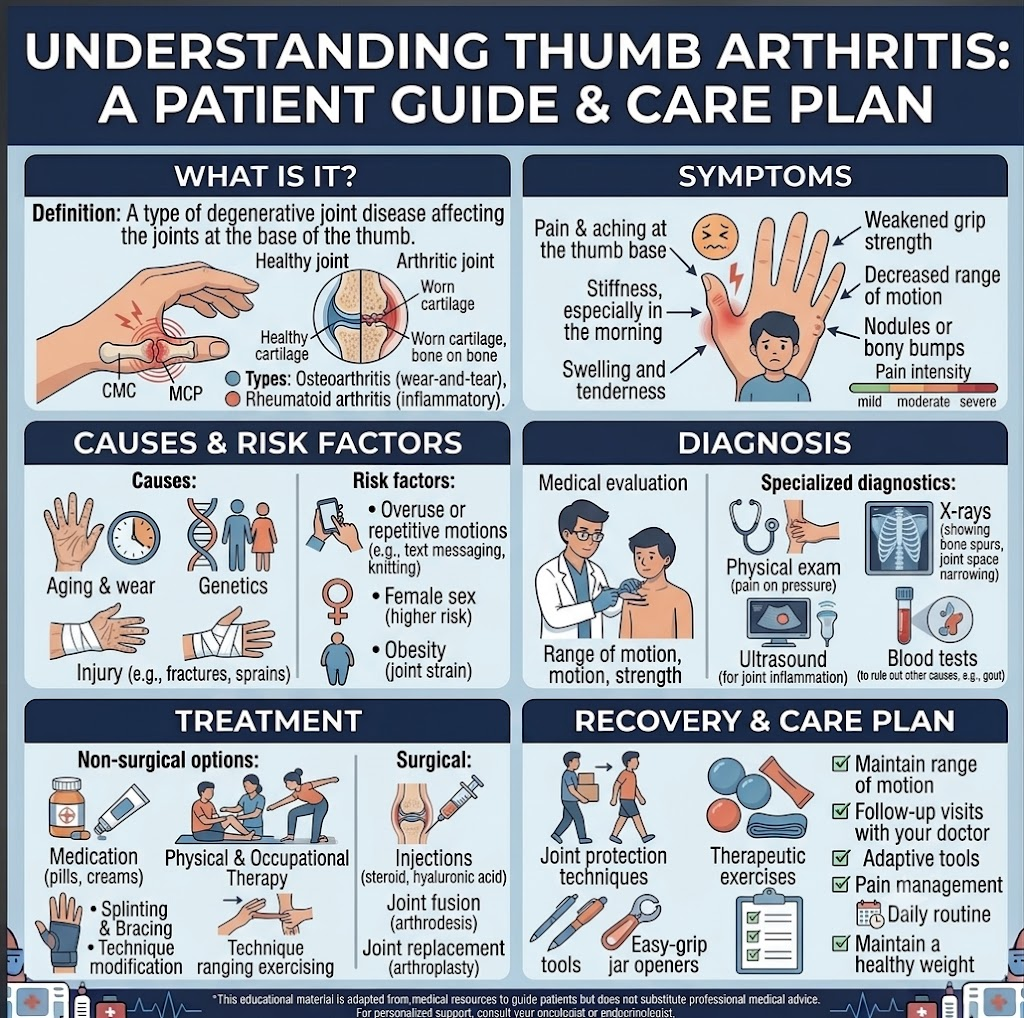
Thumb arthritis is a common condition, especially as people age, affecting the joint at the base of your thumb. This specific joint is often called the carpometacarpal joint or CMC joint. It happens when the smooth, protective tissue called cartilage, which cushions the ends of bones and allows them to glide easily, wears away. Without this cushion, bones rub against each other, causing pain, swelling, and stiffness. This can make everyday tasks like gripping, pinching, turning doorknobs, or opening jars difficult and painful. Treatment options range from simple home care and medications to specialized therapies and, in some cases, surgery.
Understanding the Condition
Understanding the Condition
Common Symptoms
Pain at the Base of the Thumb: The most common symptom, often worsened by grasping, pinching, or using your thumb.
Swelling, Stiffness, and Tenderness: Noticeable at the base of the thumb joint.
Weakness: Reduced strength when performing tasks that require pinching or gripping.
Decreased Range of Motion: Difficulty moving the thumb as freely as before.
Enlarged or Bony Joint: The joint at the base of the thumb may appear larger or develop bony bumps.
Consultation Guide
Which Specialist to Meet
You should first consult your primary care doctor, who may then refer you to an orthopedic surgeon (a doctor specializing in bone and joint conditions), a rheumatologist (a doctor specializing in arthritis and autoimmune diseases), or a hand therapist.
Preparations Before Your Visit
Before your visit, make a note of your symptoms, including when they started, what makes them better or worse, and how they affect your daily activities. List any previous thumb injuries, medical conditions, and medications you are currently taking. Prepare any questions you have for the doctor.
Book a doctor visit near me
Routine Follow-ups: Regular check-ins with your doctor or specialist to monitor the condition, adjust treatments, and discuss any new symptoms.
Consultation Guide
You'll be positioned to allow clear images of your thumb. You must remain still for a few seconds as the X-ray is taken. The procedure is brief and causes no pain.
CT scan (Computerized Tomography scan)
Creates detailed cross-sectional images of bones and soft tissues using X-rays and computer processing, offering more comprehensive views of joint damage.
Splinting/Bracing: Wearing a supportive splint or brace can stabilize the thumb joint, reduce pain, and allow it to rest. (Duration: Worn as needed, especially during activities that cause pain, or overnight; can be long-term)
Occupational or Physical Therapy: Exercises and techniques taught by a therapist to strengthen thumb muscles, improve joint mobility, and learn joint-sparing methods for daily tasks. (Duration: Several weeks to months, with ongoing home exercises)
Diagnostic Procedures
A quick, painless test using radiation to visualize bones. It helps identify cartilage loss, bone spurs, and joint changes indicative of arthritis.
What to Expect
What to Expect
You'll lie on a table that slides into a donut-shaped scanner. You may hear mechanical noises. In some cases, a contrast dye may be given intravenously to enhance image clarity, causing a brief warm sensation. Remaining still is important.
A nuclear imaging test involving a radioactive tracer to highlight areas of increased bone activity, which can indicate inflammation, infection, or arthritic changes not visible on standard X-rays.
What to Expect
A small amount of tracer is injected into a vein. After a 2-3 hour waiting period for the tracer to be absorbed, you'll lie on a table while a special camera scans your body. The scan itself is painless and takes 30-60 minutes.
A minimally invasive surgical procedure where a tiny camera (arthroscope) is inserted through small incisions to visually inspect and, if necessary, perform minor repairs within the joint.
What to Expect
Treatment Options
Performed under anesthesia in an operating room. Small incisions allow insertion of the camera and instruments. The surgeon views the joint on a monitor. Recovery involves some post-procedure discomfort, but generally faster than open surgery.
Rest and Activity Modification: Avoiding activities that trigger pain, such as forceful gripping or pinching. (Duration: As needed, ongoing)
Ice or Heat Application: Applying ice packs can reduce swelling and pain; heat pads can relax stiff muscles. (Duration: 15-20 minutes, several times a day, as needed)
Medications
Over-the-Counter Pain Relievers: Nonsteroidal anti-inflammatory drugs (NSAIDs) can reduce pain and inflammation. (Duration: Short-term use, as needed, or as directed by a doctor)
Prescription Pain Relievers: Stronger medications may be prescribed for more severe pain or when over-the-counter options are insufficient. (Duration: As directed by a doctor, typically for limited periods)
Corticosteroid Injections: Directly injected into the thumb joint to reduce pain and inflammation. (Duration: Pain relief can last weeks to months. Limited to a few injections per year.)
Therapies
Adhere to Treatment: Consistently follow prescribed medications, splinting recommendations, and therapy exercises.
Pain Management Plan: Work with your healthcare provider to develop an ongoing plan for managing pain, which may include a combination of treatments.
Assistive Devices: Utilize specialized tools or devices that can help with gripping, opening jars, or turning doorknobs to reduce thumb strain.
Prevention & Long-Term Wellbeing
Joint Fusion (Arthrodesis): The bones in the joint are permanently joined together, eliminating movement and pain, but reducing flexibility. (Duration: Permanent procedure. Recovery typically takes several months.)
Joint Replacement (Arthroplasty): The damaged parts of the joint are removed and replaced with artificial components or a patient's own tissue from another area. (Duration: Permanent procedure. Recovery typically takes several months.)
Trapeziectomy: The small bone at the base of the thumb (trapezium) is removed, creating space and often reducing bone-on-bone friction. (Duration: Permanent procedure. Recovery typically takes several weeks to months.)
Prevention
Early Recognition: Pay attention to any persistent pain, stiffness, or swelling at the base of your thumb and seek medical advice promptly.
Joint Protection: Learn to perform daily tasks in ways that minimize stress on your thumb joint, such as using larger handles or distributing weight differently.
Ergonomic Adjustments: Modify tools, work environments, and hobbies to reduce repetitive strain on your thumb.
Maintain Healthy Weight: Reducing overall body weight can lessen the stress on all joints, including the hands.
Long-Term Management
Gentle Exercise: Incorporate light hand and thumb exercises recommended by a therapist to maintain flexibility and strength without overstraining the joint.
Tags & Topics
Notice an error or need an update?
Help us keep medical information accurate. Report incorrect info or suggest an edit.


