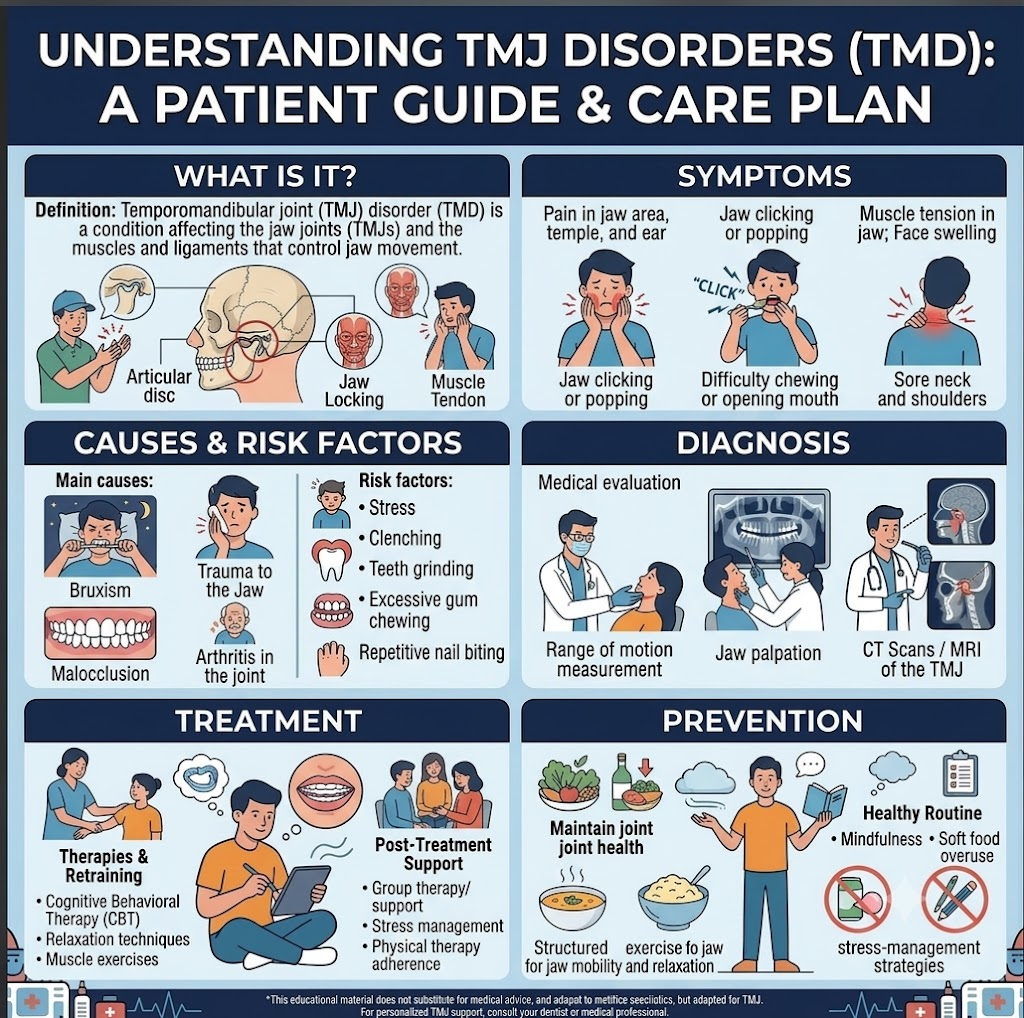
The temporomandibular joint (TMJ) connects your jawbone to your skull, acting like a complex sliding hinge. You have one on each side of your jaw. TMJ disorders (also known as TMD) cause pain in these joints and the muscles controlling jaw movement. Often, the exact cause is unclear, but contributing factors can include teeth clenching or grinding (bruxism), stress, jaw injury, and conditions like arthritis. Most TMJ discomfort is temporary and often improves with simple care.
Understanding the Condition
Understanding Temporomandibular (TMJ) Joint Disorders
Understanding the Condition
Common Symptoms
Jaw Pain: Tenderness or pain in the jaw area.
Joint Pain: Pain in one or both temporomandibular joints.
Ear Ache: Aching pain in and around the ear.
Chewing Difficulty: Pain or trouble when chewing.
Facial Pain: Aching pain across the face.
Jaw Locking: The joint locks, making it hard to fully open or close your mouth.
Tooth Pain: Tooth sensitivity that occurs alongside jaw tenderness.
Before your appointment, consider keeping a journal of your symptoms (when they occur, what makes them better or worse), any stress you're experiencing, and questions you have for the doctor. Be ready to discuss your medical history and lifestyle habits like teeth clenching or gum chewing.
Book a doctor visit near me
A quick, painless imaging test that uses radiation to create pictures of bones and teeth, helping identify issues within the jaw joint or dental problems that might be contributing to TMJ symptoms.
Over-the-counter Pain Relievers: Medicines to reduce pain and inflammation. (Duration: Short-term for symptom relief.)
Maintain Jaw Exercises: Continue any recommended gentle jaw exercises to maintain flexibility and strength, even after symptoms improve.
Mindfulness: Be aware of jaw tension throughout the day and consciously relax your jaw and facial muscles.
Consultation Guide
The temporomandibular joint (TMJ) connects your jawbone to your skull, acting like a complex sliding hinge. You have one on each side of your jaw. TMJ disorders (also known as TMD) cause pain in these joints and the muscles controlling jaw movement. Often, the exact cause is unclear, but contributing factors can include teeth clenching or grinding (bruxism), stress, jaw injury, and conditions like arthritis. Most TMJ discomfort is temporary and often improves with simple care.
Diagnostic Procedures
Your doctor will examine your jaw, listen for clicking sounds when you move it, and check for tenderness or difficulty with movement. They may also feel the muscles around your jaw for spasms or tenderness.
What to Expect
The doctor will gently press on areas around your jaw and ask you to open and close your mouth, move your jaw side to side, or clench your teeth. This is typically quick and minimally uncomfortable.
What to Expect
You will be asked to sit or stand, and a lead apron will be placed over your body for protection. You might bite down on a small plastic device. The X-ray machine will be positioned around your head, taking images from various angles. The process takes only a few minutes, and you won't feel anything during the X-ray itself.
CT Scan (Computed Tomography Scan)
A CT scan uses specialized X-ray technology and computer processing to create detailed cross-sectional images (slices) of bones, blood vessels, and soft tissues, offering a more comprehensive view of the joint and surrounding structures than a standard X-ray.
What to Expect
You will lie on a motorized table that slides into a large, doughnut-shaped machine. You'll need to lie very still. The scanner rotates around you, taking multiple images. You might hear buzzing or clicking noises. The procedure is painless and usually takes 10-30 minutes.
Treatment Options
Clicking or Grating: Clicking sounds or a grating sensation when opening your mouth or chewing. Treatment is usually not needed if there's no pain or restricted movement.
Consultation Guide
Which Specialist to Meet
If you experience persistent jaw pain, sudden tenderness, or difficulty moving your jaw, consult a dentist, an orofacial pain specialist, an oral and maxillofacial surgeon, or your primary care doctor.
Preparations Before Your Visit
Medications
Prescription Pain Relievers: Stronger pain medication that may be prescribed for severe pain. (Duration: Short-term, as directed by a doctor.)
Muscle Relaxants: Medications that help relieve muscle spasms and pain. (Duration: Typically short-term, often before bedtime.)
Low-Dose Antidepressants: Certain antidepressants can help reduce pain, especially nerve pain, and promote sleep at low doses. (Duration: As prescribed, often several weeks to months.)
Therapies
Physical Therapy: Specific exercises, stretches, and massage techniques to improve jaw movement, reduce pain, and strengthen muscles. (Duration: Several weeks to a few months, with regular sessions and home exercises.)
Oral Appliances (Mouthguards/Splints): Custom-fitted plastic mouthpieces worn over teeth to reduce clenching/grinding or correct jaw position. (Duration: Worn primarily at night, often for several months to long-term.)
Cognitive Behavioral Therapy (CBT): A type of talk therapy that helps identify and change unhelpful thought patterns and behaviors contributing to pain or stress, teaching coping skills. (Duration: Typically 8-20 sessions over several weeks or months.)
Arthrocentesis: A minimally invasive procedure where small needles are inserted into the joint to flush out inflammatory substances and debris, and sometimes inject lubricating fluid. (Duration: One session, with potential follow-up if needed.)
Surgical Procedures
Open-Joint Surgery: Traditional surgery to repair or replace the joint directly, usually considered when conservative measures have failed. (Duration: Varies, followed by recovery and physical therapy for several months.)
Prevention & Long-Term Wellbeing
Soft Diet: Eating softer foods to reduce strain on the jaw. (Duration: As needed during flare-ups.)
Heat/Cold Packs: Applying warm moist heat or ice packs to the jaw for pain relief. (Duration: 15-20 minutes, several times a day as needed.)
Jaw Exercises: Gentle stretching and strengthening exercises for the jaw muscles. (Duration: Daily, as instructed by a healthcare professional.)
Avoiding Habits: Stopping gum chewing, nail biting, and avoiding wide jaw movements. (Duration: Ongoing.)
Other Surgical Options: Less invasive procedures like arthroscopy (using a small camera) or modified condylotomy (jawbone reshaping) may be considered depending on the specific problem. (Duration: Varies, followed by recovery and physical therapy for several months.)
Prevention
Stress Management: Practice relaxation techniques like meditation, deep breathing, or yoga to reduce stress, which can worsen jaw clenching and grinding.
Avoid Harmful Habits: Refrain from clenching your jaw, grinding your teeth (conscious efforts during the day), chewing gum, and biting nails to reduce strain on the jaw joint.
Good Posture: Maintain good head and neck posture, as poor alignment can contribute to jaw issues.
Limit Hard Foods: Reduce consumption of very hard, chewy, or sticky foods that require excessive jaw effort.
Long-Term Monitoring
Regular Dental Check-ups: Continue routine dental visits to monitor jaw health and address any emerging issues early.
Consistent Oral Appliance Use: If prescribed a mouthguard or splint, use it consistently as directed to protect your teeth and jaw joints.
Tags & Topics
Notice an error or need an update?
Help us keep medical information accurate. Report incorrect info or suggest an edit.


