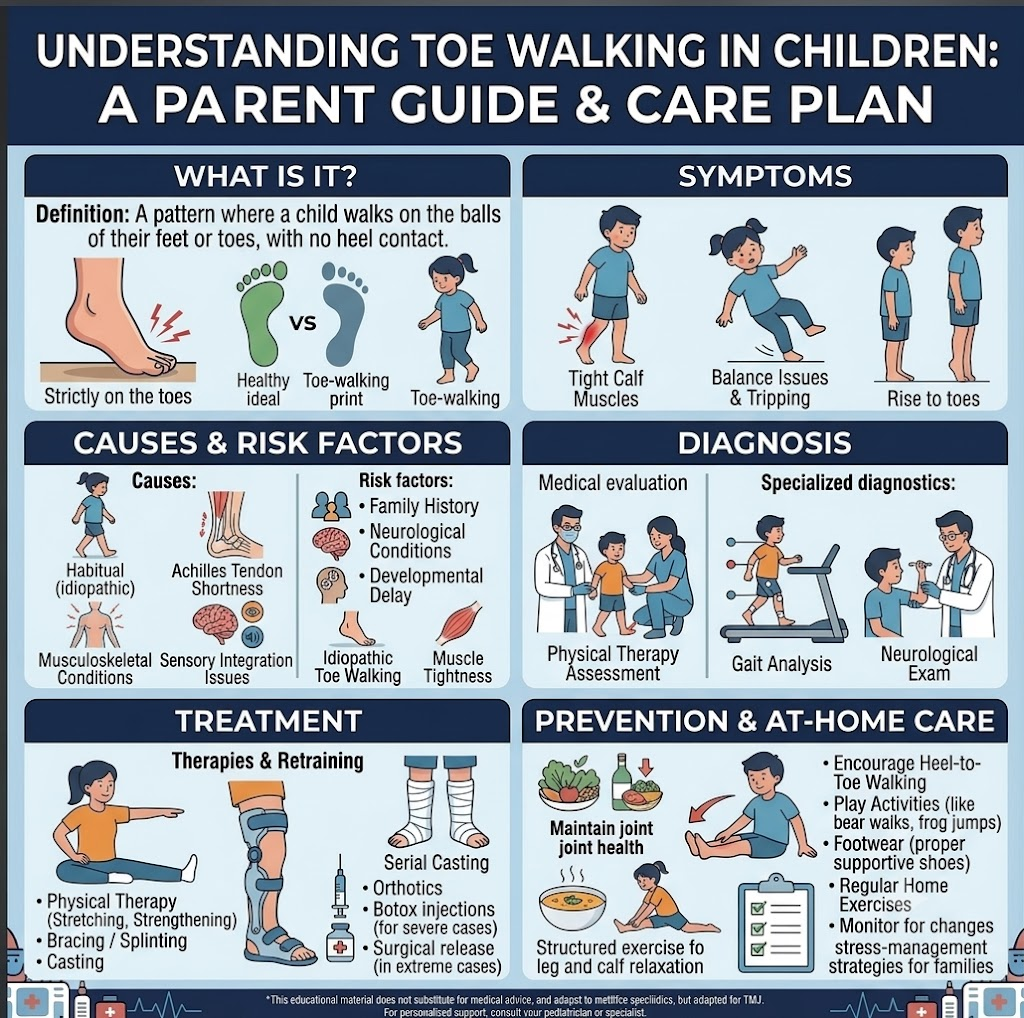
Toe walking is when a child walks on their toes or the balls of their feet, rather than with their heels touching the ground first. While common in toddlers learning to walk and often outgrown, persistent toe walking past toddler years can be a habit or, less commonly, linked to conditions like cerebral palsy, muscular dystrophy, or autism spectrum disorder. Though often harmless, ongoing toe walking can lead to tight leg muscles, changes in foot structure, increased fall risk, and potential social challenges.
Understanding the Condition
Toe Walking in Children: A Guide for Parents
Understanding the Condition
Toe walking is when a child walks on their toes or the balls of their feet, rather than with their heels touching the ground first. While common in toddlers learning to walk and often outgrown, persistent toe walking past toddler years can be a habit or, less commonly, linked to conditions like cerebral palsy, muscular dystrophy, or autism spectrum disorder. Though often harmless, ongoing toe walking can lead to tight leg muscles, changes in foot structure, increased fall risk, and potential social challenges.
Common Symptoms
Persistent Toe Walking: Your child continues to walk on their toes beyond the age of two, or if the toe walking seems to worsen over time.
Tight Leg Muscles: Noticeable stiffness or tightness in your child's calf muscles, making it difficult for them to place their heels flat on the ground.
Achilles Tendon Stiffness: The tendon at the back of the ankle (Achilles tendon) feels stiff or appears shortened, limiting the foot's flexibility.
Lack of Coordination: Your child frequently trips, falls, or has difficulty with balance, which may indicate broader motor skill issues.
Consultation Guide
Which Specialist to Meet
Initially, consult your child's pediatrician. They may refer you to a specialist such as a neurologist (a doctor specializing in the brain and nervous system), an orthopedic specialist (a doctor specializing in bones and muscles), or a physical therapist (a healthcare professional who helps improve movement and manage pain).
Preparations Before Your Visit
Before your visit, observe your child's walking pattern: note how often they toe walk, if it occurs on one or both feet, and if they can put their heels down when asked. Be prepared to discuss developmental milestones, any other symptoms you've noticed (e.g., stiffness, balance issues), and your family's medical history.
Book a doctor visit near me
During the exam, the doctor will ask about your child's medical history and observe their physical and mental status. They may check reflexes, muscle strength, balance, coordination, sensation, and cognitive function through simple tasks like walking, standing on one leg, touching their nose, or following objects with their eyes. The exam duration varies depending on your child's symptoms and initial findings.
Electromyography (EMG) and Nerve Conduction Study (NCS)
An EMG assesses the health of muscles and their controlling nerve cells (motor neurons), revealing problems with nerve function, muscle function, or the signals transmitted between nerves and muscles. An NCS measures the speed and strength of electrical signals traveling through nerves.
Diagnostic Procedures
Neurological Examination
A neurological exam checks how well your child's nervous system (brain, spinal cord, nerves, muscles) functions. This helps healthcare professionals identify any underlying nervous system conditions that might be contributing to toe walking.
What to Expect
What to Expect
For a needle EMG, thin needle electrodes are inserted directly into specific muscles, usually in the leg, to record their electrical activity while at rest and during gentle contractions. Your child may feel a brief sting or discomfort. For an NCS, electrode stickers (surface electrodes) are placed on the skin over nerves. Small electrical pulses are delivered to stimulate the nerves, and the electrodes measure how quickly and strongly the nerves respond. This might feel like a brief, mild tingling or shock.
Treatment Options
Home Care & Physical Therapies
Observation and Encouragement: For habitual toe walking, gentle reminders and encouraging a heel-to-toe pattern can be helpful. Focus on creating awareness without pressure. (Duration: Ongoing, as needed.)
Stretching and Strengthening Exercises: A physical therapist teaches specific exercises to stretch tight calf muscles and Achilles tendons, improving flexibility. They also provide exercises to strengthen leg and foot muscles for a more typical gait. (Duration: Typically several weeks to many months, depending on consistency and progress.)
Gait Training: Guided exercises with a physical therapist help children learn and practice proper heel-first walking mechanics, often involving balance activities and guided movements. (Duration: Varies; often done in conjunction with stretching and strengthening programs.)
Ankle-Foot Orthoses (AFOs) / Bracing: Special plastic braces (AFOs) worn on the lower leg and foot gently encourage the foot into a proper position, preventing the child from rising onto their toes. (Duration: Often worn for several months, either during the day or overnight, as prescribed by a specialist.)
Serial Casting: A series of lightweight plaster or fiberglass casts are applied to the lower leg and foot, typically changed weekly. Each new cast slightly increases the stretch on the calf muscles and Achilles tendon, gradually lengthening them over time. (Duration: Typically 4-6 weeks, with casts changed every 1-2 weeks.)
Muscle Injections: In some cases, specific medications can be injected into the calf muscles. These injections temporarily relax overly tight muscles, making them more receptive to stretching, physical therapy, and bracing. (Duration: Effects typically last for several months, and injections may be part of a broader treatment plan.)
Surgical Procedures
Achilles Tendon Lengthening: For severe cases of toe walking, especially when other treatments have not been successful and the Achilles tendon has become significantly shortened and tight, surgery may be recommended to lengthen the tendon. This allows the heel to fully touch the ground. (Duration: Recovery typically involves several weeks of cast immobilization, followed by several months of physical therapy and rehabilitation.)
Regular Follow-up Appointments: Schedule periodic visits with healthcare professionals to monitor your child's walking pattern, muscle development, and overall progress, especially during growth spurts or after treatment.
Consistent Home Exercise Program: Continue with prescribed stretching and strengthening exercises at home, even after formal therapy ends, to maintain muscle flexibility and prevent recurrence of tightness.
Encouraging Active Play: Promote a variety of physical activities that encourage a full range of motion in the ankles and legs, such as running, jumping, and climbing, to support healthy motor development.
Prevention & Long-Term Wellbeing
Prevention of Complications
Early Detection and Intervention: Addressing toe walking promptly can help prevent the development of permanent muscle tightness, structural changes in the foot, and reduce the risk of falls and injuries associated with an unstable gait.
Appropriate Footwear: Ensure your child wears supportive shoes that provide stability and encourage a natural heel-to-toe walking pattern, avoiding overly flexible or restrictive options.
Emotional and Social Support: Offer understanding and support to your child, especially if their toe walking leads to self-consciousness or challenges in social settings. Encourage participation in activities they enjoy.
Long-Term Monitoring
Tags & Topics
Notice an error or need an update?
Help us keep medical information accurate. Report incorrect info or suggest an edit.


