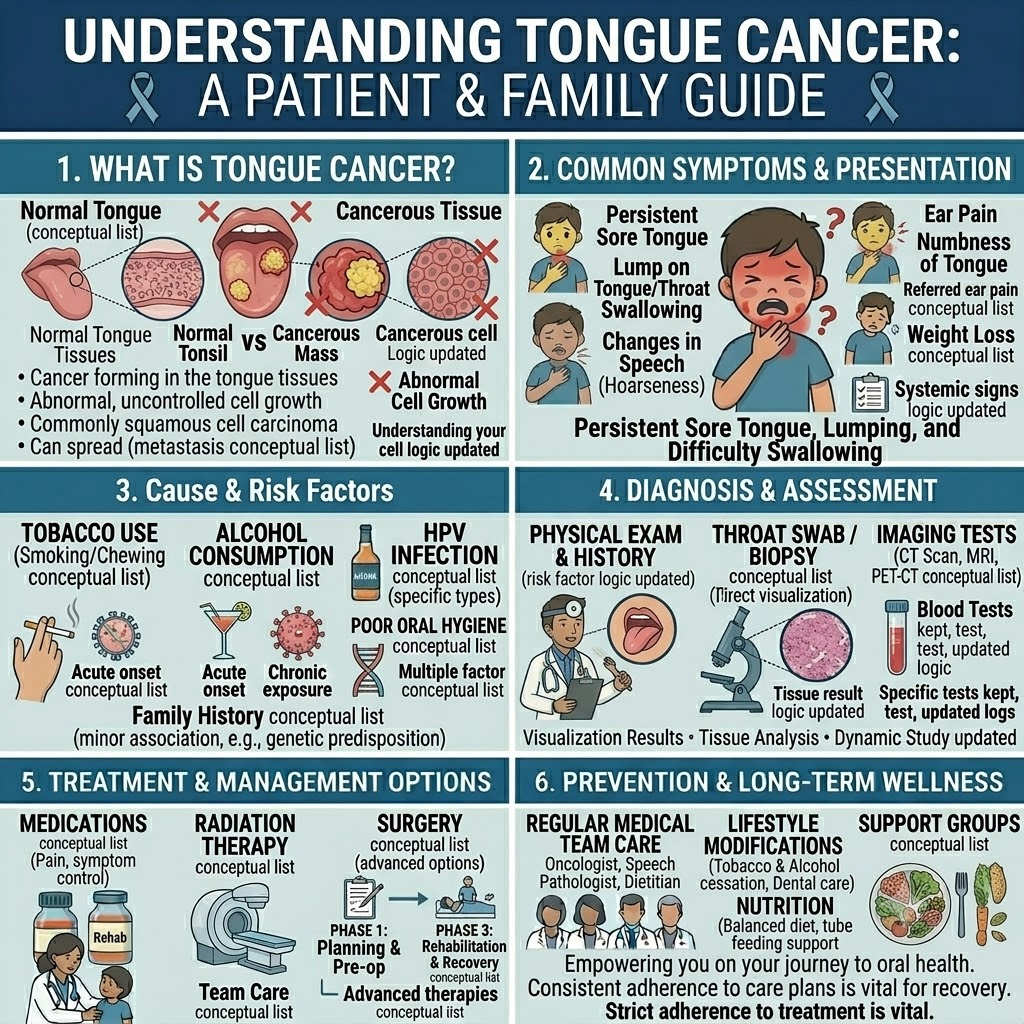
Tongue cancer is a type of cancer that begins when cells on the tongue grow abnormally and out of control. The tongue is a vital organ in the mouth and throat, essential for speaking, eating, tasting, and swallowing. Tongue cancer is categorized based on its location: oral tongue cancer affects the front part of the tongue in the mouth, while oropharyngeal tongue cancer affects the back part of the tongue in the throat. Most tongue cancers start in the thin, flat cells lining the tongue's surface and are known as squamous cell carcinoma. Early detection of oral tongue cancer is more likely due to its visible location, whereas oropharyngeal tongue cancer may progress longer before symptoms become noticeable, often leading to diagnosis after it has spread to nearby lymph nodes.
Understanding the Condition
Tongue Cancer: An Easy-to-Understand Guide
Understanding the Condition
Tongue cancer is a type of cancer that begins when cells on the tongue grow abnormally and out of control. The tongue is a vital organ in the mouth and throat, essential for speaking, eating, tasting, and swallowing. Tongue cancer is categorized based on its location: oral tongue cancer affects the front part of the tongue in the mouth, while oropharyngeal tongue cancer affects the back part of the tongue in the throat. Most tongue cancers start in the thin, flat cells lining the tongue's surface and are known as squamous cell carcinoma. Early detection of oral tongue cancer is more likely due to its visible location, whereas oropharyngeal tongue cancer may progress longer before symptoms become noticeable, often leading to diagnosis after it has spread to nearby lymph nodes.
Common Symptoms
Sore or Ulcer That Doesn't Heal: A persistent sore or ulcer on the tongue that bleeds easily and does not heal within a few weeks.
Pain or Bleeding: Unexplained pain or bleeding in the mouth, especially on or around the tongue.
Lump or Thickening: A noticeable lump, thickening, or rough spot on the tongue or inside the mouth.
Swollen Lymph Nodes: Swollen glands (lymph nodes) in the neck, which can be an early sign, especially for cancer at the back of the tongue.
Persistent Sore Throat: A sore throat that does not go away, often described as a constant irritation or feeling of something caught in the throat.
Red or White Patches: New or changing red or white patches on the tongue or the lining of the mouth.
Difficulty Eating or Swallowing: Pain or difficulty when chewing, swallowing, or moving the tongue or jaw.
Numbness: Numbness of the mouth or tongue that doesn't resolve.
Voice Changes: A noticeable change in your voice, such as hoarseness.
Unexplained Weight Loss: Significant weight loss without trying.
Ear Pain: Persistent ear pain, particularly on one side, which can be a referred pain from the throat.
Coughing Up Blood: Coughing that produces blood.
Consultation Guide
Which Specialist to Meet
If you notice any persistent symptoms, start by consulting your primary care doctor or a dentist. They can perform an initial examination and, if necessary, refer you to a specialist such as an otolaryngologist (an ear, nose, and throat or ENT specialist) or an oncologist (a cancer specialist) for further evaluation and care.
Preparations Before Your Visit
Before your appointment, prepare a list of your symptoms, including when they started and how they have changed. Also, gather information about your medical history, any medications you are taking, and your lifestyle habits, especially regarding tobacco and alcohol use. Write down any questions you have for your doctor to ensure all your concerns are addressed.
Book a doctor visit near me
The doctor will ask about your symptoms and medical history. They will then visually inspect your mouth and throat, using a light and possibly a small mirror. They may also gently feel your neck and under your jaw to check for any swollen areas.
If a suspicious area is found, a small tissue sample (biopsy) will be taken from the tongue for laboratory analysis. This is the only definitive way to confirm cancer.
Consultation Guide
Avoid Tobacco Products: Refrain from using all forms of tobacco, including cigarettes, cigars, chewing tobacco, and snuff, as tobacco is the single largest risk factor for tongue cancer.
Limit Alcohol Intake: If you choose to drink alcohol, do so in moderation (up to one drink per day for women, up to two for men). Heavy and frequent drinking significantly increases risk, especially when combined with tobacco use.
Consider HPV Vaccination: Discuss with your healthcare provider whether the HPV vaccine is appropriate for you. It can help protect against certain types of HPV infections linked to some throat cancers, including those at the back of the tongue.
Maintain Oral Hygiene: Practice good dental care by brushing and flossing regularly. Schedule routine dental check-ups to allow your dentist to spot any early changes in your mouth.
Regular Health Check-ups: Visit your doctor regularly for check-ups. During these appointments, your healthcare team can examine your mouth and throat for any signs of cancer or precancerous changes.
Long-Term Monitoring and Support
Diagnostic Procedures
Physical Exam and Oral Exam
A doctor or dentist will thoroughly examine your mouth, tongue, throat, and neck, looking for any unusual lumps, sores, red or white patches, or swollen lymph nodes.
What to Expect
What to Expect
You will receive a local anesthetic to numb the area. The doctor will then use a small instrument to remove a tiny piece of the suspicious tissue. This might involve a small incision or a brush to collect cells. The sample is then sent to a pathologist who examines it under a microscope for cancer cells. You might feel some pressure or a brief pinch during the procedure, and the area might be sore for a few days afterward.
Imaging Scans (CT, MRI, PET)
These scans create detailed pictures of the inside of your body to determine the size and exact location of the cancer, and whether it has spread to other parts of the body, such as lymph nodes or distant organs.
What to Expect
For a CT scan, you will lie on a table that slides into a large donut-shaped machine, which takes X-ray images from different angles. For an MRI, you will lie in a long, narrow tube, and the machine uses magnetic fields and radio waves to create images; it can be noisy. For a PET scan, you will receive a small injection of a radioactive sugar solution, and then lie on a table while a scanner detects areas where cells are more active (like cancer cells). You might need to fast before some scans, and sometimes a contrast dye is used, which might be given intravenously. These procedures are generally painless but require you to lie still for some time.
Enteral Nutrition (Tube Feeding): If chewing or swallowing becomes difficult due to cancer or its treatment, a feeding tube can deliver liquid nutrition directly to the stomach or small intestine. This ensures adequate nutrient intake. (Duration: Can be short-term (weeks to months) during recovery or long-term if eating difficulties persist.)
Treatment Options
Surgical Procedures
Tumor Removal (Glossectomy): Surgery to remove the cancerous part of the tongue. The amount removed depends on the tumor's size and location. Reconstructive surgery may follow to rebuild the tongue and restore function. (Duration: A single procedure, followed by recovery that can last weeks to months, potentially with ongoing therapy.)
Neck Dissection: If cancer has spread to the lymph nodes in the neck, these nodes may be removed to prevent further spread. (Duration: A single procedure, often performed at the same time as tumor removal.)
Transoral Robotic Surgery (TORS): A minimally invasive surgical approach where a surgeon uses a computer system to guide robotic tools through the mouth. This allows for precise movements in hard-to-reach areas of the mouth and throat, often leading to quicker recovery and fewer complications compared to traditional open surgery. (Duration: A single procedure, with recovery typically weeks shorter than open surgery.)
External Beam Radiation: High-energy beams (like X-rays) are precisely directed at the cancerous area from a machine outside the body to kill cancer cells. (Duration: Typically delivered in daily sessions, five days a week, for several weeks (e.g., 5-7 weeks).)
Internal Radiation (Brachytherapy): Radioactive sources are placed directly into or near the tumor. This delivers a high dose of radiation to the cancer while sparing surrounding healthy tissues. (Duration: Can be a single high-dose treatment or several lower-dose treatments over days to weeks.)
Chemotherapy: Powerful medications that kill fast-growing cancer cells throughout the body. It may be given intravenously (into a vein) or orally. (Duration: Administered in cycles, typically over several months, depending on the specific regimen and response.)
Targeted Therapy: Drugs that specifically attack certain vulnerabilities in cancer cells, often with fewer side effects than traditional chemotherapy. (Duration: Can be ongoing for months or years, depending on the drug and patient response.)
Follow-up Care: Regular follow-up appointments with your medical team are crucial to monitor for any recurrence of cancer and manage long-term side effects of treatment.
Nutritional Support: Work with a dietitian to ensure you maintain adequate nutrition, especially if you experience difficulty eating or swallowing after treatment.
Speech and Swallowing Therapy: Many patients benefit from therapy to regain optimal speech and swallowing functions, improving quality of life after treatment.
Psychological Support: Coping with cancer can be challenging. Seeking support from counselors, support groups, or mental health professionals can be beneficial for emotional well-being.
Prevention & Long-Term Wellbeing
Prevention
Tags & Topics
Notice an error or need an update?
Help us keep medical information accurate. Report incorrect info or suggest an edit.


