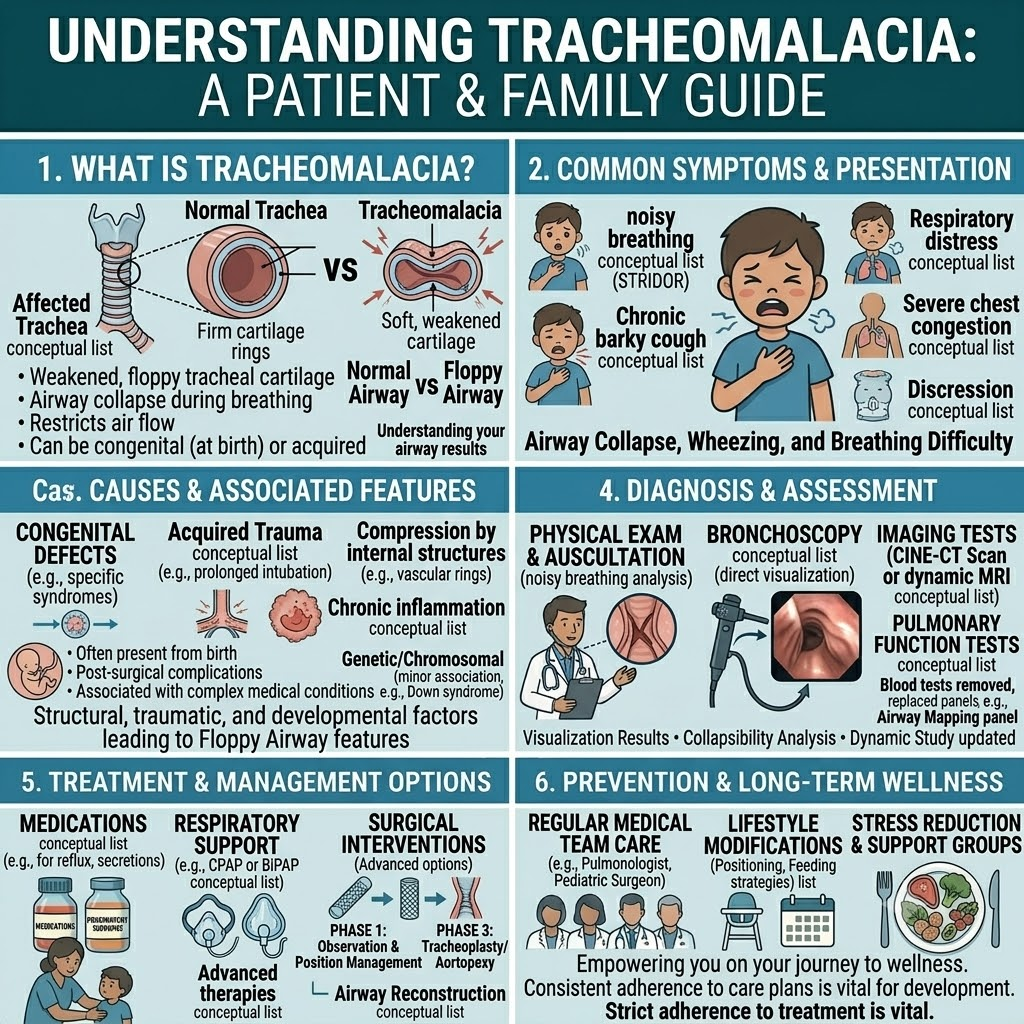
Tracheomalacia (pronounced tray-key-oh-muh-LAY-shuh) is a condition where the windpipe, also known as the trachea, becomes softer and floppier than it should be. The windpipe is a crucial tube that carries air from your nose and mouth down to your lungs. Normally, strong, flexible rings of cartilage keep the windpipe wide open, especially during breathing. In tracheomalacia, these cartilage rings are weak or haven't developed properly, causing parts of the windpipe to collapse or narrow. This often happens when breathing out, coughing, or crying. While it can affect adults, it's most common in babies. This can make breathing difficult and, in severe cases, be life-threatening.
Understanding the Condition
Tracheomalacia: Understanding Your Child's Floppy Windpipe
Understanding the Condition
Tracheomalacia (pronounced tray-key-oh-muh-LAY-shuh) is a condition where the windpipe, also known as the trachea, becomes softer and floppier than it should be. The windpipe is a crucial tube that carries air from your nose and mouth down to your lungs. Normally, strong, flexible rings of cartilage keep the windpipe wide open, especially during breathing. In tracheomalacia, these cartilage rings are weak or haven't developed properly, causing parts of the windpipe to collapse or narrow. This often happens when breathing out, coughing, or crying. While it can affect adults, it's most common in babies. This can make breathing difficult and, in severe cases, be life-threatening.
Common Symptoms
Frequent Cough: A common, often loud cough that might sound like a barking seal. It may worsen with eating.
Noisy Breathing: Sounds like high-pitched wheezing (a whistling sound) or rattling, especially when breathing out.
Difficulty Breathing: Struggling to get enough air, which often worsens with crying, coughing, eating, or physical activity.
Trouble Clearing Mucus: Inability to effectively cough up mucus from the airways, leading to build-up.
Frequent Airway Infections: Repeated episodes of conditions like pneumonia or bronchitis due to difficulty clearing airways.
Feeding and Swallowing Issues: Problems with eating or swallowing, which can sometimes trigger breathing difficulties.
Shortness of Breath with Activity: Getting winded easily during play or physical exertion, more so than other children.
Blue or Gray Skin Color: In severe cases, a bluish or grayish tint to the skin, lips, or fingernails, indicating low oxygen levels. May be harder to see on darker skin tones.
Consultation Guide
Which Specialist to Meet
If you suspect your child has breathing difficulties or symptoms of tracheomalacia, start by consulting your pediatrician. They may refer you to specialists such as a pediatric pulmonologist (a lung specialist for children), a pediatric ENT (ear, nose, and throat) specialist, or a pediatric gastroenterologist if reflux issues are suspected. For adults, a pulmonologist or ENT specialist would be appropriate.
Preparations Before Your Visit
Before your visit, gather any relevant medical records, make a detailed list of your child's symptoms (including when they started, what makes them better or worse), note any medications they are taking, and prepare a list of questions you have for the doctor. Knowing your family's medical history can also be helpful.
Book a doctor visit near me
Watchful Waiting and Supportive Care: For mild cases, symptoms may improve on their own as a child grows. Doctors monitor progress and manage associated illnesses. (Duration: Often resolves by 1-2 years of age, but monitoring may continue longer.)
Positioning and Airway Clearance: Keeping the child upright, especially after feeding, can reduce collapse. Parents may learn techniques to clear mucus, like gentle chest physiotherapy. (Duration: Ongoing as needed.)
Reflux Management: If gastroesophageal reflux disease (GERD) contributes, medications to reduce stomach acid and dietary changes can help prevent irritation. (Duration: As long as symptoms persist, often several months to years.)
Continuous Positive Airway Pressure (CPAP) or Bi-level Positive Airway Pressure (BiPAP): These therapies deliver gentle air pressure through a mask, helping to keep the floppy windpipe open for easier breathing. (Duration: Used nightly or as needed, potentially for months or years.)
Supplemental Oxygen: If blood oxygen levels are consistently low, extra oxygen may be delivered via nasal tubes to ensure adequate supply. (Duration: As needed, short-term or long-term.)
Tracheostomy: For severe cases, a surgeon creates a small opening in the neck into the windpipe, inserting a tube to bypass collapsed areas and ensure a clear airway. (Duration: Can be temporary (months to years) or, in rare cases, permanent.)
Regular Vaccinations: Ensuring your child receives all recommended childhood vaccinations helps protect against respiratory infections that can worsen symptoms.
Avoiding Irritants: Protecting airways from smoke, strong fumes, and other airborne irritants can prevent inflammation and further weakening of the windpipe.
Diagnostic Procedures
Bronchoscopy (and Laryngoscopy)
A thin, flexible tube with a camera (bronchoscope) is inserted through the mouth or nose into the windpipe to directly see areas of weakness or collapse during breathing.
What to Expect
What to Expect
Your child will lie still while images are taken. Sedation may be used for younger children to help them remain still. The scan itself is quick.
A standard X-ray providing a general view of the chest, lungs, and windpipe. It can help rule out other conditions.
What to Expect
Your child will be asked to lie or stand still for a few seconds while the X-ray is taken. It's a quick, painless procedure.
Barium Swallow Study (Esophagram)
Your child drinks barium liquid, and X-ray images are taken as it travels down the esophagus to identify abnormal connections or severe reflux.
What to Expect
Your child will drink a small amount of barium. X-ray images are taken while they swallow. The procedure usually takes 15-30 minutes.
A test to measure acidity levels in the esophagus over 24 hours if severe reflux (GERD) is suspected as a contributing factor.
What to Expect
A thin tube with a sensor is gently passed through the nose into the esophagus, taped in place, and connected to a small recorder for a day.
Treatment Options
Medical Management and Home Care
Aortopexy or Vascular Surgery: If a blood vessel presses on the windpipe, this surgery carefully repositions or tacks the vessel away to relieve pressure. (Duration: One-time surgical procedure.)
Tracheoplasty (Tracheal Stent Placement): This surgery reinforces the windpipe. A temporary stent (small tube) may be placed inside to hold it open. Less common in infants. (Duration: Stents can be temporary (weeks/months); surgical repair is a one-time procedure.)
Prompt Treatment of Illnesses: Quickly addressing any respiratory infections with appropriate medical care can prevent complications and reduce stress on the airway.
Adequate Nutrition: Children with tracheomalacia may struggle with feeding. Ensuring sufficient calories and nutrients is crucial for growth. Special feeding strategies may be needed.
Long-Term Monitoring and Support
Regular Medical Follow-ups: Consistent visits with specialists are essential to monitor the condition's progression, adjust treatments, and manage any emerging complications.
Emergency Preparedness: Parents should be trained in CPR and know what to do in case of a severe breathing episode. Have an emergency plan and contacts readily available.
Developmental Support: Some children may experience developmental delays. Early intervention and developmental therapies can be beneficial if needed.
Airway Safety Practices: Learning proper techniques for airway clearance, suctioning, and tracheostomy care (if applicable) is critical for daily management and preventing complications.
Prevention & Long-Term Wellbeing
Your child will receive sedation or general anesthesia. The procedure typically takes 15-30 minutes, and they will be monitored during recovery.
Airway Fluoroscopy or Dynamic CT Scan
These specialized X-ray or CT scans capture moving images of the windpipe and lungs during breathing to visualize airway collapse.
Prevention and Management of Infections
Tags & Topics
Notice an error or need an update?
Help us keep medical information accurate. Report incorrect info or suggest an edit.


